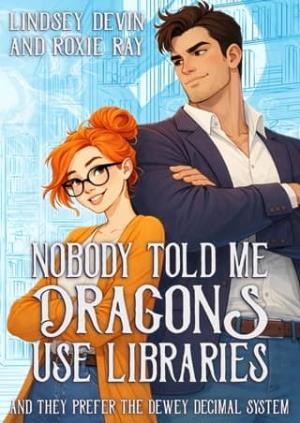
Nobody Told Me Dragons use Libraries
1. Arthur
ARTHUR
The Overlook Hearth sat on a quiet stone ledge above the river that fed the Canadian side of Niagara Falls.
Long before the café was opened to the rest of the world, my parents had built the patio with wide cedar planks and heavy timber beams that were anchored deep into the rock.
A line of lantern posts cast steady light across the tables, and the stone fireplace at the center gave off enough warmth to hold back the evening chill.
The protective magic woven into the patio walls softened the roar of the water, keeping the space calm even when the mist rose high.
From where I sat, I could see the curve of the river, the distant lights along the shoreline, and the faint rise of water where the current met the drop.
The scene held a kind of order that belonged to my parents alone.
It was the sort of place I now knew humans described as charming—a word I had learned usually meant expensive, curated, and slightly inconvenient.
My mother liked that it felt permanent. I liked that nothing about it surprised me anymore.
I had been trained to only trust what I knew, what was familiar.
This place was safe—even if it had changed.
My mother picked up her teacup and stared at me over the rim. “You’re not even pretending to relax.”
We had only opened the Overlook Hearth to humans six months after my father died.
I had resisted the idea at first. Not because I believed it was dangerous, but because it was unfamiliar. My father had always insisted that distance from the rest of the world meant safety, that remaining unseen was the reason our kind had endured as long as we had.
The decision to open to humans had been my mother’s. This place had been her dream long before it was my father’s project. She wanted it filled with conversation, warmth, and voices that did not all sound the same.
She believed a table was strongest when it was widened, when different creatures with different histories and different ways of seeing the world were allowed to sit next to each other without being asked to shrink themselves.
My father had called that dangerous. My mother called it necessary.
She had been right.
Somehow, she’d found a way to grieve my father and honor his memory while still honoring her dreams and beliefs.
The Overlook Hearth hadn’t changed when humans were introduced to it—at least, not in any way that was a threat to us. The tables remained where they had always been. The stones retained their heat. The magic adapted without protest once I adjusted the wards to recognize me as head of household.
It taught me something I hadn’t expected to learn: a place could remain itself even when a new culture was invited inside. It made me wonder if people were like that too.
I lowered my gaze to the journal resting beside my plate. I’d promised my mother I would keep it closed during lunch. That had lasted for exactly four minutes. A personal record. “I’m listening.”
“You’re reading,” she said. “And worrying.”
I shut the leather cover and placed my hand on it, as if that would silence the pull behind my ribs.
It didn’t. It never did. Knowledge had teeth. Once it bit, it didn’t let go. “I’m close to something. I can feel it.”
My mother picked up her fork and pushed a portion of roasted vegetables toward me. The meal was simple: chicken, potatoes, root vegetables braised in herbs she preferred. The basic heartiness of the food always put her at ease. It did the same for me, though I rarely admitted it.
My father had always dismissed meals like this as unnecessary pauses. His beliefs ran more toward eat when you’re hungry, work until the work’s done, and rest when you’re forced. My mother had never agreed, and, on that, at least, the house had followed her rules instead.
“What does your mind insist you’re missing?” she asked.
“There’s a fracture somewhere.” I kept my tone steady.
“Our family wasn’t always the ruling line.
Before my great-great-grandfather, the branches are…
broken. There are no records of it, and if there were, they’ve disappeared.
The shift in power didn’t occur by chance.
Something happened, and whatever it was coincided with the beginning of the long decline in dragon strength. ”
I didn’t say what followed that thought. If magic continued to thin, brute force would be all that remained to keep our clan from being overpowered, either by another clan or by time itself. And, much to my father’s chagrin, I had never been built for brute force.
My mother listened with rapt attention. She always did. Even when she did not understand the academic layers, she understood me.
“Older dragons were larger,” I continued. “Stronger. Their abilities ran deeper. But then our power began to fade, and it hasn’t stopped. I want to know why.”
She folded her napkin with care. “You’ve carried this puzzle since you were a boy. You believe the answer is in the past?”
“I know it does,” I said. “Sometimes to understand the future, you have to look to the past. Every scholar knows this.”
My father had hated that saying. He used to say the future favored those who acted, who pushed forward and created their own opportunities, not those who stared backward and searched for answers in books. He’d said it often—usually right before forbidding something.
“You are more than a scholar.”
“What I am is an alpha with fading magic,” I said. “I can feel it. If I don't solve this, I’ll fail our clan.”
Her expression softened. “You carry too much, Arthur.”
“I don't carry enough.” The truth sat heavy in my chest. “I can’t meet all my responsibilities. I spend my days researching, digging for answers no one else can find. And I spend my nights wondering if I’ve done enough for you. I worry you grieve alone. I worry I’m not doing anything well.”
The list of what actually troubled me was far longer than that, but I kept it trimmed for public consumption.
My mother reached across the table and placed her hand over mine, her touch warm and familiar. “Your father was a force. You aren’t him, but you were never meant to be him. His strength was in his body. Yours is in your mind.”
I looked down at our joined hands. “He was brave.”
“So are you. You’re different from him, but not less capable. He didn’t always understand that, but he loved you, Arthur.”
I’m not the alpha my people expected. They were used to power through physical strength and aggression. That has never been my strong suit. My father had made that quite clear repeatedly, and often in front of others. As if exposure might fix it.
The old ache pulled through me with the same precision as always. “We never found a way to speak to each other without misunderstanding.”
“You tried,” she said. “He tried. That is more than some families manage.”
I closed my eyes briefly, forcing the tension out of my shoulders. “You should not have to sit across this table alone. I should have done more when he died. I should do more now.”
It had been a year since my father died. A year of battling very confusing emotions. A year of wishing I had pursued this harder while he was alive. Even without his blessing.
Part of me wondered whether I could have saved him if I’d been able to figure this out sooner. I would carry the guilt of that for the rest of my life.
“You’re here,” she said. “That has always been enough for me.”
The falls glowed dimly through the protective magic, and the evening pressed in with a weight I had grown familiar with. Grief, duty, and unspoken expectations lived in the silence between us.
Just beyond the barrier, the human world existed, full of things my father had insisted were unnecessary distractions.
According to him, our kind survived by staying hidden.
He’d always said that curiosity invited danger, and that the world beyond our borders was shrinking magic, thinning bloodlines, and weakening discipline.
He had never once allowed me to see it for myself.
My mother took a sip of her tea. “Even in the darkest nights, the sun returns with the dawn.”
Something inside me sharpened.
I sat up straighter. “Say that again.”
She tilted her head. “The sun returns with the dawn.”
Realization pulsed through me as I remember a phrase from an old genealogy letter I had dismissed as poetic nonsense. My father’s father had written it during the early years of their displacement, when dragons first began hiding from the world. I’d never thought it might be anything useful.
My father had hated that letter. He’d said it was nothing but sentimental, and that was a weakness in his eyes. But he had been wrong about other things—maybe he was wrong about this, too.
If the phrase repeated across generations, it might be more than comfort.
It might be a code, even if its deeper meaning had been forgotten by most.
“I need to check something,” I said. I placed money on the table before she could protest. “I’m sorry to cut this short.”
Human currency still felt faintly absurd in my hand. Paper and numbers, so transient. I had purchased my car with it two months earlier and still suspected I’d done it incorrectly.
She closed the journal of notes she brought for me, even though she hadn’t once read from it. “Go. When you return, I want to hear all about it.”
I stood. “I will.”
“And Arthur,” she added, touching my hand again, “you won’t solve everything in one day.”
“I can solve this.” The certainty in my tone surprised me.
I gathered my coat, stepped past the enchanted barrier, then shifted into my other form the moment I reached the cliff.
My body stretched into its truest form, joints locking into place with familiar strength.
Heat surged through my spine, wings opening with clean force as magic settled under my skin in a steady pulse.
The ground fell away beneath me, replaced by the weightless clarity that came with being this version of myself.
This part, at least, had never confused me.