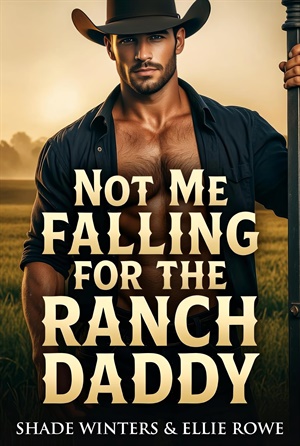
Not Me Falling For The Ranch Daddy
1. Lila
LILA
The SUV dies without drama, which feels like an insult on top of everything else.
No warning sputter, no theatrical shudder—just a quiet, final click somewhere beneath the hood and then nothing but the sound of rain hammering the roof and my own breathing.
I coast another twenty feet on momentum alone before the tires find the gravel shoulder and stop.
Outside, the Iowa sky has turned the color of a bruise, and the trees lining the road are bending sideways in a wind that rolled in from nowhere about forty minutes ago, right around the time I noticed the temperature gauge creeping into dangerous territory.
I try the ignition twice. Then a third time, because apparently I enjoy confirming bad news.
Nothing.
I grab my phone from the cupholder and hold it up toward the windshield like that's going to help the signal situation.
One bar blinks at me, uncertain of its own existence.
I dial the roadside assistance number I have saved under Please God Answer and listen to it ring four times before dropping the call entirely.
The bar disappears completely. I lower the phone and press it against my forehead and take one slow breath, the kind that's supposed to stop catastrophizing before it starts.
I'm twenty-nine years old, sitting on the side of an unfamiliar county road in the middle of a summer storm, with forty-three dollars in my checking account, a dead vehicle, and a professional camera that costs more than my last three months of rent combined.
The camera is the only thing I'm not panicking about. Everything else is negotiable.
I pull on my denim jacket and push out into the rain.
It soaks through immediately, curls plastering flat against my forehead, but I walk to the front of the SUV and pop the hood anyway, which achieves absolutely nothing except getting me wetter.
I don't know what I'm looking for. I know how to compose a frame, find the light in a windowless room, and talk a stranger into trusting me with their most guarded story.
I do not know how engines work. The hood comes back down with a clang that the storm swallows whole.
That's when I notice the gate.
It's maybe thirty feet behind where I stopped—tall iron, the kind built to communicate permanence rather than convenience.
Beyond it, through the curtain of rain, the road continues into land so sweeping it takes me a moment to understand the scale.
Fencing runs in both directions as far as I can see, following the treeline before curving away into the gray.
A painted wooden sign hangs just above the arch of the gate, and even in this light I can make out the letters: HARTLAND RANCH — PRIVATE PROPERTY.
I have heard of Emberland Ranch. Everyone who has spent more than a week in this part of Iowa has heard of Emberland Ranch.
I walk back to the gate anyway and peer through the bars at the road beyond, because there is nowhere else to look, and I have a policy about choosing forward over standing still.
My phone finds half a bar when I hold it against the iron, and I manage to get a text through to the one contact I have in the county—a woman named Claire who runs a bed-and-breakfast in town and told me two days ago she'd help if I ever needed anything.
SUV broke down on CR-14, outside a big cattle ranch gate.
Know anyone? I watch the message sit unsent for forty seconds before it finally pushes through. Then I pull my jacket tighter and wait.
I don't hear the truck until it's almost on top of me.
It comes from inside the property, headlights cutting through the rain, moving fast enough down the private road that I take two involuntary steps back from the gate.
A black truck, the serious kind, utility and power in equal parts, stops on the other side of the iron bars. The engine idles. Nobody gets out.
Then the driver's door opens.
The man who steps out is tall—I register that first, then the black ranch hat shedding water off its brim, then the set of his shoulders, which makes it clear he hasn’t come out here with cooperation in mind.
He’s wearing a dark button-down with the sleeves pushed to his elbows despite the rain, and he walks toward the gate with the kind of unhurried certainty that comes from long practice occupying whatever ground he stands on.
He stops on his side of the bars and looks at me the way a person looks at something they're trying to decide whether to deal with.
"You're on private property." His voice is low, measured, the kind that doesn't need volume to carry weight.
"I'm on the shoulder of a county road," I say, "which I'm fairly certain is public."
Something shifts in his expression—not softening, more like recalibration. He studies my face for a second, then glances past me at the SUV. "That yours?"
"Unfortunately."
"How long have you been out here?"
"Long enough to confirm my phone hates me and that I know nothing about engines." I push my soaked hair back from my face. "Is there any chance you have service in there? Or know a mechanic who makes house calls in the middle of storms?"
“There’s no service until you get to the main house.” He glances back at the SUV, calculations moving behind his eyes. “What are you doing on this road? It doesn’t connect to anything.”
"I had a tip about a nineteenth-century grain storage facility about two miles east of here. I'm a photographer. I document historical structures." I watch his face remain completely unmoved by this information. "I took a wrong turn somewhere around mile marker seven."
"You trespassed on a wrong turn."
"I broke down on a wrong turn. There's a distinction.
" Rain is running down the back of my neck now, soaking into my collar, and I'm aware that I look like something that got dragged out of a creek.
I refuse to let it affect my posture. "I'm not trying to cause problems. I just need to get somewhere dry long enough to call a tow truck. "
He doesn't answer immediately. He has blue eyes—I notice because they're startling against the dark hair and the storm-gray everything else around us—and they're fixed on me with an attention that feels less like interest and more like assessment.
Like he's waiting for me to say something that will make his decision easier.
"The gate stays locked until I know who you are," he says.
"Lila Anderson." I hold out my hand through the bars, which is objectively absurd, but I do it anyway. "I'm nobody worth worrying about. I promise."
He doesn't take my hand. He looks at it, then back at my face, and for a stretched moment I'm genuinely unsure whether he's going to turn around, get back in his truck, and leave me standing in the rain on a county road in a storm.
It would be within his rights. It would also be the most aggressively unwelcoming thing anyone has ever done to me, and I've knocked on doors in towns that did not want to be documented.
Then he pulls a key from his front pocket and unlocks the gate.
"Leave your vehicle where it is," he says, swinging it open just wide enough. "We'll send someone for it tomorrow if the storm clears. Tonight you can wait at the main house."
I don't move immediately, because something about the phrasing—we'll send someone, you can wait—makes me want to establish a few things. "I appreciate that. I do. But I'm not going to be anyone's charity case, so if there's a way I can help with something in exchange for a phone and a dry room?—"
"Miss Anderson." He says my name like a period at the end of a sentence. "Get out of the rain."
I get out of the rain.
He holds the gate and says nothing while I squeeze past him, and I’m close enough for a moment to catch the faint smell of cedar and rain-soaked denim and something harder to name beneath both.
I don’t look up at him when I pass. My attention stays on the road ahead, on the sweep of land beyond the headlights, on the first full view of Emberland Ranch opening up around me in the gray and the dark and the driving summer rain.
It's enormous. Even through the storm I can feel it—the sheer settled weight of a place that has been exactly itself for a very long time.
He walks back to his truck without further comment, and I climb into the passenger side when he pulls it alongside me, because apparently that's what we're doing. He doesn't offer. He just stops the truck. I take it as an invitation.
We pull away from the gate and I watch it disappear in the side mirror, the iron swinging shut behind us, and I tell myself this is temporary. A phone call, a dry hour, a tow in the morning. I have been stranded in worse places and walked away without leaving a mark.
The man driving doesn't say another word for the entire length of the private road, and I don't push him.
Instead I watch the land through the rain-blurred window and try to understand what I'm looking at, because something about the way this property sits beneath the storm feels less like land and more like a statement.
Like something that has been holding its breath for a very long time.
I'll be gone by morning.
That's what I tell myself.