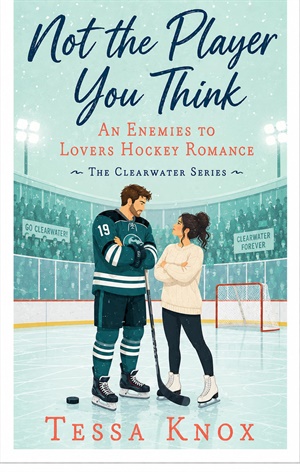
Not the Player You Think (The Clearwater #3)
Prologue
Jenna
It is two in the morning and I am about to ruin a man's reputation, which would bother me more if the man hadn't done most of the work himself.
The cursor blinks at the end of the last sentence. I read the whole thing again, top to bottom, the way I always do before I file. Three weeks of work. Eleven sources. A timeline I built in a spreadsheet so detailed my editor said it looked like I was prosecuting a war crime.
The story is about Cole Weston. Twenty-six years old.
Fourth line at the time, though everyone said he had top-six hands and a bottom-six attitude.
The story is about the three charity appearances he cancelled in one month.
It's about the agent who declined five separate interview requests with the polite venom of a man who has done it many times.
It's about the photographs — him at a rooftop party in one city on a Thursday, a club in another city on the Saturday, a third party two states over the following weekend.
I didn't editorialize. I'm proud of that. I just laid the tiles down and let the reader walk across them.
"You're still here," says the security guard, doing his last loop of the floor.
"I'm always still here, Marcus."
"You need to sleep."
"I'll sleep when the internet does."
He laughs, because Marcus is kind, and he keeps walking, and I go back to the screen.
Here's the thing nobody tells you about being right. It's supposed to feel clean. You do the work, you check the facts, you stand by the words, and there's supposed to be a click at the end, a key turning in a lock, everything in its place.
I don't get the click.
I get something else, something low and itchy at the base of my skull, the feeling I get when I've packed for a trip and I'm already on the plane and I cannot for the life of me remember whether I turned off the stove.
Probably I turned off the stove. I always turn off the stove.
The plane is in the air. There is nothing to be done.
I reread the paragraph about the cancelled appearances. Solid. Sourced. The charity confirmed the cancellations on the record. I have the emails.
I reread the part about the agent. Fair. I quoted the declines verbatim. I gave him every chance.
I reread the part where I describe him as a man who has confused being talented with being owed something, and that one is mine, that one is interpretation, but it's interpretation the evidence earns. I keep it.
So why the stove feeling.
I save the file. I attach it to the email. I write a subject line that just says WESTON — FINAL, because my editor and I have been doing this long enough that we don't need pleasantries at two a.m.
My thumb hovers over send.
"Don't be precious," I say out loud, to no one, in an empty newsroom. "It's a good piece."
It is a good piece. It's a true piece. Every sentence in it can survive a lawyer.
I send it.
The relief I expect does not arrive. What arrives instead is the stove feeling, slightly louder, and a tiredness that goes past my eyes and into my teeth.
I make myself a coffee from the machine that makes coffee the way a vending machine makes friendship — technically, joylessly — and I sit back down and I look at the published preview my editor sends back twenty minutes later, formatted, headlined, with a photo of Cole Weston mid-laugh at one of those parties, a drink in his hand, looking exactly like the man I described.
"I wrote you exactly as you are," I tell the photo.
The photo, being a photo, does not argue.
The piece goes live at six a.m. By seven, Cole Weston has blocked me on every platform that has a block button, which is all of them, and his publicist has issued a statement so cold you could store organs in it. By eight, the piece is the third most-read thing on our site. By noon it's the first.
I don't feel good. I keep waiting to. I tell myself the not-feeling-good is just fatigue, just the comedown, just the stove.
I file the feeling away the way I file everything I can't immediately use.
There's always another story. There's always a next one.
I close the laptop and I go home and I sleep for eleven hours and I do not dream about Cole Weston, which I will think about later, much later, with the particular embarrassment of a person who got everything right and still missed the entire point.
Because here is what I want you to understand before I tell you the rest of it.
I was not wrong about the facts.
I was wrong about the man.
And the gap between those two things — that narrow, terrible, fascinating gap — is where this whole story lives.