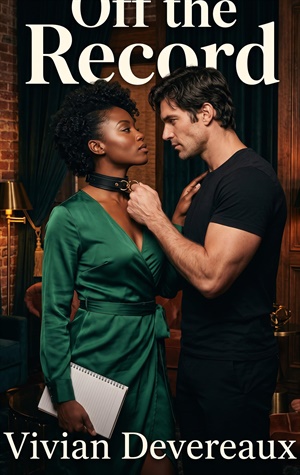
Off the Record (The Obsidian Club #6)
Chapter 1 The tip and the assignment
Camille Carver had been in the business twelve years, and she could count on one hand the number of times Desmond Hale had closed his office door for her.
Twice for raises she’d had to pry out of him with a crowbar and a competing offer.
Once for a layoff round she’d survived. Once for the lawsuit that hadn’t gone anywhere.
So when he appeared at the edge of her desk at four on a Tuesday afternoon — actually appeared, in person, instead of sending one of his two-word Slack summonses — and said, “Got a minute? Door closed,” she saved her draft, capped her pen, and felt the specific stillness come down over her face that she’d been perfecting since she was twenty-one years old.
The colleagues who liked her called it composure.
The ones who didn’t called it something else.
Either way, it was the face she wore into every room where something was about to be decided about her, and it gave away exactly nothing.
“You know Judd Merchant,” he said.
“I know of Judd Merchant.” Camille took the chair across the desk without being asked, crossed her legs at the knee, and set her notebook on her thigh unopened. “The way you know of a smell in a stairwell.”
“He’s got something.”
“Judd Merchant always has something. That’s his whole model. He has something, he teases it for a week, it turns out to be a Buckhead divorce with the names misspelled.”
“Not this time.” Desmond came around the desk and half-sat on the edge of it, close enough that she had to tilt her chin up slightly to hold his eyes, which she was fairly sure he did on purpose and fairly sure he didn’t know he did.
“I got a call last night from somebody at Exposure ATL who still has a conscience, or at least a grudge. Merchant’s been sitting on a piece for a month.
Members’ club off Memorial, very private, very vetted, very —” he moved one hand in a slow circle, choosing the word — “specialized. Place called the Obsidian.”
The name meant nothing to her, and she filed that fact itself as interesting, because Camille had made a career out of knowing every room in this city worth knowing about: every supper club and listening bar and members-only floor above a restaurant, every scene that thought it was a secret.
Twelve years in Atlanta media and she had never heard the word.
“Specialized how?” she asked, though the shape of Desmond’s hesitation had already told her.
“It’s a kink club, Camille. Leather, whips, contracts, whatever they do.
Merchant’s version has photographs. Parking lot stuff, long lens.
And my guy says he’s got names. Not boldface names — worse.
Regular people. A nurse. A teacher, maybe.
People with custody agreements and school boards.
” He rubbed his jaw. “He’s calling it ‘Inside Atlanta’s Secret Pain Club. ’”
“Of course he is.”
“It’s going to do eight hundred thousand page views and ruin nine lives, and Exposure will sell programmatic ads against every one of them.
” Desmond said it flatly, without disgust, which was its own kind of disgust. He’d been a real newsman once.
Everyone said so, usually right before they said something unkind about what he’d become.
“And when it drops, every outlet in this city is going to have to chase it, a week behind, with nothing. Including us.”
Camille let the silence sit for a moment.
Down on the street a MARTA bus exhaled at the light.
Outside the glass wall of his office, the newsroom carried on in its diminished way — Priya on the phone with her feet up, the sports desk laughing at something, the wire TVs closed-captioning a press conference nobody was watching.
“So chase it now,” she said. “Put Renner on it. He loves this stuff.”
“Renner would write Merchant’s piece with worse jokes.
” Desmond pulled his glasses down out of his hair, looked at them, and pushed them back up — a gesture she’d watched him make ten thousand times, the tic of a man buying three seconds.
“I don’t want Merchant’s piece. I want the piece that makes Merchant’s piece look like what it is.
The one that’s already published when his drops, so that his reads like the trash follow-up.
I want it smart, I want it sourced, I want it inside. And you’re the byline.”
And there it was.
“No,” Camille said pleasantly.
“Camille.”
“I do culture, Desmond. I do the archive piece on the Royal Peacock. I do the profile of the eighty-year-old seamstress on Auburn Avenue that gets taught in J-schools. I don’t do” — she gave the words back to him with exactly the amount of care they deserved — “secret pain club.”
“That’s precisely why it’s you.” He stood off the desk and went to the window, and this, she knew, was the real pitch coming, because Desmond always delivered the real pitch to the glass.
“Anybody can write a scandal. I need the person who can walk into a room like that and not flinch, not leer, not perform being scandalized for the reader. You’re the one I send when a story needs teeth and tact both.
You’ve never once lost your face in front of a subject.
I’ve watched you interview a man about his dead son and a councilman about his kickbacks in the same afternoon, same voice, same —” he waved a hand back at her without turning around — “that. Whatever that is. Nothing gets in and nothing gets out. It’s the best poker face in Georgia journalism and I’m asking it to go sit in the one room in Atlanta where it’s actually worth something. ”
She was aware, distantly, that she’d just been complimented and described, and that the description was of a wall.
Nothing gets in and nothing gets out. He said it like a job qualification, which — fair.
She’d built it like one. Thirteen years old at her mother’s dining table learning that the daughter who cried was the daughter who got managed; twenty-one in her first newsroom learning that the Black girl who reacted was the story instead of the writer of it.
She’d sanded herself smooth for this business one small refusal at a time, and now the business was cashing the check.
The reporter who feels nothing on the record.
Every source she’d ever had trusted her because of it.
Every editor prized her for it. She had long ago decided it was ethics — objectivity, professionalism, the discipline of the work — and she’d had no reason on earth to reexamine that.
She didn’t now, either. She just noticed, in passing, the way you notice a hairline crack in a windshield, that Desmond had described her most private architecture in one sentence without knowing he’d done it, and that it had taken him four seconds.
“Sourcing,” she said, because moving to logistics was how you buried a moment. “Places like that don’t return calls from press. That’s the entire point of them.”
Desmond turned from the window with the first real energy he’d shown, which told her he’d already solved this part, which told her this meeting had never been a question.
“That’s the thing. They came to us. Sideways.
” He picked a folded sheet of paper off his desk and held it, not yet offering.
“My guy’s tip got back to the club somehow — don’t ask, I don’t know — and yesterday I get a call from a lawyer.
Buckhead firm, very expensive voicemail manners.
Her client is aware of what Exposure ATL is preparing.
Her client has no comment, will never have a comment, and is not offering an interview.
Her client is offering one journalist — vetted, named in advance, on premises, on their terms — a look at what the place actually is. Before Merchant defines it.”
“They’re getting ahead of it,” Camille said slowly. “Same as us.”
“Same as us. The enemy of my enemy has a press strategy.” He held the folded paper out.
“There’s a meeting. Thursday evening. You’d be sitting down with the person who runs their front of house — membership, intake, all of it.
The lawyer’s word was gatekeeper. Everything past that door gets negotiated with her, not with me, not with the lawyer. Her name’s on the paper.”
Camille didn’t take it yet. “Terms.”
“Whatever you can get.”
“No — my terms, Desmond. If I do this.” She kept her voice at interview pitch, level and unhurried, the voice that had gotten a sitting judge to say the quiet part on tape.
“I’m not writing a peep show. I’m not writing Merchant-but-classier, and I’m not writing eight hundred words of winking euphemism with a stock photo of handcuffs.
If I go in there, I write what I find, whatever it turns out to be.
Culture piece rules. My angle, my call, my draft. ”
“Your byline,” Desmond said, agreeably, and she registered — with the part of her brain that never stopped taking notes on everyone, including him, including herself — that agreeable was what Desmond sounded like when he was lying, or at least when he was renting the truth by the week.
He’d give her the angle right up until the traffic numbers came in and the board asked what else she’d seen inside.
She knew it. He possibly even knew she knew it.
“There’s no one else, Camille,” he said, and now the salesmanship dropped away and what was underneath was worse, because it was true.
“We lost eleven people in eighteen months. If Merchant scoops the whole market on this, we bleed another quarter, and I don’t get to promise you there’s a newsroom on the other side of it.
I’m not asking you because it’s beneath everyone else.
I’m asking because you’re the only person left here I’d trust in that room. ”
The gold light had gone amber on the empty desks outside. Somebody had finally turned off the wire TVs.
Ethics, she told herself. That was the frame that fit.
Nine ordinary lives in the blast radius of a man like Judd Merchant, and one publication in this city willing to send an adult instead of a jackal.
Damage control as public service. The story it was better she wrote, because she’d write it clean, because nothing got in.
She took the paper from his hand.
One name, in Desmond’s blunt felt-tip capitals, and beneath it an address off Memorial Drive with no business name at all, and a time: Thursday, 7 p.m.
DAHLIA OKAFOR.
“Tell her we’re not Merchant,” Desmond said, already reaching for his ringing phone, meeting over, machine turning. “Tell her whatever you have to.”
“I’ll tell her the truth,” Camille said, standing, notebook squared against her hip like a sidearm. “It’s cheaper and I never have to remember what I said.”
She walked back across the dying newsroom to her desk, folded the paper once more, and slid it under her keyboard.
Then she opened a new file, titled it OBSIDIAN — NOTES with the dry efficiency she titled everything, and sat for a moment with her hands still on the keys, composed, unreadable, professionally unbothered, while something in the deep water under all that composure — some small pressure she had no filename for and no intention of finding one — turned over once, and settled, and waited.
She started typing.