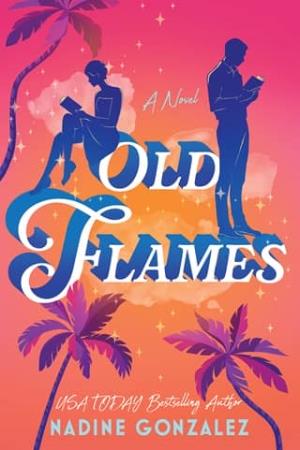
Old Flames
Prologue
“Light?”
“Of course.”
They were alone in the alley. Leo had found her reclined against the exposed brick wall, phone in hand, scrolling. She was
dressed in black, a white apron tied low on her hips, wavy hair twisted into a tight bun at the nape of her neck. Leo remembered
her as the one who’d offered him sparkling or still and refilled his wineglass halfway through dinner, her pretty face frozen
in a pleasant mask of indifference . . . much like it was now.
He expected her to hand him a matchbox with the venue’s logo. Instead, she tossed him a silver lighter. It was scuffed and
had some heft. He tested it. The flame came easy. He reached for his pack of Marlboros. “Mind if I smoke?”
She returned her attention to her phone. “A little late for that.”
Ouch. She bites.
Leo wasn’t seeking a confrontation. He needed a respite from his dinner companions, a moment to clear his head and stave off
a headache. Having worked as a waiter through college and beyond, he’d spotted the venue’s rear exit and bolted. The alley
was narrow, lit by a few flickering bulbs. Yet somehow, she glowed. Her amber skin, like stained glass, caught the light of
the bold September moon. With her profile framed in a silver halo, dark lashes catching droplets of moonlight, and her mouth
gathered in the slightest pout, he was ready to kneel at her altar.
He blinked, coughed, and snapped out of it.
“Are you alright?” she asked.
“I’m okay,” he assured her. Though, honestly, she didn’t seem truly invested in his well-being.
“Are you not enjoying the . . . ?” She waved as if she was conjuring a spell.
“Not really,” he replied.
An arched brow was her only response. He felt compelled to explain. “It’s called imposter syndrome. Don’t worry, it’s not
contagious.”
A skeptical look. “What do you have to feel insecure about?”
Hand to chest: “Do you have any idea what’s going on in there?”
“The New York City Literary Club Annual Thirty Under Thirty Rising Stars Charity Dinner,” she replied evenly.
Granted, she was working the event and knew what it was about, but how could she know, truly know, the layers of bullshit
he was dealing with inside that dining room? The jockeying, the ass-kissing, the small talk, and mini-digs. Leo was the youngest
of the honorees, barely squeaking in at twenty-three. He was a polarizing figure, the subject of ire or admiration. Some found
him overrated. Others hailed him a horrormeister in the making. Either way, he couldn’t win. It wasn’t anything he couldn’t
deal with, but the night was dragging. He was hungover and sleep-deprived. This weekend, he’d promised friends from out of
town to show them a good time in the city and had made good on that promise.
“I can’t speak for the other twenty-nine,” he said, “but my star will collapse into a black hole in a year.”
“Black hole.” He watched as she rolled the words around in her mind. “That could be the title of your second book.”
Now we’re getting somewhere. “You know my first?”
A shrug. “I’ve read it.”
“You . . . read?”
That earned him an angry flash from her pretty eyes.
“Sorry,” he said quickly. “That was stupid. It’s just . . . you threw me off there. I can’t even get my parents to read my
book.”
The attempt to hide his bewilderment in a joke failed. She went back to scrolling. He wasn’t usually this awkward, but it
shocked him that she’d even heard of his book. He was a newcomer on the scene, nowhere near a household name. He hadn’t even
told her his name. Had she studied the seating chart?
Before he could flatter himself that she’d singled him out, she delivered this blow, “I’ve read all the books.”
“What? All thirty under thirty of them?”
“Yes.”
Leo let out a low whistle. “I haven’t read half of them.”
Her sour expression confirmed she was in the camp of people who thought him overrated. He loved it.
“This event was on the calendar for months,” she explained. “When they published the list of authors, I challenged myself
to read their work.”
“I’m challenging myself to stay awake during dinner.”
“Hang in there,” she said. “The chocolate mousse is delicious.”
He tossed back the lighter. What did he need it for? He was already playing with fire.
“You read the one on the First World War?” he probed.
“I love a wartime epic.”
He approached and, adopting her posture, leaned against the wall next to her. “The one on the Great Plague?”
“All of them.”
He hesitated. “Did you like mine?”
“Does it matter?”
“Does it matter?”
“I thought it raised an interesting question,” she said thoughtfully.
Nice to see the mask of impassivity slip away. “Yes?”
Leo didn’t write books about war or plagues. He wrote about immortals. He was the only horror writer featured tonight. Some people, like his family, regarded the genre like a processed candy: good only for the dopamine release.
“I find it interesting that your character chose to live forever,” she said. “We’ve bought into the idea that you don’t have a choice. If you’re good, you’re ushered in through
the pearly gates. If you’re bad, you take the elevator to the basement. Either way, you don’t have a choice. It’s too late.
For your character, death was just a door. He had so much more living to do on the other side.”
“If you can call it living.” The premise of the novel was that immortals lose their humanity with time and, within a decade
or so, start to see people as prey, even those they swore to love and protect for an eternity.
“Want to know what I really think happens when you die?” he asked.
She turned to him with wide, brilliant eyes. Leo had her full attention. He teased out the moment to savor it.
“Go on,” she said.
“Ashes to ashes. You’re compost.”
“You don’t believe that.”
Well, he didn’t believe in pearly gates. “It’s for the best. It gives me a blank canvas to work with. If I were too attached
to one theory over another, I couldn’t write as freely as I do.”
She nodded, pensive. “That makes sense.”
This was the debate he’d love to have had earlier with his fellow authors, not whose work was overrated, whose prize was deserved
or not.
“Which would you choose?” he asked her. “To live on or rest?”
In the book, choosing death was a positive.
It meant choosing to rest in peace. Even so, it wasn’t an easy choice.
The human heart was never content. It always wanted more.
Before she could answer, her phone chimed.
She tapped on the screen to silence it. “That’s my time,” she said, pulling away from the wall—and from him.
She pocketed the phone and made her way to the heavy iron door.
“Which would you choose?” Leo asked again.
She paused with her hand on the doorknob and turned to him. She studied him with open interest. Her diamond gaze drilled straight
into the clay wall of his heart. Leo wasn’t sure he would ever recover.
“I don’t think I could rest if I had unfinished business.”
Then she stepped through a gate of another kind.
They did not speak again. For the rest of the evening, she averted her gaze as she carried out her tasks. At the end of the
night, he lingered at the door, lurked around, but did not spot her. Reluctantly, he followed a few of the others to a bar
next door.
Four years passed. He was at the Strand, killing time before the reading of his third book. He browsed the tables, picked
up a “hot new release,” a fantasy novel with a striking black-and-gold cover. A new author on the scene: July Levy Jones.
He flipped it over and, finally, there she was, staring back at him.