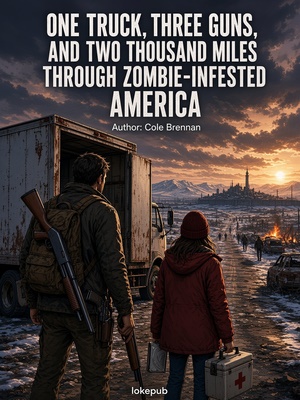
One Truck, Three Guns, and Two Thousand Miles Through Zombie-Infested America
Chapter 1 The Road West
By the time Dane Whitlock found the dead state trooper hanging from the pharmacy ceiling, he had already learned not to be surprised by the ways people chose to leave the world.
The building had been a RiteWay once, bright and harmless and stuffed with things people had believed they could not live without—mint gum, heartburn tablets, batteries in cheerful orange packaging, birthday cards that still sang when opened because nobody had taken the time to steal them.
Now the front windows were spiderwebbed with impact marks, the automatic doors had frozen halfway open, and the air inside held the sweet-rot stink of spilled cough syrup, spoiled milk from the back refrigerators, and something older beneath it.
Dane stood just inside the entrance with the twelve-gauge low against his ribs, the barrel angled toward the floor, finger resting outside the trigger guard the way his father had taught him before his father forgot most things except old anger and the names of dogs he had owned as a boy.
Rain tapped on the roof in a slow, uneven rhythm.
Somewhere deep in the store, a loose sign creaked gently on its chain.
The trooper swung in the aisle marked FIRST AID.
He was a big man, or had been. Boots brushing the toppled shelves. Hat gone. One hand locked around a rosary so tightly the beads had cut dark crescents into his palm. He had climbed onto a display of discount diapers, tied off with electrical cord, and stepped into whatever he believed came next.
Dane looked at him for less than three seconds.
“Sorry,” he said, because the dead deserved at least the shape of a word, even when there was no one left to hear it.
He moved around the body without touching it.
The town outside was called Sallow Creek, Nebraska.
A name no one on the coasts had ever said unless they were reading a weather alert from a studio.
Dane knew it because his route used to cut through here twice a month when he hauled frozen chicken west and produce back east, sleeping in the cab behind truck stops and listening to late-night preachers promise that endings were only beginnings wearing frightening masks.
For three weeks, endings had been endings.
The first reports called it a rabies variant.
Then a hemorrhagic fever. Then an unknown neurological pathogen with aggressive behavioral presentation, which was the kind of phrase a man in a clean shirt used when he did not want to say that mothers were tearing open their sons in parking lots and nurses were eating through restraints with
their own broken teeth.
By the fourth day, there were curfews. By the seventh, the emergency broadcast tone had become so common that Dane stopped flinching.
By the tenth, the president’s face appeared once, pale and recorded, and then not again.
Dane had survived because he was good at leaving before the crowd decided which direction to run.
He had been in Kansas when the interstate snarled into fifty miles of burned vehicles and screaming families.
He had taken county roads, farm roads, maintenance cuts behind grain silos, and the forgotten service lanes that only truckers, state plow crews, and teenagers looking for privacy knew existed.
By dumb luck and old habit, he had found his refrigerated box truck in a transfer yard outside Lincoln with the keys still in the dispatch office and half a tank of diesel in its belly.
Tomber, the name stenciled in fading letters under the driver’s window by some previous owner with sentiment and a poor sense of humor, was ugly as a cinder block and twice as stubborn.
The refrigeration unit no longer cooled.
One side mirror was cracked. The rear door stuck unless you cursed at it in the right order.
But the engine turned over, the tires held air, and the cargo box could be locked from the inside.
That made it a palace.
Dane filled a duffel with gauze, alcohol pads, iodine, children’s fever medicine, two bottles of antibiotics he could not pronounce, and every pack of sterile syringes that had not been trampled.
He left the insulin because the refrigerator had died and he did not know if warm insulin helped anyone or killed them faster.
He stood for a long moment in front of the painkillers, reading labels by flashlight, thinking of all the people he had seen limping, burned, bitten, bruised, and shaking on the shoulders of highways.
He took less than he wanted.
That was survival too.
A soft thump came from the stockroom.
Dane froze.
The rain kept ticking overhead. The trooper’s boots turned slowly behind him, leather whispering against cardboard. Dane lowered the duffel inch by inch and brought the shotgun up.
Another thump. Then a wet scrape, not loud enough for a footstep, too heavy for a rat.
Dane did not call out. Calling out was for the old world, when a reasonable person might answer. In the new one, noise was an invitation and mercy was a door left unlocked.
He stepped past the pharmacy counter. Empty pill trays crunched under his boots. The stockroom door hung open a few inches, breathing darkness. A smear of blood ran down the handle and dried there, reddish black at the edges.
Dane pressed his shoulder to the wall beside the doorway, waited, and listened.
The thing inside inhaled.
Not like a man. Like a clogged drain trying to clear itself.
Dane stepped into the doorway and the infected came at him from behind a tower of paper towels, fast in that first terrible second before its ruined balance failed.
It had been a woman in a pharmacist’s coat.
Her mouth was torn wide at one corner, cheek hanging in a dark flap.
One eye was milked over; the other fixed on him with a hunger so empty it felt almost innocent.
He fired once.
The blast filled the stockroom and slapped sound back against his ears.
The pharmacist folded sideways into the shelves, dragging a rain of antacids and vitamin bottles down with her, limbs shuddering against the concrete.
Dane worked the pump by instinct and kept the bead on her skull until she stopped moving.
Only when the silence returned did he realize his jaw was clenched so hard it ached.
“One shell for aspirin,” he muttered. “Good trade.”
The joke did not land, even with him.
He backed out of the stockroom, gathered the duffel, and walked quickly for the entrance. The shot would carry. Everything carried now. Sound had become a kind of scent.
Outside, Sallow Creek lay under a low gray afternoon, all its ordinary pieces arranged with nightmare patience.
The gas station canopy sagged over pumps wrapped in yellow tape.
A minivan sat nose-down in the ditch with a child’s bike strapped to the rear rack.
Wind rolled a plastic grocery bag along the gutter until it snagged on a storm drain and beat itself there like a trapped bird.
Tomber waited at the curb, engine off, front end pointed west.
Dane had parked it that way because he did not like turning around under pressure.
A length of welded cattle guard protected the grille.
Plywood covered the passenger-side window.
The driver’s door bore three muddy handprints that no amount of rain had yet washed away.
He had just reached the truck when the church bell rang.
Dane stopped with one hand on the door handle.
It rang once, low and cracked.
Then again.
The church sat two blocks over, its white steeple visible above the feed store and the library roof. Dane stared at it through the rain, counting without wanting to count.
A bell could mean survivors. It could mean infected pulling ropes by accident.
It could mean a trap. In the first week, Dane would have gone running toward it.
In the second, he would have left without looking back.
Three weeks in, he stood beside the truck with a duffel of medicine and tried to measure how much of himself he could afford to keep.
The bell rang a third time.
Not random. Slow. Deliberate.
He opened the driver’s door, tossed the duffel onto the seat, and looked at the shotgun in his hands.
“Dumb,” he said.
He shut the door without getting in.
The clinic was across from the church, a low brick building with a blue awning and a sign that read Sallow Creek Family Care.
Dane saw the plywood first, then the sandbags behind the glass doors, then the old ambulance parked crooked across the entrance with its tires slashed and its back doors painted with a red cross so wide and rough it looked like a warning made by a child.
The bell rope had been tied to the clinic’s front awning and run through a broken second-floor window in the building beside it. Someone had rigged it so they could ring the church bell from cover.
Clever, Dane thought.
Clever people were more dangerous than desperate ones.
He approached from the side alley with the shotgun low and his revolver heavy under his jacket. His third gun, a lever-action rifle with a cracked walnut stock, lay in Tomber’s cab because carrying three guns at once only made a man look prepared to die tired.
A woman’s voice came from behind the ambulance.
“Stop there.”
Dane stopped.
The voice had grit in it, but not enough years to hide the strain. He shifted his eyes without turning his head and saw the black circle of a pistol barrel between two sandbags.
“I’m stopped,” he said.
“Put the shotgun down.”
“No.”
The barrel did not move.
“That wasn’t a negotiation.”
“Sounded like one from here.”
There was a pause, and in that pause Dane heard another sound behind the door: someone coughing, hard and wet, and someone else whispering for them to be quiet.
The woman behind the sandbags said, “You fired in the pharmacy.”
“Something objected to my shopping.”
“You bitten?”
“Not today.”
“Lift your sleeves.”
Dane looked down the street. Rain blurred the town into wavering gray strips. Nothing moved yet, but that did not mean nothing had heard.
“Lady, I’m standing in the open because your bell asked me to. If you want a medical history, you can take it through a window while I’m in my truck.”
The pistol barrel steadied.
“Lift your sleeves.”