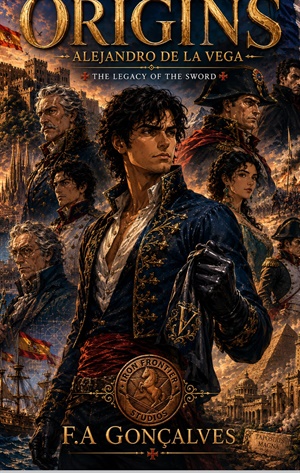
Origins (Iron frontier studios)
Chapter 1
The Roll of the Golden Drums
(Spain, 1782)
The sun that rose over the parched plains of Castile never brought relief, only the promise of one more day of servitude.
In the small hut of straw thatch and adobe walls belonging to the De La Vega family — a family that had once been aristocratic, though fate willed that by the time of Alejandro's father the family name was worth nothing anymore — the day began before darkness had even finished its retreat.
Alejandro, sixteen years old, already had the build of a grown man, but his stomach growled with the same steady insistence as his younger brothers'.
At the rough wooden table, silence was the only courtesy.
Alejandro's father, Gaspar Manoel, a man whose back had been shaped by the curve of the hoe and whose hands were as thick as harness leather, divided the last of the stale bread.
There was no butter, no milk; only brackish water to wash the dry wheat down.
Of that entire harvest Alejandro had helped wrest from the stony earth over the past weeks, more than three-quarters had vanished into the King's tax collectors' chests, and the rest had been handed over as tithe to the local parish.
What remained was mud, hunger, and a gray horizon.
"Eat one more piece, Alejandro," his mother Rita whispered, her tired, prematurely aged eyes fixed on her eldest son. "You're going to the olive grove today, you'll need your strength."
Alejandro looked at the piece of bread, then at his younger brothers watching the table with hollow eyes. He pushed the plate back.
"I'm not hungry, madre. The sun hasn't warmed the ground yet, the work will be slow."
Manoel looked at his son. There was a bitter pride in that fatherly gaze.
He knew that Alejandro could not bear the thought of watching his family waste away while the fruit of his labor crossed the ocean in Spanish galleons or fed banquets in Madrid.
Alejandro wanted more. His eyes, a deep, cutting brown, did not spend the day staring at his own feet in the dust; they searched the mountain peaks, the roads that vanished beyond the province. He wanted a way out.
And the way out came with the sound of thunder.
It was not rain. Castile's sky remained clear and pitiless. It was a dry, rhythmic sound, one that made the water in the tin cup tremble on the wooden table.
Boom... boom... boom-boom-boom.
The military drums.
In the space of a heartbeat, the sleepy stillness of the humble village dissolved into a whirlwind of shouts and running feet.
In the narrow lanes, the old folk crossed their arms and murmured prayers of protection, or curses against the Crown.
To those who had already seen the scars of war in Europe, that drumroll smelled of gunpowder, blood, and mass graves.
But to the young men of Alejandro's age, that march was the song of the sirens.
It was the one chance to stop being a ghost in the mud and become someone whose name commanded respect.
Alejandro leapt up from the table, ignoring his mother's frightened cry.
"Alejandro, no! Stay in the cabin!" Rita shouted, trying to grab him by the worn cloth of his shirt.
"It's the enlistment, madre. It's the royal envoy," the young man said, his voice steady despite the tremor of anticipation climbing up his legs. "I have to see it."
He ran to the central square, mixing into a crowd of young men who seemed gripped by a collective fever.
The packed-earth square, usually occupied by scrawny goats and broken carts, had transformed into the stage for a spectacle of military splendor.
Low-ranking officers set up rough wooden tables, arranging inkwells and heavy ledgers.
Sergeants — burly men with voices like cannon fire — barked orders, pushing the young peasants into a straight line.
The young men pressed against one another.
There was the blacksmith's son, the baker's boy, the shepherds from the hills.
All of them, without exception, tried to look taller.
They puffed out their chests beneath their rags, lifted their soot-covered chins, and wiped their faces on their sleeves, desperate not to be turned away for physical weakness.
To be accepted meant a clean uniform, three hot bowls of stew a day, and the mythical promise of rising in rank, gaining land and gold in the King's overseas campaigns.
To be rejected meant going back to the hoe and starving to death before the age of thirty.
That was when the main escort broke through the curtain of dust on the royal road.
Silence swallowed the square like a shroud of ice. At the head of the cavalry detachment, mounted on a sumptuous black Andalusian stallion whose coat gleamed like obsidian under the sun, rode the officer in charge of the recruitment commission. Don Luiz.
To young Alejandro, who had never left that God-forgotten province, Don Luiz did not look like a man of flesh and bone; he looked like a living statue carved for war.
His blue-and-white uniform did not show a single stain, not a single loose thread.
On his chest, medals of gold and silver bearing the Bourbon crest jingled softly to the rhythm of his horse's steps, throwing the sunlight straight into the dazzled peasants' eyes.
Luiz's face was angular, severe, dominated by two gray, surgical eyes that seemed to weigh the soul of anyone who crossed his path.
He carried himself with the erect, impeccable bearing of Europe's great fencing masters, an aura of absolute authority that made even the roughest sergeants hunch their shoulders in submission.
Don Luiz dismounted with feline lightness, handing the reins to a subordinate without so much as looking at him.
His steps on the packed earth were unhurried, but each fall of his tall boots landed like a verdict.
He walked with a small leather crop in his right hand, tapping it lightly against his left palm as he passed down the line of trembling young men.
Luiz needed no files or reports. He read the fiber of men through their eyes.
"Too weak," Luiz murmured, passing the tailor's son, who lowered his head in shame. "Rejected. Send him back to the scissors, sergeant."
"This one's back is crooked," he said, pointing with the handle of his crop at another young man. "He wouldn't survive a marching pack for two leagues. Out."
Panic mixed with eagerness grew along the line as Don Luiz's footsteps drew nearer. When the officer finally stopped in front of Alejandro de La Vega, the world around them seemed to fall silent.
Unlike his companions in misery, who dropped their eyes to the ground in a show of respect or fear, Alejandro kept his chin raised.
His brown eyes fixed directly on the captain's gray ones.
There was a fire there that Luiz had not found in any other village in that province: not the insolent recklessness of a criminal, but the fierce determination of a young man who would rather die fighting on the front line than spend the rest of his days digging his own grave in the soil of Castile.
Don Luiz narrowed his eyes, intrigued. He took a step forward, invading the boy's space in an intimidating manner.
The smell of expensive leather, gunpowder, and tobacco emanating from the officer collided with the odor of sweat and earth coming off Alejandro.
Luiz raised the leather crop and delivered a firm, dry blow straight to Alejandro's breastbone.
The impact cracked against the young man's chest bone.
Alejandro felt the air waver in his lungs and his heels threatened to give way in the dust.
But he clenched his teeth, planted his boots in the ground, and forced his chest forward, absorbing the blow while keeping his gaze locked on the officer, without so much as a groan.
A cold, one-sided smile cut across Don Luiz's severe expression. He had found what he was looking for.
"What's your name, boy?" Luiz's voice was a contained thunder, projected so the whole square could hear.
"Alejandro de La Vega, sir!" the young man answered, his voice firm and powerful, ringing in the morning air.
Don Luiz stepped back, looking toward the sergeant who carried the ledger, pen already dipped in ink.
"Enroll this one, sergeant. Write it in a firm hand. He has the blood and the backbone the King needs for the new frontiers. This one won't break at the first battle."
Luiz then brought his gloved hand to the inner pocket of his dress coat.
He pulled out a heavy coin of pure silver, struck with the effigy of King Charles III.
With a careless flick, he tossed it to the ground.
The coin spun through the air and landed with a crystalline clink in the dust, stopping exactly at the feet of Gaspar Manoel de La Vega, who had watched it all from a distance, straw hat in his trembling hands, silent tears running down his weathered face.
"The King pays for his men, peasant," Don Luiz said, not looking at Alejandro's father, keeping his eyes fixed on the boy.
After the sound of the coin meeting the earth, the silence of the square was broken by Rita's desperate weeping, her face buried in her shawl.
Don Luiz turned his back on the enlistment table and mounted his black Andalusian once more with mastery.
From atop the saddle, his figure looked even more towering against the Castilian sky.
He pulled the reins, making the animal curvet, but before ordering the detachment to march, he faced the group of ten young men selected that morning.
"Listen well, recruits," Don Luiz's voice rang out, cutting as a Toledo blade.
"The King has no time to waste on laments, and the roads to the Royal Academy of Mathematics and Fortification of Barcelona are long, brutal, and dangerous. You have exactly four hours. Four hours to gather your rags, embrace your mothers, and say goodbye to the miserable life you knew until today."
He paused with surgical precision, letting the weight of his words settle into the young men's minds. His gaze rested on Alejandro one second longer than the rest.
"When the sun begins to set behind those hills and the Crown's drums roll once more, whoever is not standing in the road with my detachment will be considered a deserter. And you will learn early that the Crown punishes desertion with the hangman's rope. Make the most of every minute."