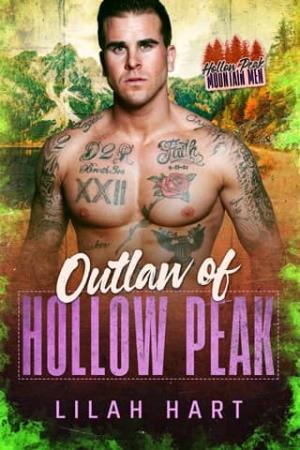
Outlaw of Hollow Peak (Hollow Peak Mountain Men #8)
Chapter 1 Mia
MIA
Iknew his name before I knew anything else about him.
That was how Hollow Peak worked. A stranger couldn't so much as think about ordering a cup of coffee without the whole town knowing his name, his business, and probably what kind of boots he wore.
News didn't travel fast here—it seeped, soaked in, worked its way through conversations and glances and the way people leaned a little closer over their mugs when the bell over the door chimed.
Mae Whitlock had told me about him the morning he first came in.
New guide, she'd said, not even pretending she wasn't watching him through the front window like she had a right to catalog every newcomer who crossed into Hollow Peak.
Military background. Something happened.
She could tell by the way he held himself.
Mae could always tell.
I'd followed her gaze, drying my hands on a towel that didn't need drying, and watched him walk to his truck.
Even from that distance, there was something about him that made you pay attention whether you meant to or not.
I thought she was probably right, though I couldn't have said exactly why—not in any way that would've held up under questioning.
He moved like someone who'd learned not to waste anything—not steps, not words, not even the effort it cost to be in a room full of people who all wanted to know his business.
Every motion had purpose, stripped down to only what was necessary.
No extra weight. No hesitation. The kind of efficiency you didn't just pick up—you earned it, one hard lesson at a time.
He hadn't looked back at the café once.
Not at the window. Not at the people inside who were already talking about him. Not at me, even though I'd been standing right there, watching like I didn't have better things to do.
Mae had filled in the rest over the following days the way she always did—the way information moved through Hollow Peak. Not all at once, never clean or complete. In pieces. Over coffee refills. Between customers. In the quiet seconds when the door didn't open and the world outside felt far away.
His name was Hale Nichols.
He was staying up at Ridgeview Lodge.
Rowan Pike had brought him on as a guide at PeakBound Adventures.
Black coffee, no food. Fair tip. Gone before anyone could pull him into a conversation long enough to ask the questions they were all already forming.
I told myself I wasn't interested. I was just noticing. There was a difference. Or at least there was supposed to be.
But I'd been thinking about him for three weeks.
Every morning, like clockwork, he came in, ordered the same thing, and left just as fast. Like Hollow Peak was just a pit stop—not the kind of place that stuck with you whether you wanted it to or not.
I started recognizing his truck before I even saw it—the low rumble cutting through the early morning quiet like a warning I pretended not to hear.
I'd refilled his coffee once without asking.
It had felt like crossing some invisible line I couldn't quite define. He'd looked up at me then, those eyes settling on mine with a steadiness that made it feel like I was the one being assessed.
Like I'd done something that required evaluation.
Like he was deciding whether I mattered.
Then he'd given a single nod—brief, deliberate—and gone right back to looking out the window, like that was all I was going to get.
It should have been enough.
It should have been nothing.
I'd thought about that nod more than I should have. More than made any kind of sense for a man who didn't talk, didn't linger, didn't so much as glance around the room like he cared who might be watching him walk in or out of it.
Which, of course, made him exactly the kind of man people in Hollow Peak couldn't stop watching. Apparently, I wasn't any better than the rest of them.
I knew this river better than most people in Hollow Peak. I grew up on it—learned its moods before I learned my multiplication tables. My mom used to fish it like it was something sacred. Not just something you took from, but something you listened to. Respected.
After she was gone, my dad brought me out every Saturday morning, like clockwork. Like keeping that one thing the same might keep everything else from falling apart.
It was a ritual.
But it was more than that. The Hollow Peak River was the one place where Cal Granger forgot to be a sheriff for a few hours. Out there, he wasn't the man everyone turned to when something went wrong. He wasn't the one carrying the weight of a town that trusted him to keep it safe.
Out there, he was just my dad. And I was just his kid, standing ankle-deep in cold water, trying to cast a line straight instead of tangling it in the brush behind me.
I'd learned to read water the way other kids learned to read books—slow at first, sounding it out, getting it wrong more often than not.
But eventually, it started to make sense.
The shifts in current. The subtle changes in color.
The places where the surface looked calm but wasn't, where something moved just beneath if you knew how to look for it.
Most people saw a river. I saw patterns. Signals. Warnings. I saw what was hidden.
And lately—whether I liked it or not—I'd started to feel that same pull when Hale Nichols walked into the café. Like there was something there, just under the surface. Something I couldn't define yet, but something I couldn't quite ignore.
Something that made me pay attention. Even when I told myself not to.
So it wasn't unusual for me to be out here at dawn, knee-deep in the current with a five-weight rod.
It was a little unusual that I'd come to this specific stretch.
The lower bend, where the current slowed around a gravel bar and the overhanging willows held the morning shade an extra hour.
The stretch where I'd seen a truck parked three mornings running.
His truck was there now.
He was upstream, maybe forty feet, working the deeper channel where the water darkened.
He was casting—not the mechanical loop-and-throw that tourists managed after a lesson, but the real thing.
The kind that came from understanding how a line wanted to move through air.
His back was to me. The current covered sound, and he hadn't heard me arrive.
I watched two casts before I said anything.
"You're mending too early."
He went still. Not startled—more like a man who'd learned to absorb surprises rather than react to them. Then he turned, and I got the full weight of him in a way I hadn't let myself in the café.
Dark hair pushed back from his face, damp at the temples.
A jaw that looked like it had been put there to win an argument.
His eyes were an interesting color—somewhere between gray and green, the exact shade of the river right before a storm changes the light.
Ink covered both forearms where his sleeves were rolled, disappearing up past his elbows.
There was nothing soft about any part of him, but he wasn't looking at me like a threat.
He was taking inventory. Deciding what was there.
"The mend," I said, because he hadn't spoken, and I was committed now. "You're throwing it before the line has time to land. You're correcting drag that isn't there yet."
He looked at the water, then back at me. "You've been watching me cast."
"I've been watching your mend."
"There a difference?"
"Yes."
Something moved at the corner of his mouth. Not a smile—the suggestion that one had considered appearing and thought better of it. He looked back at the water. "Show me."
I waded upstream until I was close enough to be useful, stripped some line off my own reel, and made a cast into the current below his. "See how I'm waiting? The fly lands, the line settles, then you throw the mend. You're doing it in the wrong order."
He watched. "I learned on moving water. Faster current."
"This river looks slower than it is. The drag sets up before you expect it." I lifted my rod tip and demonstrated. "Give it two beats after the fly lands. Then mend."
He tried it. The adjustment was immediate and clean—he'd understood on the first explanation. The line lay on the water the way it was supposed to.
"Better," I said.
"Thanks." He said it without looking at me, eyes already back on the drift. Then, "You always correct strangers' casting technique?"
"Only when they're doing it wrong."
"And if I'd been doing it right?"
"I'd have kept quiet and fished my own stretch." I waded back to where I'd been. "Mia Granger. I work at the Switchback—you've come in a few times."
"I know who you are."
I looked at him. He was still watching his fly.
"Mae," he said, by way of explanation.
"She mentioned you too," I said. "You made an impression."
"I just order a black coffee."
"That's all it takes with Mae." I pointed upstream at a dark slot behind a mid-channel boulder.
"There's a brown trout in that seam. She's been there every morning for the past month.
Educated fish—she's seen enough bad presentations to know what she doesn't want—but she'll eat a size sixteen Parachute Adams if you come at her right. "
He looked at the seam. "Why are you telling me that?"
"Because I've already caught her twice, and I'm happy for someone else to have a turn."
"You catch the same fish twice?"
"She's very catchable if you know what she wants." I paused. "Most things are."
He looked at me then. Long enough that I felt it, but not so long that I had to do anything about it.
"Hale Nichols," he said.
"I know."
He looked back at the seam without answering, worked out a cast, and adjusted his angle of approach without being told. The mend came late and patient. The fly settled into the slot and rode the current without drag.
The brown took it on the third pass.
I didn't say anything while he played her. She ran twice—short and fast, the way educated fish did. He kept his rod tip up and gave her room, and she came to his net looking ancient and offended and beautiful in the flat gray light.
He held her there, facing upstream, waiting. She kicked free.
"She's not boring," he said, still watching the water where she'd gone.
"No," I agreed. "She isn't."
"You made her sound like she was. Caught her twice, ready to move on."
"I was happy for someone else to have a turn." I started for the bank. "That's different."
"Is it?"
"Yes." I climbed out and reached for my rod case.
"The upper bend above the old mining road gets better after ten when the sun moves off it.
There's a population of cutthroats up there that doesn't see much pressure.
Worth the walk." I looked back at him. "And Mae makes a breakfast sandwich that will change your life, if you're not opposed to having your life changed. "
He was still watching me. "You always this helpful to strangers?"
"Only the ones who are doing something worth helping with." I shouldered my bag. "She'll be in that seam tomorrow morning too, if you want another shot at her."
"I'll keep that in mind," he said.
I made it to my truck, stowed my rod, and sat for a moment with my hands on the wheel while the engine warmed.
He'd said maybe twelve sentences in forty minutes on the water, and I knew more about him from those twelve sentences than I'd gathered in three weeks of watching him come and go from the café.
The way he'd taken the correction without flinching.
The way he'd said show me instead of defending himself.
The way he'd watched the fish go and called her not boring—like it actually mattered to him to say the right thing about her.
I pulled out of the lot and drove toward Main Street, the mountains coming clear above the tree line as the light built, and told myself that was enough to know for now.
It wasn't. But it was a start.