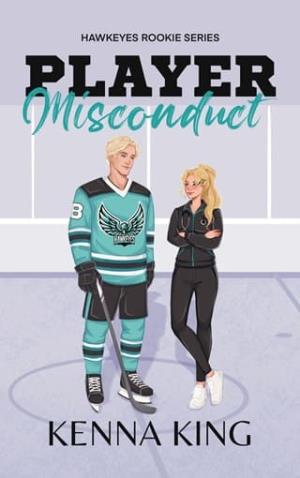
Player Misconduct (The Rookie Hawkeyes #4)
Chapter One
Kendall
Hockey.
One of the only sports where you sit close enough to hear bones break, where fans pay to watch car-accident-like injuries in real time, and where tall walls of plexiglass and nets ring the rink because a puck flying at slap-shot speed could knock the Chiclets out of a fan in the nosebleeds.
Somehow, Penelope Matthews—the Hawkeyes’ GM—recruited me out of the NFL to be team doctor for a sport where players don’t just show up; they skate out with the kind of pride you can feel in your bones.
It’s game three. We’re down 0–2 in the Western Conference playoffs. The boys have worked all year to get here. A loss tonight doesn’t mean we’re dead… but we’d be bleeding. And no amount of med school and a five-year fellowship can keep a team from hemorrhaging on the scoreboard. It’s up to them.
A win tonight and the city breathes again. Our guys sleep a little sounder.
I’m on the bench at the far end, shoulder to shoulder with the equipment guys and Theo, our athletic trainer, kit open at my feet: gloves, gauze, ammonia caps, extra mouth guards, stacks of blue nitriles.
I’ve taped three wrists, glued one knuckle, and told a rookie he’s not dying—he just needs to spit the blood out before he swallows it and pukes on the spot.
The puck pops up near the boards in front of us. Scottie Easton, our right wing, snatches it and wheels through neutral. The crowd’s roar shifts—hopeful, hungry. I stand because I always stand when he hits the blue line; the way he leans into speed should be illegal.
The hit comes a breath after he crosses.
A defenseman meets him shoulder-to-chest and drives through. Textbook—and still vicious. The kind of hit that won’t go unspoken for. Scottie goes glass, then down, and the whole bench surges forward.
I hop the boards as soon as I’m sure I’m not going to set out in front of a player, my body moving on instinct and adrenaline, Theo on my heels, and Aleski M?kelin skating full force towards us to build a force field to protect us from getting run over by players.
“I got you Doc,” Aleksi says… and I know I can trust that he does.
By the time I drop to my knees beside Scottie, the world has narrowed to the cold sting of ice shavings and someone in section 224 screeching, “Get up!”
Aleksi pointed his stick at the drunk fan as a warning to the fan in 224 to shut his mouth about his teammate or he’ll do it for him.
“You’re going to be fine, East.” Aleksi calls out of his shoulder, still standing guard as other players start to circle around us now to give us some privacy from fans without blocking out too much light.
“Hey, Scottie. It’s Kendall and Theo.” My gloved hand cups the back of his helmet as his eyes blink fast, unfocused. “Don’t try to sit up yet. Look at me.”
His pupils are big. Too big.
Theo’s already got the light out, flashing. We both know what this is and move in unison.
“What period?” I ask, steady.
He swallows. “First.”
“Good. Who are we playing?”
He blinks. Blinks again. “—Vegas? No. Sorry. Sorry.”
“Okay.” Calm is the job. Calm is the whole job.
After a fellowship with the pro football team in Florida and then getting hired on as the team doctor for an additional two years, I know a concussion when I see one.
In my first Hawkeyes season, I’ve seen more concussions than in my years in the NFL.
“Follow my finger.” Left to right. His eyes lag to follow, just slightly, but enough.
“I can skate,” he mutters. “I’m fine, Doc, I can—”
He braces to move. Theo rests a palm to chest. “Easy, buddy. Doc’s making the call.”
Two of our players crouch low and close to us, waiting for my word.
“You’re not skating anywhere,” I say, firmer now. “We’re going to the tunnel and you’ve got a date with a quiet room. You know the drill.”
The crowd drops from roar to rumble, their patience and tone starting to shift. Someone pounds on the glass—three angry thumps. I don’t look up. This is the playoffs and Scottie is key, but my job isn’t to win the Cup. My job is to keep the players healthy.
He attempts to push up to his knees. His glove slips. Strong as a horse, stubborn as one too. I catch his shoulder pad and give him one second of gentle pressure. Just enough to remind him I’m not asking.
His mouth twists. “You’re pulling me, aren’t you?”
“Yeah,” I say. “I’m pulling you.”
Two of our other players: Wolf Ziegler, our defensive player, and Slade Matthews, our center and captain, flank him under the arms, and as they help him up, he throws me a look that says every awful thing this means to him: Not tonight, not like this.
It lands low, a bruise under my ribs. I tuck it away.
Boards, gate, the tight chute of the tunnel. A few drunk fans boo me; two of our guys on the bench bark something protective and unsavory back on my behalf.
I’m not always loved by fans. Sometimes not by players either. They work their whole lives for this moment, and I’m the one who sometimes ends their night early.
It’s not a choice I make lightly. But at the end of the day, as the doctor of this team, it is my choice—and Theo and I are the only two qualified to make it.
The arena noise slams the back of my skull when the door shuts, leaving only rubber under skates and Scottie’s swearing while Slade gives him the best consolation pep talk he can muster.
The quiet room is small, bright, and as sterile feeling as you’d expect for a medical space in the belly of a locker room stadium.
Everything starts moving like clockwork. Like Theo and I have done this more than a dozen times… because we have.
Helmet off.
Orientation.
Symptoms.
Theo tries to use humor to lighten the mood between the three of us, but it fails both times.
“I know,” Scottie says when I shine the light again. “I know what you’re going to say.”
“Then say it to me.”
Head tipped back, eyes closed. “I’m out.”
“You’re out,” I confirm. “Tonight.”
His jaw flexes. “What about the road game?”
“We’ll see how you feel tomorrow,” I say, gentle but immovable. “Right now we’re not there.”
A knock. An assistant coach peeks in with the face I’ve learned to hate. “Dr. Hensen—uh—they just want to know.”
“I’ll tell the bench.” I respond. Then I turn to Scottie: “You’re staying put. I’ll grab a towel and a bottle. Head back, eyes closed, slow breaths. You don’t do anyone any favors pretending this is less than it is.”
His mouth twitches. “You gonna tell my mom?”
At least the humor’s alive. I chuckle. “If you don’t, I will.”
Back on the bench, the guys are tight and keen—the kind of angry that focuses you.
I lean between coaches and say the words no one wants to hear.
Coach Haynes’s head dips, and then he nods as if he was expecting this but was hopeful I would come back with better news.
I wish I were coming back with better news, too.
The next line is already over the boards, and the hitter is back on the ice. Wolf bee-lines and plants him into the plexi. The ref’s whistle shrieks. Wolf skates to the box with a satisfied grin; Coach Haynes slams his clipboard.
As if we needed our best left-side D serving time for retaliation. But trying to reason with Ziegler, who’s as close to a provoked, angry hornet’s nest when an opposing team messes with one of his teammates–is impossible.
We take a penalty that feels like it lasts an hour. JP Dumont, our goalie, robs a sure goal with a toe save I’ll see in my dreams. A defenseman eats a slap shot in the sacrum and pops up anyway.
Between whistles, I tape a finger, refill a mouth-guard tub with ice, one eye on the clock, one on the players.
You learn your team like a set of vitals.
Every time #8, Aleksi M?kelin, loops past our side, he cuts a glance to me—quick, yet warm, like checking on me is as reflexive as lining up for the draw.
It’s ridiculous, kind of sweet, and also…
not the sort of distraction I need as the team doctor, considering players are off limits. Which is just as well.
“Hydrate,” I say to Aleksi when he’s close enough.
It’s neutral–Both clinical and safe. Not to mention that I say it to everyone so there’s no concern that it sounds like favoritism. I say it to him like it isn’t a tell.
He grins around his mouth guard like I told him his shot looks pretty. Blond hair flying, skating like physics owes him an apology.
Horn. Intermission. The room turns into steam, curses, the slap of tape. Slade Matthews’ voice sounds something like belief. I duck into the quiet room: towel over Scottie’s eyes, breaths steadier. Theo is already jotting notes; we’ll debrief every chart in the morning.
“You’re doing great,” I tell Scottie. “Any nausea?”
“Just nausea about not being on the ice.”
“You’re not missing much. It’s boring out there. Real snooze fest,” I lie.
He snorts. “You’re a shitty liar, Doc.”
I swap his bottle and review Theo’s plan. “No screens. No lights. No heroics. If you want back on the ice for the upcoming game, you need to show me you’re healthy enough.”
He shoots me a begrudging thumbs-up.
Second period ages me. We’re down one off a tipped shot. I realize I forgot to breathe for a minute when stars press in and dissolve. Irony noted.
Halfway through, Aleksi takes a stick up high and comes to the bench blinking, one hand cupping his eye.
“Sit,” I tell him, already reaching. Blood, bright and thin, spiders down his cheekbone. “Don’t rub it.”
“I wasn’t going to,” he says with a slight Finnish accent, and takes a seat in front of me. “How tough do I look right now, Doc?” He asks, still grinning.
“You want it straight?”
“Always. You know how I like it.” His eyes sparkle back at me with playful interest, eating up the banter.
I cut him a look—his grin widens. This flirting can’t keep going on like this. Not if I want to keep my license. Not with the medical board still remembering my last review.