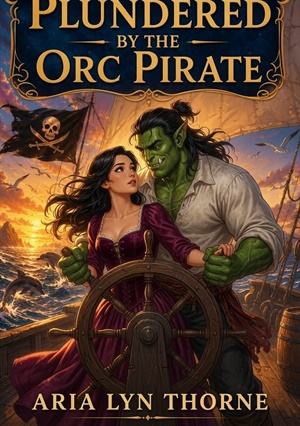
PLUNDERED BY THE ORC PIRATE (ORCS OF ARDEMERE #2)
Chapter One
Charting the Unknown
The ink was not cooperating.
Sable held her pen at the angle that usually produced a clean line, thirty degrees, light pressure, a steady exhale to keep her hand from trembling, and drew the contour of the reef she’d been sounding all morning.
The line came out thick, then thin, then blotted where a swell rocked the chartered vessel beneath her and sent her nib skittering across the vellum like a startled crab.
She swore. Quietly, because Captain Harwick and his crew of six were within earshot and she’d learned in three weeks aboard the Maiden’s Luck that sailors took a woman’s profanity as either an invitation or an omen, and she wanted neither.
She blotted the error with the heel of her hand, smearing ink across her palm (her left hand was already stained to the wrist, a permanent cartographer’s tattoo that no amount of soap could fully remove), and started the line again.
This time the swell cooperated. The pen moved.
The reef took shape: a crescent of shallow water curving around the eastern approach to an island that, as far as she could determine, had never been properly charted by anyone.
Three weeks in the Shattered Isles, and Sable was fairly certain she understood why.
The islands were a cartographer’s nightmare and a cartographer’s fever dream in equal measure.
Over a hundred fragments of land scattered across two hundred miles of ocean, some large enough to hold forests and freshwater springs, others barely more than rocks wearing crowns of seabird shit.
The channels between them shifted with the tides, navigable at high water, ship-killing at low, and the currents ran in patterns that defied every model Sable had studied.
Reefs surfaced and submerged without warning.
Fog banks rolled in from nowhere and sat for days, thick as wet wool.
No wonder the existing charts were useless. The three she’d consulted before departure had disagreed with each other on the location of major landmasses by as much as twelve miles. Twelve miles. She could have wept.
Instead, she’d done what she always did when the world handed her a mess. She’d sharpened her pen, opened a fresh sheet of vellum, and started from scratch.
? ? ?
The deck of the Maiden’s Luck was Sable’s kingdom, and she had colonized every inch of it.
Her charts covered the aft deck in overlapping layers: the master chart pinned to the makeshift table she’d built from crate lids, the detail sheets weighted with stones, the sounding logs drying in the sun.
Her instruments were arranged in the precise order she’d established on her first day aboard: astrolabe, lead line, compass, parallel rulers, dividers, and the battered leather case of nibs that had been her mother’s and were now, along with a talent for spatial reasoning and an inability to leave a blank space unfilled, the only inheritance she’d received.
Lord Thatch had been generous with the commission.
Generous enough to make her suspicious, at first. A cartographer of her modest reputation didn’t usually attract the attention of wealthy collectors.
But Thatch had been charming, and specific, and his gold had been real, and Sable had spent twenty-six years learning that when opportunity knocked, you opened the door before it changed its mind.
Map the Shattered Isles. Every channel, every reef, every navigable passage. Spare no detail. I want charts accurate enough to sail by.
She’d asked him why. He’d smiled, a pleasant, cultivated smile that she now realized had never reached his eyes, and said he was a collector of rare knowledge. That the Isles were the last great unmapped territory on the Ardemere coast, and he wanted to be the man who owned their secrets.
It had sounded romantic. Noble, even.
Sable had not been seduced by the romance.
She’d been seduced by the number on the contract: enough gold to pay off the debts her father had left when he drank himself to death, enough to rent a proper studio instead of working out of a rented room above a tannery, enough to buy the kind of inks and vellum that she’d been stealing glimpses of in other cartographers’ workshops for years.
She’d looked at that number and signed before the ink dried, because romance was a luxury for people who’d never had to choose between a new set of nibs and a meal.
She’d been poor long enough to know that money didn’t solve everything. But she’d also been poor long enough to know that it solved the things that mattered first.
? ? ?
The afternoon had settled into the rhythm she loved best, pen on vellum, sun on her back, the gentle creak of the ship and the whisper of the sea, when the lookout called from the mast.
The word was indistinct. The wind had picked up in the last hour, snapping the canvas and filling the air with the restless percussion of a ship under way. But the tone was unmistakable. Sable had spent enough time on vessels to know the difference between a routine sighting call and an alarm.
This was an alarm.
She looked up from her chart. Captain Harwick was already at the rail, spyglass extended, his weathered face gone the color of old sail.
He said something to his first mate that Sable couldn’t hear, and the first mate went pale too, and then Harwick turned and looked at her with an expression she would remember for a long time afterward.
It was the expression of a man doing the arithmetic of survival and coming up short.
“Black sails,” he said. “Southwest. Closing fast.”
Sable set down her pen. Wiped her ink-stained hand on her trousers. Walked to the rail and took the spyglass from Harwick’s unresisting fingers, because knowing was always better than imagining and she had never in her life been able to stop herself from looking at the thing that frightened her.
The ship was beautiful. That was her first, absurd thought: that the vessel cutting toward them through the afternoon chop was one of the most beautiful things she’d ever seen.
Dark-hulled, lean, built for speed the way a blade was built for cutting.
Her sails were black as ink against the sky, and they were full, and she was fast, and she was coming.
Sable adjusted the glass. The deck swam into focus: crew moving with disciplined purpose, weapons glinting. And at the prow—
An orc. Tall, lean, standing at the bowsprit with one hand on the rigging and the other resting on the hilt of a curved blade.
The wind had his hair, black, long, unbound, and his face was turned toward the Maiden’s Luck with an expression of focused intent that reminded Sable, with a lurch beneath her ribs, of the way she looked at an uncharted coastline.
Like something he intended to claim.
He was smiling.
Sable lowered the glass. Her hands were steady. Her stomach was not.
“How fast?” she asked.
“Faster than us.” Harwick’s voice was flat with the calm of a man who had already done the math. “Nothing in these waters is faster than the Black Tide.”
The Black Tide. She’d heard the name in port towns up and down the coast, spoken in the particular hush that people reserved for storms and plagues and things that came for you in the night.
An orc pirate ship, captained by a man whose name was used to frighten children and silence barroom arguments. A murderer, they said. A monster.
Sable looked at her charts spread across the deck, three weeks of work, the best maps of the Shattered Isles that existed anywhere in the world, and felt something cold settle into the base of her spine.
She was still looking at them when the first grappling hook bit into the rail.