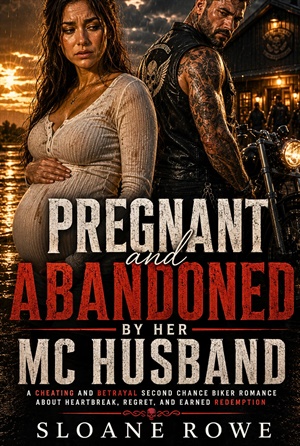
Pregnant and Abandoned by Her MC Husband (Broken Vows MC #3)
Prologue
POV MARLOWE
The night I found out my husband was the kind of man who could look at me and say nothing, I was seven months pregnant and standing in a room full of men wearing his last name on their backs.
Ironclad. Stitched in red thread over black leather, twenty-some jackets deep, the chapter room thick with cigarette smoke nobody bothered hiding from a pregnant woman because nobody in that room had asked me to come.
I’d let myself in through the side door Weston thought I didn’t know the code to.
I knew the code. I’d known it for six years, since before it was a marriage, back when it was just a girl from the Hale ranch riding on the back of a boy’s bike because her father would’ve shot him for asking her to the front seat of a truck instead.
I found the phone on the pool table where he’d left his cut. It lit up before I even reached for it, the way things do when you’re not looking for trouble and trouble finds you first.
Reyna. 3:14 a.m. You okay? Text me when you’re up.
Not the first message from her. Just the first one I’d seen.
I want to tell you I screamed. I didn’t.
I have never once in my life screamed, not the night my father’s horse threw him and broke three ribs against a fence post, not the night my water almost broke early with a hay bale on top of me, not that night.
I stood very still in a room that smelled like motor oil and old beer, and I felt the baby turn over inside me like she already knew, and I said his name once, quiet, the way you’d call a spooked animal you didn’t want to startle further.
“Weston.”
He was across the room with Hank and two prospects, going over the schedule for a run that had gone bad two nights before — I knew that much, I’d sat up with him after, watched him not sleep, watched him not say why.
He turned. I have relived the half-second between when he turned and when he saw the phone in my hand more times than I can count in four years, and I still cannot tell you what was on his face.
I used to think it was guilt. I have had a long time to consider that I might have been wrong, and an even longer time to decide it doesn’t matter, because guilty or not, he did the same thing either way.
He said nothing.
Twenty men in that room, my husband’s brothers, men who’d eaten at my table, men who’d held my hand at my father’s funeral, and not one of them said a word either, and the silence had a texture to it, thick as the smoke, and I understood in that silence something I have never been able to unlearn: that whatever code lived in that room outranked whatever we had built in the house six miles from it.
That I was, and had maybe always been, standing outside a door with a code I only thought I knew.
“Say something,” I said. Not loud. I don’t think I have ever been loud in my life.
He looked at Hank. Not at me. At Hank, like he was asking permission for something, and Hank’s jaw was so tight I heard it, actually heard the click of it from ten feet away, and neither of them said anything, and I understood that this was an answer.
Silence, in a room like that, is a language, and I had just been told everything I needed to know in it.
I put the phone back down on the felt of the pool table, careful, the way you set something down when you don’t want to hear it break.
I walked out through the side door I wasn’t supposed to have the code to.
Nobody followed me. I want you to sit with that a moment, because I have had to: twenty men who called themselves my family, and not one set of boots on the gravel behind me.
*
I drove myself to the Hale ranch that night with a baby doing slow rolls under my ribs and a suitcase I packed in eleven minutes flat, timed, though I didn’t mean to time it — some old part of my brain just started counting the way it counts contractions, the way it counts everything that matters.
My mother met me on the porch in her robe like she’d been waiting up, though there was no way she could have known, and she didn’t ask a single question.
She just opened the screen door, and it made the sound it’s made my whole life, that specific catch-and-swing, and I walked into a kitchen that still smelled like my father’s coffee tin even four years after we buried him, and I sat down at the table and put both hands flat on the wood and did not cry.
“You’ll stay as long as you need,” my mother said. Not what happened. Not are you sure. She has always known when a question would be cruel.
“I need somewhere he can’t find,” I said. “Not yet. Not until I know what I’m going to say.”
She didn’t ask why I thought he’d come looking.
Later I would learn she was right not to ask, though it took me two years to learn what she already seemed to understand that night: that a man who stays silent in a room full of witnesses is not, necessarily, a man without a reason.
She never said that to me either. She let me believe what I needed to believe to leave, because leaving, that night, was the only thing keeping me and the baby safe from a silence I didn’t have the tools yet to survive standing still inside of.
I was gone before the sun came up, out past the cattle guard and onto FM 12, past the low-water crossing where Weston taught me to skip stones the second week we were together, back when I still thought silence between two people could be a comfortable thing.
I didn’t look at the clubhouse in my mirror.
I have never once, in four years, driven past it on purpose.
*
Ash Hollow is two hours from Larkspur if you don’t stop, longer if you do, and I stopped exactly once, at a gas station outside Comfort, to be sick in a bathroom that smelled like bleach and to buy a bag of peppermints because my mother always said peppermint settles a stomach and I needed, badly, for something my mother said to be true that night.
Birdie was born nine weeks later in a hospital two hours from every person who shared her blood except my mother and me.
I named her Birdie because it was the name Weston and I picked together, back when picking names was still a thing we did in bed at night with the window open and the cicadas going, and I could not make myself give her a different name just because everything else about that plan had come apart.
She has his eyes. I noticed it in the delivery room, exhausted and furious at my own body for handing me that particular detail at that particular moment, and I have noticed it every day of her life since, three years of his eyes looking up at me from a face he has never seen.
I did not call him. I want to be honest about that, here, before anything else gets told: I had the number.
I had it memorized the way you have your own memorized.
There were nights, especially the early ones, rocking her in a rental with thin walls and a landlord who complained about the crying, when I stood over her crib with the phone in my hand and my thumb over the call button and did not press it, and told myself it was because of the silence in that room, because a man who lets a room decide for him doesn’t deserve to know, because she was safer as a secret than as a bargaining chip in whatever that club considered its business.
That was true. It is still true.
It was also, I have come to understand in the years since, not the whole truth.
Some of it was punishment. Some of it was a woman who grew up watching her father win every argument by simply outlasting it, learning the same trick, and using it on a man three hundred miles away who never got the chance to lose.
I don’t know yet, writing this down the way I’ve started doing at night after Birdie’s asleep, whether I’ll ever tell him that part.
I know what I owe him the truth about the club, about that room, about a text message at 3:14 in the morning.
I am less sure what I owe him about the four years of silence I built on top of it, brick by brick, mile by mile, because it was easier to be the one who was wronged than the one who also, in her own quiet way, wronged back.
What I know is this: Birdie turns three in the spring. She has started asking, the way three-year-olds start asking everything, in that flat unbothered voice they use for the biggest questions, like it’s no different from asking why the sky is blue.
Where’s my daddy.
I have run out of ways to answer that don’t involve a road I said I would never drive down again.
* * *
POV MARLOWE
The call came on a Tuesday, which is a detail I only remember because Tuesdays are when I do large-animal calls out at the Delgado place, and I was up to my elbow in a mare who didn’t want to be examined when my phone buzzed against the truck seat with a number I hadn’t seen in four years and had somehow, impossibly, still known on sight.
Carol Cade.
I let it go to voicemail. Then I stood in the Delgados’ barn aisle with hay dust turning gold in the light through the slats and listened to my former mother-in-law’s voice shake in a way I had never once heard it shake, not at Weston’s father’s funeral, not at any of the dozen family suppers I’d sat through with my spine straight and my hands folded, learning too late that a family’s manners are not the same thing as a family’s honesty.
“Marlowe, honey, I know I have no right.” A breath, wet at the edges.
“It’s my heart. They’re saying surgery, and I know it’s not fair to ask you of all people, but I don’t have anybody else who’d tell me the truth about how bad this is instead of just being kind about it, and I need somebody who’ll tell me the truth. ”
I called her back forty minutes later, once my hands weren’t shaking either.
She told me the rest — a blockage, a surgery scheduled inside the week, a recovery that would need someone steady in the house for a month after, because Weston worked twelve-hour days at the shop and ran a chapter besides, and her sister was eighty-one and couldn’t lift a coffee pot let alone a woman recovering from open-heart surgery.
“I’m not asking you to see him,” Carol said, and I heard, underneath it, that she knew exactly what she was asking, and had decided to ask it anyway because a woman looking at her own mortality stops being able to afford most of her manners.
“I’m asking you to come stay a month and let an old woman heal in a house with a little girl’s laugh in it, because Lord knows this house has had enough quiet. ”
She didn’t know about Birdie. I understood that in the half-second after she said it — she meant it as a wish, not a fact, and I stood there in my kitchen with my daughter’s laugh actually happening twelve feet away over a bowl of macaroni, and understood that the wish and the fact were about to collide whether I drove to Larkspur or not.
I didn’t sleep that night. I sat at my own kitchen table, the way I’d sat at my mother’s four years before, hands flat on the wood, and did the arithmetic I’d been avoiding since the day Birdie was born.
She was three. She’d started asking. Carol was seventy-one years old and scared and had never once, in the two years before I disappeared, been anything but decent to me, and decency doesn’t stop being owed just because it gets inconvenient.
And Weston — I let myself think his name in full for the first time in longer than I want to admit — Weston was going to walk into that hospital waiting room at some point in the next week and find his daughter sitting in it, whether I arranged it or whether the whole thing happened by the kind of accident I’d spent four years driving two hours out of my way to avoid.
I called my mother. She listened to the whole thing without interrupting, which is its own kind of answer from a woman who interrupts everybody.
“You’ve been telling that girl her whole life that people ought to tell the truth even when it costs them,” Dot Hale said finally. “Time to find out if you meant it.”
I packed the truck in eleven minutes. I noticed myself doing it, noticed my hands falling into the same fast, careful rhythm they’d used four years before packing to leave, and understood with a kind of grim humor that I hadn’t have the sense yet to feel, that I was about to spend the same eleven minutes running the opposite direction.
Birdie slept most of the drive, her head tipped against the window, one sock lost somewhere around Comfort.
I watched Larkspur’s water tower come up over the hill the way it always did, LARKSPUR painted on the tank in letters that had needed a fresh coat of paint since before I left and clearly still did, and I did not look at the turnoff for the clubhouse when I passed it.
That’s a lie, actually. I looked. I looked, and it looked exactly the same, and I felt my whole chest go tight and small the way it does right before a horse decides whether to bolt.
“Are we there, Mama?” Birdie asked, waking at the exact moment we crossed the low-water bridge on FM 12, the one place in the whole county I’d told myself for four years I would never drive across again.
“Almost, baby,” I said, and my voice came out steadier than I had any right to expect. “Almost there.”