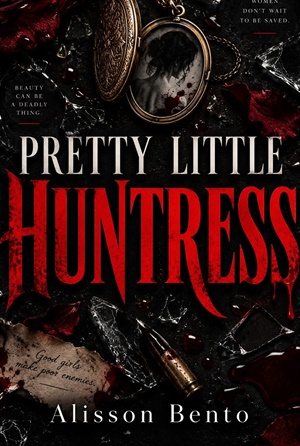
Pretty Little Huntress (The Silent Protectors #13)
Chapter 1 — The Girl in Gold
◆
My left hand held a champagne coupe I had no intention of drinking, my right hand held nothing at all, and the ballroom smelled of spilled champagne and hothouse lilies with clove smoke threading underneath.
The string quartet played something bright and forgettable near the donor wall.
Ice scoops clinked, valet whistles cut through from the front drive, and three hundred donors laughed too loud under chandelier glare that turned every sequin into a small argument.
I smiled like I belonged on page three of the program.
Perception first: Peter Lang nursed one drink by the ice buckets, twenty feet from me, shoulders turned half away from the room.
Meaning second: he did not want to be approached, which made him easy to approach, because every man who does not want to be approached at a charity gala stands in the same spot and watches the same door.
My pulse ticked once against the cornflower-blue silk ribbon tied on my right wrist under my cuff.
I decided: work the line, not him. Action: I turned my smile up two degrees and let the room come to me.
The ribbon stayed flat under my bracelet.
My sister Lark's ribbon, washed thin after twelve years, knotted twice so it would not slip.
The vintage gold locket sat warm at my throat where it always sat, thumb-smoothed from twelve years of touching it when I lied.
My champagne clutch hung in my left hand, small and stupid and perfect, holding a burner phone and a decoy valet ticket and nothing else.
The mother-of-pearl stiletto rode high in its sheath against my right thigh, taped and quiet, six inches of manners I never had to use in public.
Easy, fox girl. Donor smile. Teeth later.
Twelve years ago I came home from boarding school to ash and three fresh graves cut in a row. I still smell charred pine when the wind turns wrong.
That was the whole history I allowed myself tonight. Two sentences, shut the drawer.
“There she is.”
Julian Corvine reached the donor line with both arms open like the night was his grandchild, silver mane combed back, three-piece suit cut within one millimeter of perfect.
Sixty-three years old and he moved like kindness had good tailoring.
The crowd parted four feet for him without being asked.
I watched his right cuff as he came in, the way I always watched it, and there it was: oxblood ink staining his right cuff in a thin half-moon arc, fresh enough to catch the light.
What I saw: the stain, the open arms, the two hundred witnesses.
The read: godfather performance, live in three seconds.
My stomach pulled tight and low. I decided: play the poster orphan, take the touch where everyone could see it, bank the goodwill for the ten minutes I would need unobserved.
Action: I stepped forward and offered my wrist like a girl who had never learned better.
He squeezed my wrist and called me my girl.
His fingers closed over the ribbon and the bones beneath, warm and dry and one second too long, and the ballroom noise dropped to a hum under my skin.
My breath hitched high in my throat. My right knee locked.
My smile did not move, because my smile had been practicing this since I was fourteen and he gripped this same wrist at the funeral until it bruised and told me to cry quietly.
Count the teeth in the room, Wren. One. Two. Two hundred.
I laughed, bright enough to carry to the next donor over, and slid my wrist out with a practiced turn that looked like affection. “You always find me by the ice, godfather. Are you tracking my champagne?”
“Someone must keep you honest.” He tapped my locket with one knuckle, gentle as a priest, and the metal clicked once against my sternum. He smelled of cigar smoke and leather and something chemical-sweet I filed away without a name. “You look like your mother tonight. Stay where I can see you.”
It was a leash dressed as a compliment. I nodded like it was a blessing.
He moved on down the patron line with a hand raised to three men whose names I memorized and did not say. I exhaled through my nose, counted five heartbeats, and rolled my right wrist once under the cuff to check the ribbon knot. Still tied. Still mine.
Ophelia Yates saved me before the shake could reach my hands.
She cut across the donor line in six-inch heels like a shark through koi, shaved-side black bob gleaming, moth tattoo flexing across her throat as she turned her head.
Twenty-nine years old, owner of the Opal Room, holder of every alibi I had used in eighteen months.
She smelled of clove cigarettes and vanilla fog even through the lilies, and when she saw my face she did not ask a single question.
“Baby bat.” She kissed both my cheeks, loud, leaving me her noise to hide inside. “You are standing in the thirstiest corner of Chicago. Come here, I need you to tell this man his tie is a crime before he donates another dime.”
She towed me four steps sideways by the elbow, directly into Peter Lang's orbit by the ice buckets, and I loved her with a focus so sharp it hurt.
Lang was forty-one, soft around the collar, a print-shop owner who printed other men's lies and kept one set of keys too many on a brass fob.
He held his single whiskey with both hands like a steering wheel.
Up close his breath was sour with mints over liquor, and his eyes kept dropping to my slit and dragging back up like a bad valet parking job.
What I saw: his left hip, where the brass key fob tented his jacket pocket, two inches of teeth showing.
The read: he had driven himself tonight, parked east, valet ticket still in his pocket and not yet handed off, which meant the fob was live and liftable for exactly eleven more minutes.
My fingertips went cold, then warm. I decided: take it now while Ophelia held his eyes.
Action: I laughed at nothing and stepped into his space with my clutch open one inch.
Ophelia did the work like a professional. “Peter. You remember my best girl. Tell her about the new press before she dies of rich people.”
“I — yes, the Heidelberg, six colors, it does eleven by seventeen —” He turned his shoulders to her, chest opening, left hip swinging six inches closer to my hanging right hand.
The quartet swelled. Somebody dropped a coupe two tables over and the whole donor line turned their heads for one full second toward the crash.
One second was plenty.
I palmed the brass fob off his hip with my right hand while my left hand tipped my champagne coupe toward his sleeve in a small, forgiving arc.
Cold drops hit his cuff. He flinched toward the spill.
My fingers closed, lifted, transferred. The fob slid into my champagne clutch beside the burner phone with a soft tick no louder than a lipstick cap, and my decoy valet ticket slid out of my palm into the condensation ring on the ice bucket rim in the same motion.
Ten seconds of small talk about paper stock. My heart counted eleven beats and settled.
Fox takes the keys. Doe keeps smiling.
Lang patted his pocket once, found paper where brass should have been, frowned, then decided the champagne on his cuff mattered more.
He excused himself toward the restrooms with his one drink sweating in his hand.
He would find the decoy ticket later and assume a valet mix-up.
He would drive home clean tonight with his driver, because his driver was already texting him from the east bay, and I would keep his brass for the print shop another night.
That was the plan. That had always been the plan.
Then I made the costly choice.
What I saw: the fob warm in my clutch, the night still young at 10:18 p.m., Ophelia's eyes flicking once toward stairwell B.
The read: Lang was done for tonight but the east garage was already in play, forty yards down one flight, empty except valets and rain, and I was wired too tight to go home with clean hands.
My jaw ached from smiling. My right thigh felt the sheath with every breath like a second pulse.
I decided: walk the garage, test the dark, see who followed the girl in gold when she left alone.
Action: I finished the coupe, set my smile down a notch, and told Ophelia I needed air.
“East or west?” she murmured, relighting nothing, just watching my face.
“East. If I am not back in twenty minutes, call the burner, not the cops.”
“Twenty minutes.” She squeezed my elbow once, hard. “Baby bat, be choosy about which shadow you bite.”
I left through the valet hall on foot, heels loud on marble, then quieter on the rubber runner, then loud again on concrete.
Stairwell B dropped one flight, twelve steps, handrail cold under my palm.
The sound changed the way it always changes: strings thinning to a chain rattle, ice scoops giving way to tire hum and traffic off Lake Shore, my own heels marking each surface change like a metronome.
The smell changed faster. Champagne and lilies cut out at the landing.
Concrete and exhaust and rain cut in, cold and honest, 48 degrees breathing through the open east bays.
Forty yards of ramp. Sodium fluorescent buzzing over empty bays. A black Escalade idling near the valet stand, wipers beating once every nine seconds. Lang's sedan pulling out clean with his driver at the wheel, fob irrelevant now, taillights washing the puddles red and gone.
There goes chapter six, driving away sober. Patience, hunter.
I crossed toward the east stair door with the brass fob ticking faintly against the burner in my clutch, counting pillars.
Five bays. Three cameras, two angled at the cashier cage, one dead since August with a cobweb in its housing.
I knew because I had counted them twice in daylight wearing sunglasses and a different walk.
Footsteps behind me counted wrong.