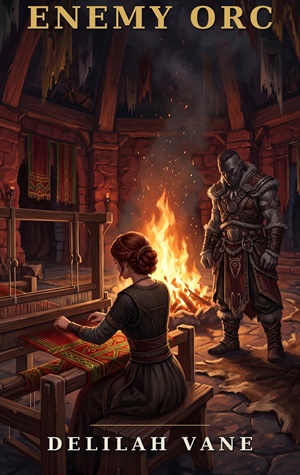
Promised to the Enemy Orc (Orc Warlord Brides #6)
Warp
I was at my loom when the enemy came to Deepford, and I finished the row before I looked up. I want that understood about me from the first pick: I finished the row.
They came up the east road in the rain, under a peace-branch, eleven riders of Clan Morda with their weapons cased and their banners furled, and at their head, on a horse the color of wet slate, the young chief himself.
Ulmar. The one who had deposed what was left of Ghazan’s faction and spent three years hunting his own clan’s broken men through the passes.
The clan whose renegades had come down on the supply road two winters back and killed nine of ours and one of the mountain’s.
My husband had been one of the nine.
I stood in the moot-hall doorway with the rain loud on the square and watched the chief of Clan Morda dismount, unarmed, bareheaded, thirty-five years old and carrying it like a man who had spent every one of them paying for something, and I felt — and I will set it down exactly, because the whole cloth depends on the first thread being true; there is the first of my ration spent already — a coal.
Somewhere low and long-banked and unasked-for: an ember, turning over in ash I had swept and swept and believed cold.
Grief is very simple until it isn’t. I hated him on sight, and I could not stop looking, and neither of those stopped being true for a long while, and nobody warns you the two can run on the same warp.
He asked the village for water and a hearing, in that order.
And in the moot hall of Deepford, dripping, formal as a treaty page, the enemy chief said the thing he had ridden two days to say.
His clan and the mountain had signed peace three years ago; his hunters had broken the last of Ghazan’s renegades that winter; the feud, on paper, was over.
“But paper,” said Ulmar of Clan Morda, “does not sit at a fire. Paper is not owed faces. Your dead and mine cannot read it.” He looked around the hall, slow, taking the weight of every eye.
And finding mine, and stopping, one breath longer than a stranger stops.
“The old custom is older than the feud. A bride, freely willing, from the wronged villages, honored at Morda’s fire for all to see.
Not a hostage. Not a payment. A living clause.
Proof at every meal, in every season, that the feud is done — proof my own hard-hearted cannot burn without burning their chief’s own hearth.
I ask it. I do not expect it. If no woman of these villages can stomach a Morda fire, that too is an answer, and I will carry it home and live with it. ”
The hall was quiet the way a village is quiet when it wants very much to look at one particular widow and is trying not to.
I’d like to say I decided at the loom, or in the night, after long wrestling.
The truth is faster and stranger. A feud is not mended.
I knew it the way I know cloth: mended cloth always shows the join, and a feud you have to weave new, pick over pick, on a warp both sides can bear.
Somebody’s hands had to go through the shed first. And I stood in the doorway of that hall, a weaver of thirty, two winters widowed, my whole life a finished bolt nobody was ever going to unroll again.
And I heard the shed open. That is the only way I have ever been able to say it.
The warp lifted, the way opened, clean through the middle of everything, and a shuttle goes now or it does not go.
“I am willing,” I said.
The hall turned. The rain went on. And the enemy chief looked at me across our moot hall — the widow of the supply road, they would have told him already, they had certainly told him already — and something crossed his face that was not triumph and was not relief.
It was cost. He was counting what this would cost me.
I watched him do the sum and reach the total and hold it, the whole cost of my life laid out in an enemy’s face, and it was the first thing about Ulmar of Clan Morda that I could not make sit still in the word enemy.
“Widow Holt,” he said. Nobody had given him my name. He had learned the dead’s families before he rode. “The custom asks freely. You owe this feud less than any soul in these valleys, and I will not have grief mistaken for consent.”
The village elders were rustling toward speech. My sister-in-law was already weeping. And I stood in my doorway and answered the chief of Clan Morda in front of all of Deepford, in the diction of my own trade, the way you state a pattern before you commit the warp.
“Two winters ago your broken men cut nine picks out of my cloth,” I said.
“You did not do it, and hanging the last of them did not put one pick back. I am not going to your fire as grief, chief of Morda. I am going as a weaver. Somebody has to make the new cloth, and I am the best in these valleys, and I have looked at the warp you are offering—” I looked at him, and made myself say it true “—and it will bear.”
They tell me it rained for a week after. I remember sun. Memory is a loom like any other; it weaves what the weaver needs.
I had one month to settle my affairs. I spent it at the loom, finishing what was on it, because you do not leave a warp standing, and on the last night my sister-in-law asked me, red-eyed, over the packed chests, the question the whole village had been weaving around me for a month: how can you sleep under the roof that sheltered the men who killed him?
“The roof didn’t shelter them,” I said. “The roof hunted them down.” And then, because she deserved better than cleverness, and because it was the last true thing I said in Deepford: “Corin is two winters dead, Ressa, and I have mourned him the way they told me to and it has not moved me a hand’s width.
I am going to go do the thing only I can do, in the one place it can be done.
If that’s grief wearing a bride’s cloak — then at least it’s walking somewhere. ”