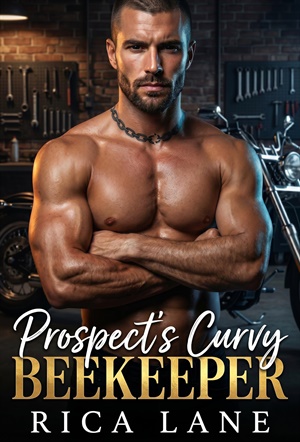
Prospect's Curvy Beekeeper (Broken Halos MC: The Prospects #5)
1. Susan
Susan
Burlap and dry pine needles catch fire inside the metal cylinder of the cold smoker.
The smell is sharp, acrid, and instantly familiar.
It cuts through the sweet scent of warm beeswax and raw clover honey that permeates every plank of the honey shed.
I pump the cracked leather bellows, coaxing the small flame until a plume of cool white smoke billows from the nozzle.
It’s five-thirty in the morning on the northern edge of Pine Valley. The sun hasn’t even crested the eastern mountain ridge yet. The air inside the single-room structure is freezing, biting through the white canvas of my beekeeping suit.
This room is my world. It was my grandfather's world before me.
My boots shift against the floorboards, scraping over old, hardened wax drippings.
The cast-iron uncapping tank sits in the corner, waiting.
The hand-cranked extractor rests beside rows of empty supers stacked halfway to the ceiling.
The single window above the workbench faces the jagged silhouette of the mountain ridge, currently painted in the bruised purple hues of pre-dawn.
Three years since a massive stroke took my grandfather right out of this shed.
He was gone within the month. My grandmother lasted one more year before the grief buried her too.
Two years I’ve held this farm alone—twelve acres of wild meadow, two hundred white wooden hive boxes, and a legacy I refuse to let die.
I grab the cold steel hive tool from the bench, gripping it in my canvas-gloved hand. The metal grounds me. It always does.
Stepping out of the shed, the high-altitude wind hits me like a physical wall.
It sweeps down from the northern peaks, bringing the scent of damp pine and cold earth.
I pull the mesh veil over my head, securing the zippers tight around my collar.
The world fractures into small, hexagonal grids through the pale netting.
The walk up the slight incline from the shed to the main hive line is a familiar march.
My thighs burn from the effort, boots sinking slightly into the dew-soaked clover.
The hum of two million bees vibrating in the dark is a sound you don't just process with your ears. It lives in your sternum. It rattles in your ribs. It’s the sound of a superorganism waking up, demanding to be tended, fed, and managed.
Managing them is easy. Managing the rest of the world is the problem.
My jaw tightens as I glance toward the southern edge of the property. The line of old-growth pines marks the boundary. Wrapped around three of the trunks, stark and glaring even in the dim light, is neon orange surveyor’s tape.
The markers are back.
The men from Crimson Hollow—the Silver Serpent Syndicate, according to the hushed, terrified whispers around town—are using my southern trail as a highway.
They run their dark SUVs and unmarked trucks through my trees under the cover of night, bypassing the main county roads.
It’s a strategic chokepoint into Pine Valley, and I hold the deed to it.
I pull their tape down every Tuesday. They put it back up every single Thursday.
It’s a silent, escalating war of attrition, and I’m fighting it alone.
Asking for help feels like waving a white flag. It feels like losing. I don’t lose.
But the pressure is cracking the foundation.
Christie down at the Cozy Cup offered me a free cinnamon-roast coffee yesterday because she said the bags under my eyes looked like bruised plums. I almost accepted it, just to smell the roasted beans and warm cinnamon of the café, but I had too much work to do.
Then, the real blow landed. Mrs. Gable caught me on the steps of the post office, clutching her cardigan against the mountain chill, her Saint Bernard sitting at her side.
Your mail-order queens never made it, Susan, she told me, her voice hushed, eyes darting toward the street. Intercepted at the county-line sorting station again. Three weeks running. Someone is signing for them, and it isn't me.
I know who is intercepting my shipments. The same men marking my trees. They want to starve the farm. They want to choke my colonies, kill my queens, and force me to sell the land so they can own the trail outright.
I turn my back on the southern tree line, marching purposefully toward the first row of white boxes. "Not happening," I mutter out loud, the canvas of my suit rustling loudly in the quiet morning. "You want this land, you're going to have to bury me under it."
I stop at Colony D.
Every beekeeper has a problem child. Colony D is mine. They’re Russian hybrids, wildly aggressive, highly productive, and intolerant of mistakes. They don’t give warnings. They just attack.
I give the entrance a healthy puff of cool pine smoke from the nozzle.
The thick white cloud rolls over the wooden landing board.
The guard bees immediately retreat inside, triggering the panic response that forces them to gorge on honey and calm down.
I wait thirty seconds. Precision matters with Colony D.
I wedge the flat end of the steel hive tool under the outer cover, prying it up. The propolis—the sticky bee glue they use to seal the cracks—snaps with a loud, sharp crack.
The vibration inside the box instantly changes. The low, steady hum spikes into a high-pitched, furious whine. They don’t like the cold air rushing in. They don’t like the light.
Before I can lift the inner cover, a sound shatters the morning quiet.
It’s a low, guttural rumble. The mechanical churning of a V-twin engine.
I freeze, my gloved hand still holding the edge of the wooden lid. The sound grows louder, vibrating through the soles of my boots. A vehicle is coming up my long, rutted dirt driveway. Not a post office truck. Not a delivery van. A motorcycle.
The engine cuts off abruptly near the main farmhouse, about fifty yards up the slope from where I stand. The silence that follows is dense with tension.
I turn my head, peering through the mesh of my veil.
A man steps out from the shadow of the farmhouse porch, walking down the slope toward the meadow.
The first thing that registers is his sheer size.
He’s massive. A towering wall of muscle and dark denim.
The second thing is the lack of protective gear.
He wears black boots, worn dark jeans, a plain black t-shirt, and a leather vest. The rocker across the back of the cut is visible as he turns slightly to navigate the uneven terrain.
PROSPECT.
Broken Halos MC. The local one-percenter club situated three miles north of here.
The reinforced iron gates, the razor wire, the lethal reputation.
Everyone in Pine Valley knows about the club.
We leave them alone; they leave us alone.
Except, lately, the whispers say the club is gearing up for a bloodbath with the Crimson Hollow Syndicate.
And now one of their unpatched members is walking through my wild clover, heading straight for the hive line.
He gets closer, and the details snap into sharp, brutal focus.
His arms are bare, corded with muscle and dark ink.
His skin is crisscrossed with faded scars.
His face looks like it was chiseled out of granite by someone angry at the stone.
Sharp jaw, broken nose, flat black eyes that don't reflect light.
They scan the meadow with cold calculation.
He radiates an unhinged energy. A man with a lit fuse and no off-switch.
He’s walking into the flight path of two million highly agitated insects.
"Hey!" I shout, my voice muffled slightly by the mesh veil. I wave the steel hive tool in the air. "Stop right there! You're in the flight path! Back away from the boxes!"
He doesn't stop. He doesn't even break his stride.
He keeps walking, his boots crushing the clover, his flat black eyes locking onto me.
Panic spikes hot and sharp behind my ribs.
He’s a walking target. Bees are highly sensitive to carbon dioxide, to erratic movement, to adrenaline, and to the color black.
He’s wearing a black shirt and a leather vest, marching right up to a colony of aggressive Russian hybrids that I just tore the roof off of.
He’s going to get lit up. Hundreds of stings.
Anaphylactic shock. A dead biker in my clover field.
"I said stop!" I yell louder, abandoning the hive and stomping toward him. "Are you deaf? They’re going to swarm you!"
He ignores me completely. He steps right up to the row of white wooden boxes, stopping barely two feet from the entrance of Colony D.
I brace myself. I grip the hive tool, fully preparing to drop it, grab this idiot by his leather vest, drag his three-hundred-pound frame all the way down to the honey shed, and stab him in the thigh with the emergency EpiPen I keep in the first-aid kit.
The guard bees surge out of the entrance of Colony D. A dark, furious cloud of venom and wings.
They hit him.
But they don't sting.
I stop dead in my tracks, my boots sinking into the damp earth. The breath leaves my lungs in a sharp, stunned rush.
The bees swirl around him. They drift toward his bare, tattooed forearms. Dozens land on his skin. They crawl over the dark ink, navigating the veins of his wrists, settling on his knuckles.
He doesn't swat them. He doesn't flinch. He doesn't take a sharp breath. He doesn't move a single muscle.
He stands there, terrifyingly still. The rage radiating off him is internal.
Physically, he’s a statue. He’s a mountain.
The bees read the stillness, the absence of elevated carbon dioxide from panic, the lack of fear, and they accept him.
They land on his bare hands like he’s just another wooden lid. Like he belongs here.
I stare at him, baffled. In my thirty years on this earth, twenty of them spent working these hives alongside my grandfather, I’ve never seen a colony of Russian hybrids swarm an unprotected, black-clad stranger and simply... accept him.