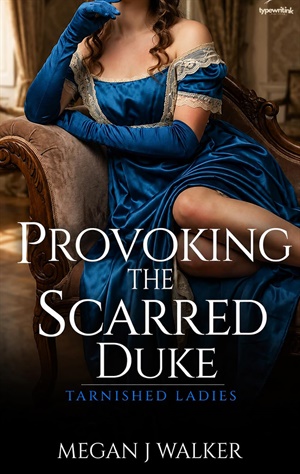
Provoking the Scarred Duke (Tarnished Ladies #2)
Chapter One
“Whoever shelved this room ought to be put on trial for it, Mrs Marlowe.”
The housekeeper stopped at the threshold with a tea tray in both hands. “I shall pass the indictment to His Grace, miss, though I cannot promise he will read it.”
“He need not read it. He should only look at it.” Giselle turned the volume so the older woman could see the spine.
“This is an estate ledger from the year nine. It has been bound between a book of sermons and a treatise on falconry, which is a crime, and a letter has been tucked inside it, which is a worse one.”
“What sort of letter?”
“The sort with a court seal half-melted into the wax, as though someone had read it by candlelight and then thought better of having done so.” She eased the page free with two fingers, careful not to disturb the brittle edges.
“I shall forgive the forgetting. Forgetting is, at least, honest, but the shelving is malice, and that is a hanging offence.”
“You ought to mind your tongue about the shelving.” Mrs Marlowe set the tray down without quite letting go of it. “The late duke arranged most of this room with his own hands, and the present one has not the patience to undo what the grief of it cost him.”
“Then the present duke has engaged the right woman, for I have patience for nothing else.” Giselle weighted the letter beneath a paperknife.
“Three months. A catalogue, a clean index, and every document restored to its rightful century. I shall be quiet about a great many things in that time, but the falconry will not be one of them.”
“You are a strange sort of scholar, miss, if you will pardon me.”
“I will pardon you. I have been called far worse by men with far better manners and far less cause.” She reached for her quill pen. “What sort had you expected?”
“A timid one with a great deal of squinting and very little judgement. His Grace’s last man of letters fainted clean away when the duke came in without his coat.”
“Then his last man of letters had never read by candlelight, which is the only honest occasion to faint over a duke.” She uncapped the inkwell with the side of her thumb. “I shall try to remain upright. Send word if His Grace intends to remove his coat, and I shall sit down first, as a precaution.”
The housekeeper’s mouth twitched against her will. A footman came quietly to her elbow and murmured something of the kitchens, a delivery of some kind, and the ordinary business of a great house. She answered him in an undertone.
“I shall send Annie up to sit with you, miss.”
“You need not trouble Annie. I keep better company with the dead than the living, and the dead require no chaperone.”
“It is not the dead I worry over.”
“Then worry over the duke, who is the only living person in this house likely to surprise me, and send Annie to guard him instead.” Giselle bent to her page.
“Books are honest witnesses, Mrs Marlowe. They have never once contradicted my catalogue. I cannot say the same for any man who has ever paid me.”
“He does not take a guard, miss. Not since he came home the way he came home.”
“And how was that?”
“With more scars than he left with, fewer friends, and a temper that sends the upstairs maids to the landing when his study door is shut.” Mrs Marlowe lifted the tray at last. “You will make his acquaintance soon enough. I only ask that you do not provoke it before I have got the tea things out of the way.”
“I shall endeavour to provoke nothing until the china is safe, but after that I make no promises at all.”
The door to the passage closed behind her.
The room settled once more into the profound quiet of a house built with thick walls, the air redolent of leather, dust, and the faint sweetness of beeswax long worked into old wood.
The accounts proceeded in good order as far as the ninth year.
Beyond that, the centuries lay in hopeless confusion, as though some hand had contrived to leave them so.
Far down the room, where the shelving turned towards a second door standing half in shadow against the gallery, the old house made one of its small sounds, a hinge easing, a board taking weight and giving it back. She put it down to settling timber and went on with the letter.
She drew the letter to the window light. The seal had been pressed by a man who expected obedience without signing his name, and the hand beneath it spoke of discretion and of a matter best left in the ground.
The cooler air reached her first, a draught that had no business in a closed room, and behind it the certainty of being watched.
Her pulse jumped once. She put it down before it could reach her face, because a woman alone learned early that a man who startled you and was rewarded with a flinch would only arrange to do it again.
“You have misfiled treason, Your Grace.”
He stood three paces off, near the gallery door, one shoulder to a shelf.
He had been there long enough to take in her hands, her posture, the letter held up to the light.
A scar ran pale from the corner of his jaw beneath an open collar, and another marked the back of the hand hooked into his waistcoat pocket. He had troubled to hide neither.
“I have misfiled a great many things,” he said. “You will have to be specific.”
“A court matter, sealed, instructing some unnamed party that a question is to stay buried. Inside an estate ledger, between sermons and falconry.” She lifted it without crossing to him. “Either you hid it badly, or someone hid it for you and trusted you would never tidy the shelf.”
“And if I said it belongs in the fire?”
“I would say I do not burn documents. And that a man who keeps a thing seventeen years and reads it by candlelight does not want it burned, whatever he tells the woman holding it.”
“You presume a great deal about a man you met four sentences ago.”
“I presume nothing. I read the seal, the wax, and the worn fold where a thumb has opened it too many times.” She set it back beneath the knife, flat and unhurried.
“Dismiss me for the impertinence whenever you like, Your Grace. The shelving will still be a disgrace in the morning, and you will still have read me correctly, which is that I am right.”
The corner of his mouth moved without becoming a smile. “You scold a duke in his own house and expect me to apologise for the filing.”
“I expect nothing from a duke. I have catalogued the libraries of four of them and learned that low expectations are the only kind they reliably meet.”
“You are bitter for a woman of your years.”
“I am accurate for a woman of any. The two are often mistaken for one another by men who have never been disappointed.” She nodded at the door. “His Grace of Calder, I take it, since the footmen go pale at the name and you walk through a locked house without troubling to be announced.”
“The footmen exaggerate.”
“The footmen are paid to. It is half their wages and the better half of their conversation.” She set down the pen.
“You hold a low opinion of footmen.”
“I hold an accurate opinion of everyone in a great house but the books. The books cannot lie to me, which is the whole reason I prefer their society and very nearly the whole reason I am never asked to dine.” She nodded at the door again.
“You have come to see whether the Strattons sold you a fraud. Produce the document, then. You have the look of a man who believes will humble me, and I would rather we got the humbling over before tea.”
He did not pretend to misunderstand. He drew a folio from beneath an unsorted heap and laid it open before her. The page was old; the hand crabbed, faded, and thick with a clerk’s contractions, the Latin worn pale where damp had found its way.
“Read it,” he said.
“You might say please. Men who say please get the truth a good deal faster, in my experience.”
“Read it, Miss Linfield.”
“That was not please, but it was at least my name.” She bent to the page and read without performing the reading, and at the foot, she set a fingertip to one line.
“A deed of conveyance. A parcel settled on a younger son in the reign before last, copied badly from a worse original. You knew that already, or you would not have brought it to a stranger.”
“That is all you find?”
“That is not nearly all, and you are holding your breath, which tells me you know it is not.” She moved her finger a fraction.
“Here. The date has been altered. The ink sits differently, the downstroke sharper. It seems like a newer pen and a steadier hand than the clerk ever owned. Someone wanted the grant to read older than it is.”
“A guess.”
“A reading. Call it a guess if it comforts you, but do not pay me for comfort. You cannot afford both that and the truth.” She straightened and held his gaze a beat longer than was comfortable.
“They were careful, Your Grace. They simply used a black that has not had its century to fade. Forty more years and no one would catch it. You have caught it early. I imagine that is the whole of your trouble, and I imagine it is not yours alone.”
“What do you imagine by that?”
“That a forged date on a dead man’s deed is seldom forged for the dead man’s benefit.
Someone living wanted the grant to read older.
You are not old enough to be that someone, which leaves you keeping another man’s lie.
” She watched him over the page. “And a man does not keep another man’s lie unless the lie can still reach out and bite him. ”
“You imagine a great deal from one altered down-stroke.”
“I imagine nothing you have not already confirmed by going so very still.” She let the silence sit a moment. “You need not say it aloud. Your quiet has excellent penmanship, and I read every hand in this room.”
For a moment he said nothing, and the clock counted out the silence in small brass increments.
“No one has found that in under a week,” he said.