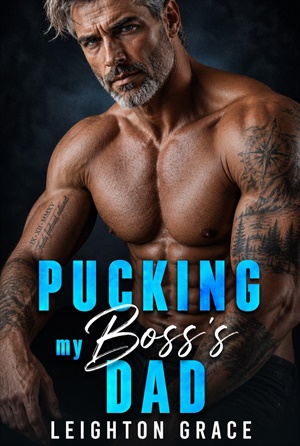
Pucking My Boss's Dad (Silver Fox Hockey #2)
1. Maren
Maren
There is a specific flavor of crazy that comes from arguing with a teleprompter at midnight, and I have achieved it.
The Crown Center at midnight is a different building than the one the public gets.
The public gets twenty thousand seats and a Jumbotron and a sound system that can rattle your sternum.
I get the bones of it, the dimmed concourse, the smell of floor wax and old beer the cleaning crews never quite kill, the hum of a refrigeration plant two levels down keeping a sheet of ice frozen for a team that won’t skate on it till morning.
I’ve been here since four in the afternoon.
My back knows it. My third coffee knows it.
The whole season I haven’t even started yet knows it.
My phone sits face-down by the cold coffee with two missed calls from my sister on it, both from hours ago, both of which I’ll return tomorrow with a guilt-flavored voicemail.
Everybody else went home at six, the comms team, the events crew, the kid from digital who actually likes me, gone into the regular-people night while I stayed, because I’m the one who stays.
The version of me that goes home before the work is perfect has never once existed, and somewhere around thirty I stopped waiting for her to show up.
“‘I’m honored to return to the organization that gave me everything,’” I read off the screen, out loud, to nobody.
The empty press room swallows it. Forty folding chairs, all facing me, all empty, and a backdrop the size of a garage door with the Crowns crest repeated on it eleven times.
I counted. That’s how the night is going.
The line is good. The line is fine. It’s warm, it’s humble, it tests well with the over-fifty season-ticket crowd who cried when this man retired five years ago.
The only problem with the line is that I have never heard the man it belongs to say a single word, and in twelve hours I have to put it in his mouth on live television.
That’s the part nobody warns you about in this job.
You build a person out of a press kit. You write words for a mouth you’ve never watched move.
Tomorrow at ten I unveil the most important hire this franchise has made in a decade, in front of every camera in the city, and the entire narrative of a man’s comeback, and, not that anyone’s saying it out loud, the entire next year of my career, rides on whether the words I’m typing at midnight sound like something a legend would actually say.
I came to Chicago eight months ago to prove I could run comms for a major franchise without a net.
This is the net being removed. I wanted that.
I have to keep reminding myself I wanted that.
I scroll up. I scroll back down. The cursor blinks at me as if it has opinions.
“Okay,” I tell it. “You’re right. The second paragraph is doing too much.”
Behind me, somebody says, “You always talk to the furniture, or is tonight special?”
I do not scream. This is important to me later, that I did not scream, because the building is supposed to be empty and locked and mine until five a.m., and the voice came from the back of the room in the dark.
When I turn around, there’s a man leaning in the doorway with his hands in his pockets like the doorway belongs to him.
He’s older. Not old, just older, in the way that makes a woman’s brain stop and reread the sentence.
Silver at the temples, gray coming in through the rest of it like he’s deciding whether to allow it.
A jaw you could check coats at. He's wearing a soft, worn-in Henley that has clearly never once tried to impress anyone, which is somehow more dangerous than if it had.
He looks like he wandered out of a whiskey ad and got lost looking for the exit.
There’s a flicker of something, like I should know him.
I don’t chase it. I’ve been in Chicago eight months, I took this job to run comms, not because I can name a single person who’s worn the sweater, and the org’s kept tomorrow’s hire locked down so tight I’ve been building a two-week rollout around a name and an embargo.
Whoever this guy is, he’s not on my call sheet, and that’s all he needs to be.
“This area’s closed,” I say, in my professional voice, the one that has gotten drunk donors out of VIP suites. “Press access is tomorrow at ten. If you’re media, I can get you credentialed in the morning, but tonight you can’t be back here.”
“I’m not media.”
“Then you really can’t be back here.”
He pushes off the doorframe and comes in anyway.
Of course he does. He walks the way certain men walk when they have spent their whole lives being the most important person in every room they enter and have stopped noticing.
There’s a hitch to it, too, barely there, a half-second longer on the left leg coming down, a thing you’d miss if noticing things weren’t the entire job.
Up the center aisle he comes, past my forty empty chairs, right up to the little staging table where I’ve got my laptop and my binder and my third coffee going cold in a paper cup.
He stops. He reads my screen upside down.
“‘Honored to return to the organization that gave me everything,’” he says. He says it flat. He says it the way you’d read a parking sign. “Nobody’s saying that.”
“Somebody is saying that, actually. Tomorrow. At ten.”
“Not those words.”
“They’re good words.” I close the laptop halfway.
“They’re focus-grouped words. People who have given this team money for thirty years are going to hear them and feel something, and feeling something is what gets a fan base behind a coaching hire that the sports radio guys are already calling a nostalgia stunt. ”
That lands somewhere. I watch it land. His mouth does a thing that isn’t a smile.
“A nostalgia stunt,” he repeats.
“I’m quoting. The ‘B’ block of the four o’clock show, if you want to go home and hate-listen.” I fold my arms. “Who are you?”
He doesn’t answer that. He picks up my binder instead, my binder, the one with the tabs, the one that took me two weeks to put together, and flips it open to the talking points, and I have to physically not snatch it back like a raccoon.
“This,” he says, turning a page, “is a man apologizing for existing.”
“That’s a man being gracious.”
“It’s the same thing when you do it in front of cameras.
” He sets the binder down, open, to a page I did not give him permission to open to.
“You’ve got him thanking ownership in the first thirty seconds.
Then thanking the city. Then thanking the players he hasn’t met.
You know what nobody thanks? A winner. Winners don’t lead with gratitude.
They lead with the thing they came to do. ”
I open my mouth. He keeps going.
“By the time your guy gets to anything that sounds like he believes the team’s going to be good, he’s already spent two minutes being humble, and the room’s decided he’s here to wave from the bench and sell jerseys.
” He taps the table once. “You wrote him a retirement speech. He hasn’t retired.
He un-retired. There’s a difference, and your whole rollout missed it. ”
The thing is, and I will be annoyed about this for approximately the rest of my life, the thing is that he’s a little bit right.
Not all the way right. The gratitude beats are doing real work; you don’t win back a skeptical base by swaggering.
But the bones of it, the un-retired-not-retired thing, the lead-with-the-thing-you-came-to-do thing.
There’s a version of tomorrow that’s sharper than the one in my binder, and I heard it ten seconds ago from a stranger who broke into my press room.
I’ve sat in pitch meetings with men paid four hundred dollars an hour to be this useful and walked out with less.
I am not going to tell him that.
“Okay,” I say. “Two questions. One. Who are you. Two. How did you get past a locked loading door, because that’s a real problem I’m going to have to write up either way.”
“The door wasn’t locked.”
“It’s always locked.”
“It wasn’t tonight.” He shrugs. “I’ve been coming in this building since before you could drive. I know where they hide things.”
He’s looking at me now in a way that’s switched tracks.
Not at the binder, not at the backdrop. At me.
Attention with a temperature to it. I’m in the leggings and the giant Crowns hoodie I wear for solo midnight builds, my hair’s in the claw clip that’s losing the will to live, there is mascara somewhere south of where mascara is supposed to be, and there is absolutely no reason for a man to look at me like he’s recalculating something.
It’s been a long time since anybody looked at me like the project and not the person running it. I don’t trust how much I notice.
“You wrote all this yourself,” he says. Not a question.
“I did.”
“It’s wrong, but it’s good.” He pauses. “That’s rarer than you’d think.”
“Wow.” I press a hand to my chest. “I’m going to get that tattooed. ‘Wrong, but good.’ My mother will be so proud.”
And he laughs.
It surprises both of us, I think. It’s not a big laugh.
It’s low and a little rusty, like a muscle he hasn’t used in a while, and it changes his entire face for exactly one second, and one second is enough to be a problem.
Because when a man like this laughs at something you said, the floor tilts about four degrees, and you have to widen your stance.
“There she is,” he says.
“There who is?”
“The person who wrote the good half.” He steps around the table.
Not far. Just enough that I have to either back up or hold my ground, and I am not, on principle, a backing-up person, so now we’re close.
Close enough that I can see his eyes aren’t just gray, they’ve got something warmer running through them, and close enough to get the actual smell of him, which is cold air and clean soap and nothing categorical, nothing I could put in a sentence, just him, unfairly.
Neither of us says anything for a second. The teleprompter blinks. Somewhere in the building a Zamboni machine hums and shuts off, and the quiet it leaves behind is enormous, and we’re standing in the middle of it like two people who forgot there was supposed to be noise.
“You should fix the opening,” he says, quieter now. “Before ten.”
“I know how to fix the opening.”
“I know you do.” His gaze drops, once, to my mouth, and comes back up, and he doesn’t apologize for it, and the four degrees becomes maybe nine. “That’s the annoying part.”
There’s a version of my life where I lean in.
I can feel the whole shape of it, hanging right there in the recycled air, close enough to step into.
He’s not going to close the distance, I can tell that much, he’s a man who makes you decide, and that’s somehow the thing that makes it hard, the choosing.
A man who takes the choice out of your hands you can resent on the drive home.
A man who hands it back to you, who stands close enough to wreck you and then makes you do the wrecking yourself, that one you think about in the shower for a week.
So I don’t lean in. I take a half-step back instead, and he apparently doesn’t mind, which is a bit insulting.
“You need to go,” I say. “For real. I’ve got a man to make sound humble by ten a.m. and I can’t do it with an audience.”
He looks at me a beat longer than is strictly polite. Then he straightens, hands back in his pockets, and starts up the center aisle the way he came, unhurried, like the building’s his and he’s just letting the rest of us borrow it.
“Fix the open,” he says over his shoulder. “The second paragraph’s still doing too much.”
“I liked the second paragraph.”
“I know. That’s the problem with it.”
At the door he stops, and for a second I think he’s going to do the expected thing, ask my name, give me his, turn this into whatever it’s so clearly trying to become.
He doesn’t. He just nods once, like we’ve concluded some piece of business I didn’t know we were transacting, and then he’s gone, and the door sighs shut behind him.
The press room is enormous and empty again. Forty chairs. A teleprompter blinking at me. And the strange fact that I never got his name, and he never asked mine, and I’m standing here anyway with my heart doing something that I’ll blame on the coffee.
I sit back down. I fix the opening. I cut the second paragraph in half, and I hate that it’s better, and I hate more that he’s the reason. Then I tell myself, I’ll never see the rude, beautiful stranger again.