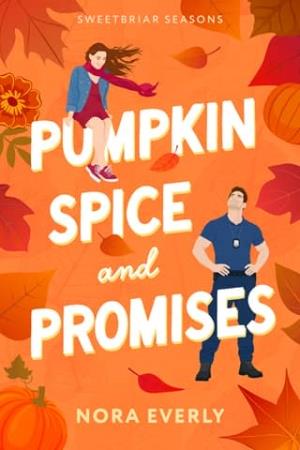
Pumpkin Spice and Promises
Prologue
Matt
The thing about weddings is that nobody watches the exits.
I did. Habit. I stood at the edge of the Barretts’ deck with a beer I’d been holding for an hour, and I knew the gate latch on the side yard stuck, which tables had candles burning closest to the paper decorations, and that the kid in the navy vest had taken exactly four cookies off the dessert table when his mother wasn’t looking and was working up the courage for a fifth.
Enough years on the job did that to a man.
You stopped seeing parties. You saw floor plans with people in them.
The pool glowed turquoise in the dark, string lights doubled on its surface in long wavering rows, little broken pieces of them scattering whenever the breeze touched the water.
Somebody had strung those lights over the whole of the Barretts’ backyard—deck to fence line, looped through the big maples—and below them a rented dance floor sat on the lawn, full of people.
Three hours ago and a few miles upriver, under a wildflower arch at the campground, I’d put my sister’s hand into Levi Barrett’s and stepped back.
Stepped back.
I’d been ready for the walk down the aisle.
I’d been ready for the vows, mostly, although I’d had to study the tree line over Levi’s shoulder for a stretch of them like the Douglas firs needed law enforcement supervision to keep from crying.
What I had not been ready for was the part that came after.
The part where it was done. Where Becca was married, and safe, and laughing on the dance floor with her husband’s enormous family, in the backyard of the house they’d all grown up in, surrounded on every side by people who loved her back, and there was not one single thing left in the world that she needed from me.
Years of checking the locks twice, walking her to her car, and keeping a folder in my head labeled Becca that never closed.
Through our parents being a polite voicemail recording of two people who really didn’t care.
Through her shitty ex, Travis. Through everything this past year that I still woke up some nights thinking about, my hand already reaching for the phone before I remembered it was over, we’d won, she was fine.
She was fine.
The case was closed, and I was standing at the edge of the party, realizing I had nothing in the world to do because her new husband would protect her with his life.
I drank some of the beer. It had gone warm. Of course.
Across the floor, Becca caught my eye over Levi’s shoulder and gave me a look I knew—you’re worrying about me—and I raised the beer at her in a way I hoped read as I am a man enjoying a party and not I have memorized the exits.
She narrowed her eyes. I’d never gotten anything past her in my life.
Then Levi spun her, and she laughed, and forgot all about me, which was exactly the way it was supposed to be, but it sat in my chest like a stone anyway.
“Okay, this is the saddest thing I’ve ever seen, and I once watched a man drop a fully loaded breakfast burrito in my parking lot.”
I knew the voice before I turned. Everyone in Sweetbriar knew the voice.
It was usually heard at the Stop it was honestly very cinematic. Dance with me, Matt.”
I considered saying no. I had a position to maintain. I had exits to watch. I had a warm beer, a glass of something sparkly, and a long-standing policy about parties, which was that I attended them the way I attended traffic court.
But she’d already set her glass down next to mine, and she was holding out her hand with one eyebrow up, and the lights were behind her, scrambling my brain as I focused on her pretty face, and I heard myself say, “One.”
“Sure,” she said, in the tone of a woman accepting terms she had no intention of honoring.
Her hand was warm. That was the first thing I learned on that dance floor—that Elizabeth Starling ran warm, like she had a furnace in her somewhere that the rest of us hadn’t been issued.
The top of her head came in somewhere south of my chin, and she had to reach to fit her other hand on my shoulder, which she did without ceremony, steering us into the slow current of couples like she’d done it a hundred times.
I put my hand at the curve of her waist, careful, the way I did everything, and made a professional decision not to think about how well it fit there.
“See?” she said. “This is called fun. I know it’s your first time. Breathe through it.”
“I’ve had fun before.”
“Name one time.” She was grinning up at me now, certain she had me, and the worst part was the wait while I tried to think of an example.
“There was a barbecue in 2019,” I finally sputtered, completely embarrassed. Why did I say that? Why couldn’t I ever know what to say to her?
She laughed—a big one, head tipped back, the whole thing. A couple of heads turned because Elizabeth’s laugh was a public event—and something happened in my chest that I categorized, filed, and decided never to examine.
We swayed to the music. The pool light wavered. The music was slow and sweet, and over her shoulder, I watched my sister dance with her husband, and for a minute I let the perimeter go unguarded and relaxed into the moment.
“She looks happy,” Elizabeth said. Quieter now. She’d followed my eyes. She did that, I was learning—clocked everything, the way I did, except she’d somehow figured out how to do it while also having a personality people enjoyed.
“She does.”
“You did that, you know.”
“Levi did that.”
“Levi loved her. You got her here.” She said it plainly, no jokes attached, which from her was practically a sworn statement.
“The whole town knows it, Matt. The patrol car parked at the campground all those nights you weren’t on shift.
You think nobody noticed, because noticing things is supposed to be your job.
But this town’s full of people who think you’re amazing. ”
I didn’t know what to do with that, so I did what I do, which was nothing, carefully.
Elizabeth leaned back enough to look at my face.
The lights moved over hers. Up close she had freckles I’d never noticed before—five of them, scattered across her nose as if someone had spilled them—and her eyes were green, properly green, the kind of detail a trained observer should have had on file years ago, and they were doing the register-tape thing again, adding me up.
“So here’s my question,” she said. “And as your self-appointed ambassador to fun tonight, I’m going to need an honest answer.”
“My what?”
“Becca’s settled. Case closed. All those years of big brother guard duty, honorably discharged.” She tilted her head. “So what does Matt Hartford want?”
The song kept going. The string lights kept rippling on the pool. Somewhere behind me, Jude Barrett was loudly losing an argument about cake to Harper, which, knowing both of them, he had probably started on purpose.
And I stood there in the middle of the dance floor, a grown man with a badge and a mortgage, and a little sister who needed him eighty percent less—and I could not answer the question.
Not wouldn’t. Couldn’t. I went looking for it the way I’d go through a house at night, room by room, and every door I opened was someone else’s.
Becca safe and happy. The town quiet. My neighbor’s cat out of the storm drain.
There was a whole floor plan in there, and not a single room with my name on it.
Elizabeth watched me not answer. I expected the joke—she always had one chambered—but it didn’t come. Something else moved across her face instead, something almost like recognition, there and gone before I could read it, like she’d opened a door in her own house once and found the same empty room.
The song ended. The last note faded over the backyard, out past the pool and the fence line into the dark.
She stepped back, and her hand left my shoulder, and the place where it had been registered the loss like a dropped signal.
“Well,” she said, and the brightness came back up like a shop light flicking on, “when you figure it out, Officer Hartford, you know where I am. Six to close, most days. We have excellent burritos, and I’m told the staff is hilarious.”
She meant it as a joke. That was the cover, anyway—the hours, the burritos, the easy grin she gave everybody.
But something underneath it snagged on the way past and pulled, and I caught it a half-second slow, the way you catch the sound of your own name in a crowded room after it’s already been said.
When you figure it out, you know where I am.
Not the store. Her. She was telling me where to find her.
I opened my mouth with a whole sentence loaded and ready—I couldn’t have told you what it was, only that it mattered—and what came out was, “Elizabeth.”
Just that. Her name, landed between us like I’d set something down without deciding to. I’d read the scene right, for once, read the one thing she was actually saying—and then stood there holding it with both hands and no idea where it went.
She was already two steps away, walking backward into the lights, the green dress and the gorgeous red hair and the smile she handed out to everybody, and just before she turned, she pointed at me the way she pointed at regulars who tried to pay with exact change from the bottom of a purse.
“You owe me another dance someday,” she called. “I’m putting it on your tab.”
Then she was gone, folded into the party, her laugh surfacing somewhere near the cake table thirty seconds later like a buoy marking where the warmth went.
I stood on the edge of the dance floor with two untouched glasses and a warm beer in custody, watching my sister dance in the middle of the life I’d helped her get, on the first night of mine that belonged to nobody.
I still didn’t have an answer. But for the first time in years, the question had a smell to it—apple cider and crushed leaves and something warm underneath, like cinnamon—and it was walking around a wedding in a dark green dress, already laughing at somebody else’s joke.
I picked up my beer. I checked the side gate on my way past. Old habits.
The question rode shotgun the whole way home, and it was still there when I let myself into my house—clean, quiet, every room squared away, the guest bed made up for a sister who had her own home. I stood in the hallway with my keys in my hand and listened to all that order say nothing back.
What does Matt Hartford want?
I didn’t have an answer.
And for the first time in longer than I could remember, I wanted one.