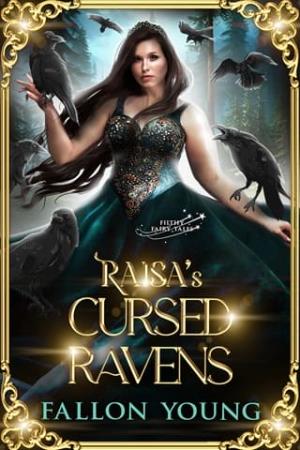
Raisa’s Cursed Ravens (Filthy Fairy-tales #2)
Chapter 1
A Gilded Cage
Raisa
Apetal falls from the rose, landing on the stone path at my feet. I kneel to pick it up, pressing my nose against the bloom to inhale its warm, honeyed scent. There’s a bite to the smell, like a secret waiting for someone to discover it.
There are a lot of those here, whispering from the darkest corners of the palace. One day, I intend to unravel them all, but I doubt that day is today.
Shadows already leak down from the castle’s towers in long, inky lines, slithering between the hedges and over the marble statuary.
Every corner drips with green, from the topiary serpents to the boxwood labyrinths, and on to the rose canopies arching just high enough to let in the dimming sky, but not so high that I forget the stone walls imprisoning me.
I never forget those. Most days, they’re my only companions, the oppressive weight marking the boundaries of my marble prison.
Father says they keep me safe. I think they keep me contained. The castle is supposed to be safe, my home. But after eighteen years, it feels a little more like a dungeon every day, isolating and cold.
The garden is the only place where I can breathe. The air shimmers with the promise of spring and the sharp tang of something else, fertilizer, maybe, or the memory of last night’s rain.
The soft, dichotic scents don’t ease the restlessness clawing at my soul.
These days, nothing does that.
I exist in a haze, forgotten by the outside world, crushed by the weight of duty. There is no escape, as much as I wish there were.
I make a circuit of the paths, counting each step even though I’ve already mapped every inch of the palace gardens.
One hundred and twenty paces from the door to the gate, if I follow the inner ring.
Three hundred, if I dare the outer edge, where the walls climb higher and the iron spikes at the top shimmer like metal teeth in the setting sun.
My slippers scuff the path with each step, the echo just loud enough to remind me that I’m alone, the forgotten ghost of a princess haunting the castle, alive but never seen.
I try to walk quietly, but there’s nothing for the sound of my steps to compete with. Not a gardener’s voice, not even the chatter of birds. Even the fountains in the lower court have been turned off for the evening, leaving a hush so complete it feels sacrilegious to interrupt it.
I want to scream anyway, just to be heard.
I reach the old sundial and collapse onto the stone bench instead, smoothing my skirt over my knees and letting my shoulders slump. My bones ache with the need to be somewhere else—anywhere else—but the garden is as far as I’ll ever go without supervision.
Father thinks I don’t know that the guards perched in the windows are there to watch me, but I feel their eyes on me, even when I pretend not to notice.
The only things allowed to come and go here are the birds. Even then, Father wishes they wouldn’t. He’d bar them from the grounds if he could. Especially the ravens.
As if summoned, a pair of them land on the sundial, their talons scraping the ancient brass. Eyes like polished onyx meet mine. One of them cocks its head to the left and then the right, the motion so sharp it looks like a glitch through the world.
The other lets out a soft croak, fluffing its neck feathers.
I try not to smile at the sound but fail miserably.
The ravens have been coming to see me for as long as I can remember.
The seven of them are my only friends in this place, my one joy in the world.
And unlike my father and his men, they listen without judgment.
They carry my secrets in silence, allowing some tiny piece of me to escape this place when they do each night.
“You’re late,” I whisper, drawing my feet up beneath me. “I was starting to think you’d found better company.”
The ravens ignore my sarcasm, like always, but I think I see the corner of one’s beak curl just a bit.
I named them when I was a child, but I never use those names out loud. They’re too precious, too private. Besides, naming things in Father’s house is forbidden unless you intend to keep them forever.
I’m not allowed to keep the ravens. Father hates them. Or perhaps it’s fear in his eyes when he sees them circling high above the gardens. I’ve never quite been able to tell for sure. All I know is that he’d kill them all if he could, leaving me well and truly alone in my golden prison.
The one time he caught me talking to them, he ordered his guards to shoot them all. I screamed in defiance, wishing they were human. My defiance landed in the silence like a bomb detonating, shocking him and the ravens both. It didn’t stop the arrow that pierced a wing, though.
It didn’t stop Father from locking me in the tower, either.
It did make the ravens more cautious, however. Or perhaps that was the arrow. It was weeks before they came to see me again, gliding down from the walls like smoke at dusk.
I was so happy to see them, I cried, my tears wetting their wings.
They now come only when Father isn’t watching.
The smaller of the two birds hops onto the bench beside me, its wings tucked in so tight it looks like one of the charred loaves from the kitchen. It peers up at me, unblinking, and I wonder—not for the first time—if it’s possible for a bird to be curious. Or if it’s just hungry.
I stroke the back of my hand over its head. The feathers are warm, smoother than any velvet in the castle.
The ravens tolerate my touch, but just barely. A single wrong move and they’ll be off, their wings shattering the quiet, leaving me with nothing but my own company again.
I make a point not to move wrong.
I bend forward, my elbows on my knees, and lower my voice to a conspiratorial whisper. “You want to hear a secret?” I ask, knowing they won’t answer, but hoping anyway.
One of the ravens shuffles closer, claws flexing. Both birds are so still I can see the pulse in their throats, fluttering as fast as a hummingbird’s wings.
“I want to leave,” I breathe. “I want to go past the walls. I want to know what’s out there, even if it’s ugly or dangerous or–” My voice catches, so I try again. “Even if I’m not supposed to. Don’t you ever want to see something besides this garden?”
Both birds cock their heads in perfect, eerie symmetry.
I huff out a laugh. “What am I thinking? Of course you don’t. You can fly wherever you want. You don’t have a king for a father.”
The word “king” makes my tongue throb in a familiar, uncomfortable way. I practically feel the weight of the crown already bruising my temples.
I’d melt it down and sell off the remnants if I could. I don’t want to rule. I just want…freedom.
I press a rose petal between my palms, rolling it until it’s a tiny, damp pellet, and then flick it at the nearest raven. The bird catches the pellet on its beak and swallows it whole.
“I wish you could talk back,” I say, smiling down at the bird. “Or better yet—“ I pause, the thought blooming in my mind, potent and forbidden, ”—I wish you were human.”
It’s been a long time since I whispered that wish out loud.
The ravens seem to freeze for a moment, as if they understand me. The one on the bench takes a deliberate step toward me, its gaze sharp enough to draw blood.
I hold out my hand, palm up, and wait.
The bird hops onto my fingers, its claws pressing little half-moons into my skin, and stares up at me with eyes that glimmer in the purple dusk.
For a heartbeat, I think it might actually say something.
But the moment passes, and the bird simply clicks its beak three times in rapid succession, then hops back to the sundial, as if to say no thanks.
I don’t blame the animal.
I’d opt out of humanity, too, if I could.
I let out a sigh so deep it feels like it empties my lungs for good.
“That’s what I thought,” I mutter. “Father keeps me locked away like I’m made of glass, and you just use me for snacks and entertainment.
” I smooth my skirt again, even though it isn’t wrinkled.
A princess can never be wrinkled. She can never run, speak too loudly, or laugh freely, either.
“If I could, I’d trade places with you. Even if it meant eating worms for the rest of my life. ”
As the last words leave my mouth, the ravens respond in a way that makes the hair on the back of my neck stand up. The one on the sundial spreads its wings wide, almost touching the stone seat on either side of me. The other raises its beak and opens its mouth, but no sound escapes.
Instead, both birds hold the pose—frozen, wings and beak stretched to their limits—until I’m certain they’re waiting for something.
“What?” I ask, half amused, half unnerved. “Are you mocking me?”
The birds don’t move.
A third raven, larger than the first two, glides in from the direction of the orchard, its flight as silent as smoke. It lands on the arm of the bench, so close I see the scars around its eye, a patchwork of white against the glossy black.
It stares at me, unblinking, and for a second, I wonder if it’s blind. But I know it isn’t. This isn’t the first time the bird has visited me here. Like these two, he’s been coming for as long as I remember.
“Do you even understand me?” I ask, my voice reed thin in the growing dark.
The large raven fluffs its wings, shaking loose a soft black feather that lands in my lap. It cocks its head, then does something I’ve never seen before. It bows. The gesture is unmistakable—wings flared, head low, chest out. A perfect, courtly bow.
I bite my lip, nerves prickling under my skin.
“Okay,” I say, trying to laugh off the sensation. “That’s new.”
The raven holds the bow, then rises slowly and fixes me with its good eye.
For a wild moment, I think it might leap into my lap, or peck my face, or transform into something else entirely. But instead, it turns on its heel and hops down to the path, leaving me with the feather still trembling in my hand.