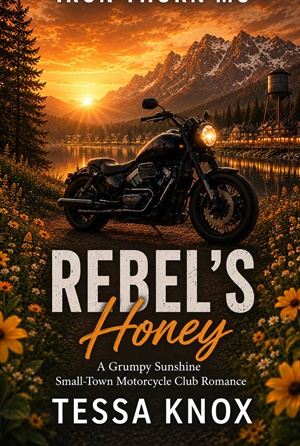
Rebel's Honey (Iron Thorn MC #20)
Prologue
Finn
Here's the thing nobody tells you about a bad childhood: it comes with a choice at the end of it, and the choice is the only part that's actually yours.
Mine went like this. A house that emptied out one parent at a time until it was just me and a string of relatives who took turns not wanting me. A couch that wasn't mine in a town that wasn't home. The specific quiet of being a kid nobody's fighting to keep.
I could tell you the details. I don't, much. Not because they're a secret — the club knows, Knox knows, the important people know — but because the details aren't the point. The point is what happens after.
Some kids get hurt like that and it hardens into something.
A wall, a fist, a flinch that never quite goes away.
I watched it happen to guys I grew up around.
I understood it. I still understand it — hurt people build things to keep the hurt out, and those things aren't wrong, they're just heavy to carry.
I was fourteen the day I decided not to carry mine.
I couldn't tell you exactly why that day and not another.
I just remember sitting on a curb outside a group home with a duffel bag that had everything I owned in it, and feeling this specific, cold certainty that if I let this turn me hard, it would have won.
Not the people. Not even my parents, wherever they'd ended up.
The whole rotten machine of bad luck and worse choices that had built my life so far — if I let it make me bitter, it got to keep building.
Forever. Every day after that would just be more of the same thing stacking up.
So I made a different call. Stupid, maybe. Fourteen-year-old logic. But it stuck.
I decided to be soft. On purpose. Like a middle finger, except made of kindness instead of anger, which turns out to be a much harder thing to throw and a much harder thing to dodge.
They started calling me Rebel a few years later, once the Iron Thorn picked me up and gave me the kind of family you don't get assigned, you get chosen into.
It was half a joke at first — the kid who smiled at everybody, who couldn't hold a grudge if you paid him, who made even the grumpiest bastard in the clubhouse laugh eventually.
Rebel didn't fit a sunny idiot who hugs people. That was the joke.
Except it did fit. It was the whole point. I was rebelling. Just against something nobody else could see.
The Iron Thorn is where I actually learned what a family does.
Not the family you're born into and hope holds — the family you build, one stubborn act of loyalty at a time, until it's stronger than anything that came before it.
Silas taught me that first, without meaning to, just by being the kind of man who'd burn the world down for people he loved.
Knox taught me by making room for a kid nobody else wanted and never once making it feel like charity.
I got a clubhouse. I got brothers. I got a town that started to feel like it might actually be mine.
And somewhere in there, being the sunshine stopped being a decision I had to keep making every morning and became just — who I was.
The guy who befriends people who don't want friends.
The guy who won't let anybody sit alone at a fire, even the ones who'd rather sit alone.
The heart of a club full of grumps who'd all, one by one, gotten cracked open by somebody exactly like me.
I figured I'd done my one great feat of stubborn joy already. Turned myself soft against all odds. Built myself a family out of nothing. Figured the rest of my life was just going to be — good. Easy. A long, warm, uncomplicated stretch of being happy on purpose in a town full of people I loved.
Then I went to the farmers' market on a Saturday morning in early spring because Del's coffee stand runs out of the good pastries by nine, and I met the meanest woman I have ever adored in my entire life.
She had a stall at the end of the row, half-shaded by an ancient oak, jars of honey lined up in a grid so precise you could've used it to check a level.
Gold and amber and a deep, almost red variety I'd never seen before, all labeled in small, blunt handwriting.
DUNMORE APIARY. NO SAMPLES. NO REFUNDS. NO, I WILL NOT PET YOUR DOG NEAR THE HIVES.
The woman behind the table had her hair shoved under a wide-brimmed canvas hat, dirt on her forearms, and an expression that could curdle milk at thirty feet. She was maybe five-four in boots that added an inch, and she radiated exactly as much warmth as a February morning.
I walked up, because I am, constitutionally, unable to walk past a sign that rude without investigating.
"Morning," I said.
She looked at me the way you'd look at a smear on a window. "You gonna buy honey or just stand there."
"Depends. Which one's the red stuff?"
"Buckwheat. It's an acquired taste. You won't like it."
"Try me."
"I don't do samples." She pointed, without looking, at the sign.
"Right, sorry, missed that." I hadn't. "I'll take a jar of the buckwheat, then. Blind faith."
She rang me up without another word, took my cash, made change with the brisk, irritated efficiency of someone doing you a favor she resents. When she handed me the jar, our fingers brushed for half a second, and I watched her yank her hand back like I'd bitten her.
"Have a nice day," she said, in a tone that made it sound like a threat.
"You too," I said, grinning so wide it probably should've embarrassed me. "I'll be back next week."
"Please don't."
"Definitely will."
I want to be extremely clear about something, for the record, because I've told this story enough times now that Diesel does an impression of me telling it, complete with hand gestures: I did not walk away from that stall thinking, there's my future wife. I'm sunny, not psychic.
What I thought — the actual, literal thought, standing in the parking lot with a jar of buckwheat honey I did not need and could not afford to be this delighted about — was: oh, she's going to be my favorite project.
I'd spent my whole life letting people in who didn't think they deserved it.
Feral clubhouse cats, brothers who thought they were too broken to be loved, a whole club full of grumps who needed exactly one stubborn idiot willing to sit with them until they cracked.
It was, if I'm honest, sort of my thing.
But this — this woman with her precise little jars and her furious sign and her voice like a closed door — this felt different. Bigger. Like I'd wandered up to a wall that wasn't just tall. It was load-bearing. Whatever was behind it was holding something up.
I twisted the lid off the jar right there in the parking lot and tasted the honey off my thumb, which is a genuinely disgusting way to eat honey and I regret nothing.
It was incredible. Dark and strange and a little bitter under the sweet, nothing like the easy stuff. Complicated. Like it had opinions.
Of course it did. It came from her.
"Yeah," I said out loud, to nobody, grinning at a honey jar like a lunatic in a farmers' market parking lot. "She's going to hate every minute of this."
I got on my bike, still grinning, already planning next Saturday.
I want it on the record, also, that I was right about exactly one thing that morning and wrong about exactly one thing, and I wouldn't figure out which was which for months.
I was right that she'd hate it.
I was wrong that hating it would win.