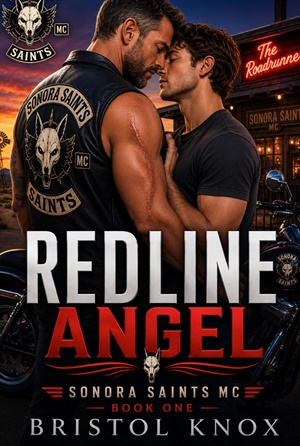
Redline Angel (Sonora Saints MC #1)
1. Dead on the Ord Highway
DEAD ON THE ORD HIGHWAY
The temperature needle had been climbing for an hour, and Wes had been watching it the way you watch a man's fist uncurl — like if he stared hard enough, it might change its mind.
It didn't. Somewhere past the last green sign that still had both bolts, the needle buried itself in the red and the engine coughed twice, apologetic, and died.
Wes let the car roll onto the shoulder on its own momentum and sat there a second with his hands on the wheel at ten and two, the sun going down behind him like somebody closing a door he hadn't gotten all the way through.
"Okay," he said, to no one. "Okay."
He'd had eleven days to get used to talking to himself. It didn't help as much as people said it would.
He got the duffel out of the trunk — everything he owned now fit in one bag, which was either freeing or the saddest fact of his life, he hadn't decided — and started walking.
There'd been a sign a mile back: RINCON SPRINGS 6.
He did the math on his feet and his ribs and figured he had maybe ninety minutes of light left and about that much give left in the ache along his left side before it turned into something he'd have to stop and breathe through.
He chewed his thumbnail down past sensible somewhere around mile three, working at a name that wasn't his.
Danny. No — Danny's already a person here, maybe.
West? Too close. Just Wes, he decided finally, spitting a sliver of nail into the dark.
Just leave the last name off and let them wonder.
People rarely pushed if you handed them half an answer with a smile attached.
The dusk out here didn't do things by half.
One minute there was a horizon, ragged and violet, saguaro shapes standing around like they were waiting for a bus that wasn't coming.
The next minute the desert had just — gone, folded itself into a black he could feel more than see, and the only light was a smear of neon a half mile off that turned out, when he got close enough to read it, to be a sign shaped like a roadrunner mid-stride, one leg lit, one leg burned out, so the bird looked like it was still running even with a bad leg.
Wes appreciated the symbolism more than he wanted to.
THE ROADRUNNER, the sign said. Under it, smaller, hand-lettered on a chalkboard bolted to the porch post: Help Wanted — Ask Inside.
He almost turned around. Eleven days of instinct told him that walking into any building with people in it who might look at him too long was a risk, and eleven days of instinct had kept him alive so far, so he generally listened to it.
But his ribs told him a different, more immediate story, and somewhere under the fear there was a hunger that had stopped being polite about a day and a half ago.
The door had a bell on it. Of course it did.
Small towns always had a bell on the door, so everyone would know exactly when a stranger walked in, which was either charming or the least private thing in the world depending on which end of the bell you were on.
Wes flinched at the sound of it — flinched hard, a full-body jerk that he covered by pretending to trip on the threshold, and felt his face go hot with the lie of it.
Nobody laughed. That was the first surprise.
The second surprise was the woman behind the bar.
She had a silver-blond braid over one shoulder thick as a rope and reading glasses on a beaded chain resting against a T-shirt that said WORLD'S OKAYEST BARTENDER, and she took one look at him — the door, the flinch, the way he was already angling his body so the exit stayed in the corner of his eye — and didn't ask him a single question.
She just reached under the bar, plated something off a warmer that smelled like every good thing Wes had forgotten existed, and set it down two stools from the end.
"Sit," she said. "Eat first. Talk later, or don't."
Wes opened his mouth to say I'm fine, I don't need, the whole practiced routine, and what came out instead, humiliatingly, was: "Sorry — I don't have money yet, I saw the sign?—"
"Did I ask you for money?" She was already pouring him water. "Sit down."
He sat.
That was when he noticed the man at the end of the bar.
He'd have said, if pressed, that he clocked the guy as trouble on pure animal instinct — big through the shoulders in a way that had nothing to do with a gym, forearms bare below rolled sleeves with a burn scar riding up the left one like something had reached out and grabbed him once and left its hand there permanently, boots that had actually been worked in instead of bought pre-scuffed.
Guy like that, two years ago, Wes would have crossed a parking lot to avoid.
Guy like that was exactly Grant's type of problem — someone who could be a threat if he decided to be.
Except the man wasn't looking at Wes like a threat looks at something. He was looking at him the way you'd look at a gauge on a dashboard. Reading him. Not hungry. Assessing.
Wes ate three bites before he trusted himself to talk, and even then it came out sideways, deflecting, the way it always did. "This a test?" he said, nodding at the plate. "Because I gotta be honest, I'd have passed for a lot less than a green chile burger."
The corner of the man's mouth moved. Not quite a smile. A down payment on one. "No test," he said. His voice was low and unhurried, the kind of voice that had never once needed to raise itself to be heard. "You looked like you'd walked a while."
"That obvious?"
"Boots are wrong for the desert. And you've got about four ounces of gravel in your left shoe you haven't stopped to shake out because you don't want to sit still that long." A beat. "You'll ruin the sock before the foot."
Wes laughed — actually laughed, a short surprised bark of it, the first one in eleven days that hadn't been about something bitter. "Noted. Thank you. I'll — sorry, I'll deal with that."
"Don't apologize for gravel."
"Sorry," Wes said again, automatically, and then heard himself do it and wanted to put his face in the burger.
The man didn't call it out. He just watched him a second longer — not unkind, not soft either, just thorough, the way a man might look at a fence line before he decided whether it would hold — and went back to his beer like the conversation had ended exactly where it was supposed to.
The woman — Deb, the sign behind the register said DEB'S PLACE in old gold paint, so he assumed — refilled his water without being asked and said, conversational, not looking up from the glass she was drying, "Kitchen's short a dishwasher and the room upstairs is sitting empty.
Cash under the table, nobody asks your last name unless you want to give it.
You interested, or you just passing through? "
Wes thought about eleven days of gas-station bathrooms and a dead phone he still hadn't been able to make himself throw in a river, and a bruise on his ribs that was three weeks old and still going yellow-green at the edges, and a name he'd rehearsed so many times it had started to feel more real than the one he'd been born with.
"Interested," he said, before he could talk himself out of it, and something in his chest that had been clenched since the night he left Grant's house loosened, just a fraction, just enough to notice.
"Good." Deb reached under the register, came up with a brass key on a leather fob gone soft with handling, and slid it down the bar to stop exactly in front of him without looking up to aim it. "North room. Deadbolt sticks a little in the cold, but it holds."
The man at the end of the bar hadn't said anything else.
But as Deb turned to holler something into the kitchen, he spoke — not to Wes, exactly, more like a fact dropped into the room for anyone who needed it — his eyes on his beer, his voice flat and certain in a way that made the back of Wes's neck prickle.
"He'll want the deadbolt that works," the man said. "Give him the north room."
Deb glanced at him, glanced at Wes, and something passed between the two of them that Wes couldn't read yet — he'd learn to, later, but not tonight — before she shrugged and went back to the key already in Wes's hand.
Wes turned the brass over between his fingers, warm now from his palm, and understood with a cold, clean certainty that had nothing to do with fear: the man at the end of the bar had looked at him for exactly ninety seconds and already knew he was running from someone.
He just hadn't decided yet whether that was the most dangerous thing that had happened to him in eleven days, or the first safe one.
---