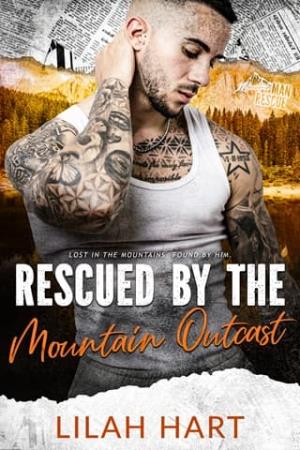
Rescued By the Mountain Outcast (Mountain Man Rescue #3)
Chapter 1
brOOKLYN
Ishould have turned back an hour ago.
Forty minutes into the hike, the trail had quietly stopped being a trail. The blazes on the trees faded. The canopy swallowed the sky. What I’d been confidently following turned out to be a drainage groove carved by decades of rainwater—not boot traffic.
Fantastic.
I pulled out my phone. The blue GPS dot blinked in the center of an endless green void. No marked trails within a quarter mile.
According to the scavenger hunt checklist folded in my pocket, the rare yellow fringed orchid grew somewhere on this ridge. Above four thousand feet. Rocky clearing. Southern exposure. I’d had to Google what “southern exposure” even meant last night.
My phone’s altimeter app read thirty-eight hundred feet. I hadn’t known what an altimeter was two days ago. Now I was apparently staking my life on one.
I was lost on a mountain I had absolutely no business being on, wearing hiking boots I’d borrowed from my friend Paisley’s suitcase and carrying a daypack I’d thrown together in twelve wildly overconfident minutes.
Two granola bars. A half-full water bottle.
A portable charger I had very confidently forgotten to charge.
This was not how the trip was supposed to go.
Three days ago, my biggest decision was whether to have blueberry or chocolate chip pancakes at the Pancake House.
Hartley and I had been in our regular booth, debating syrup distribution strategies like civilized women, while Lauralie kept our coffee topped off with the soothing consistency of someone who understood priorities.
Paisley had already been in full wilderness-commander mode—maps, highlighters, GPS coordinates spread across Evan’s booth like she was launching a small military operation.
She’d laughed when Hartley teased her about it, but the laugh hadn’t quite reached her eyes, and when she thought nobody was looking, her expression had settled into something tighter.
I’d noticed and filed it away under Paisley being Paisley. I hadn’t asked.
I’d signed up for the scavenger hunt on a whim. The prize money was real, and I wasn’t above wanting it. But my strategy had been casual, bordering on negligent. Wildflowers in the Pancake House parking lot. A few roadside pull-offs. A respectable little collection of low-point, common species.
Good enough.
Until last night.
Hartley had casually mentioned she’d racked up enough mid-tier finds to be competitive. Paisley hadn’t said much about her actual finds, but with the amount of planning she’d done, I figured she had to be sitting on something impressive.
And something in me—the stubborn, competitive, slightly unhinged part—slipped its leash.
You could win this.
You just have to stop being lazy.
So here I was. Extremely not lazy. On a ridge I couldn’t find on a map, chasing a flower that might only exist in an outdated blog post written by someone with better survival instincts than me.
The slope steepened. I grabbed a root and hauled myself up onto a narrow rock ledge jutting from the hillside like a shelf. Below me, the forest dropped away in a dizzying green plunge. The valley floor flickered through the trees, impossibly far down.
My stomach tightened.
For the record, I am not a hiker. Paisley is a hiker. Hartley is a planner. I’m the person who sleeps in, eats waffles, and texts things like If I’m not back by noon, send a search party as a joke.
Apparently, the universe does not appreciate irony.
The ledge narrowed. I pressed my back to the rock and sidestepped along it. One step. Two. Three. On the fourth, my boot hit loose scree.
Time snapped thin.
I went down hard. My right foot shot out, my ankle rolled with a sickening pop, and then gravity claimed me. I slid off the ledge—eight feet, maybe—hit the slope of loose rock below, and kept sliding.
My hands clawed for purchase. Leaves. Dirt. Nothing solid. A downed tree caught me across the ribs and stopped my fall with a violent jolt that punched the air from my lungs.
For a long second, I couldn’t breathe. Then pain bloomed in my ankle—hot, immediate, furious. I tried to rotate it.
White-hot spike.
Okay. Cool. Super.
I dragged myself upright against the fallen trunk and assessed the damage. The ledge above was unreachable now. The hillside below plunged into dense forest. My daypack dangled from a branch six feet away like it was mocking me.
My phone.
I crawled toward the pack, dragging my right leg, and unzipped it with shaking hands. The screen was intact. One bar of signal. I opened my texts.
Hartley.
I hovered over the keyboard, suddenly very aware that I had, in fact, told her to send a search party.
I typed, Hey. So, funny story, then deleted it. Nothing about this was funny.
My ankle was swelling inside Paisley’s borrowed boot. I was off-trail. On a steep mountainside. With one bar of signal that flickered like it was actively reconsidering its loyalty.
I tried calling.
Failed.
Again.
Failed.
A text might sneak through. I typed, Off trail on north ridge. Fell. Ankle might be broken. Can’t climb back up. Send help.
The progress bar crept forward. Stalled. Crept.
I leaned my head back against the tree and closed my eyes. The forest was too quiet. No birds. No wind. Just my breathing and the faint rush of what might have been a creek far below.
This was the moment in the movie where something cinematic and terrible would happen. A storm rolling in. A bear.
What I got instead were footsteps. Heavy. Deliberate. Crunching through leaves above and to my right. Boots. Not tentative, not searching, but confident.
I opened my eyes. A man stood at the top of the slope about twenty feet above me.
He was big.
That was the first thing my brain registered.
Not just tall. Broad. Solid in a way that made the trees behind him look decorative by comparison.
A face carved in sharp planes. A beard that had long since stopped pretending to be intentional.
Canvas jacket. Flannel. Boots that had clearly been resoled more than once.
He looked like the mountain had grown him itself.
His gaze found me. Moved from my face to my ankle to the dangling daypack. I watched him piece together the whole story without asking a single question.
Then he started down the slope. He moved like the terrain belonged to him. No sliding. No grabbing for support. Just controlled steps, boots landing on rocks that had nearly taken me out five minutes ago.
He crouched beside me. Up close, his eyes were gray-green. Lighter than the rest of him. Unexpectedly so.
“Can you move it?”
His voice was low. Rough. Like it didn’t get used much.
“I tried. It didn’t love that.”
He reached for my boot, and his hands—huge, calloused hands—were careful. He unlaced it slowly, easing the leather away from my swollen ankle. I bit the inside of my cheek to keep quiet.
He pressed along the bone, his movements deliberate and clinical.
“Not broken,” he said. “Bad sprain. You’re not walking out on it.”
“I gathered that when gravity and I had a disagreement.”
Something flickered at the corner of his mouth. Almost a smile. But it was quickly extinguished.
“I live about a quarter mile up the ridge,” he said. “I can carry you.”
My brain short-circuited. “You can—what?”
“Carry you.”
“You don’t have to. If you can just help me get a signal, I can call—”
“No signal up here. Not for another mile.” He straightened, already having made a decision. “My place has a landline. We’ll call from there.”
Before I could protest further, he slung my pack over one shoulder and bent to lift me. One arm under my knees. One at my back. And just—picked me up like I weighed nothing.
My hands shot to his shoulders on instinct, fingers curling into the canvas of his jacket. He was solid under my palms. Warm. He smelled like clean air, woodsmoke, and something distinctly masculine.
“I’m Brooklyn,” I blurted, because if a giant mountain man is carrying you into the woods, introductions feel relevant.
He started climbing. “Ridge.”
“Your name is Ridge,” I repeated. “And you live on a ridge.”
“Yeah.”
“That’s some strong branding.”
This time, the smile almost made it all the way.
He climbed like he’d been born on an incline. My ankle throbbed with each step, but his gait was steady enough that the pain stayed manageable. My awareness of his body—his strength, the easy way he handled my weight—was significantly less manageable.
Through the trees, a gravel road appeared.
Beyond it, a cabin. Not a cozy vacation rental with string lights and a hot tub.
A real cabin. Timber and stone. Tin roof.
A porch wrapping around two sides. Firewood stacked in precise rows.
A workshop off to one side with tools lined up in silent formation.
Everything about it said solitude. Intention. A man who had chosen this.
He carried me up the steps and through the front door, setting me carefully on a worn leather couch. Inside was spare. Clean. A woodstove. Built-in shelves crammed with books. A cast-iron skillet cooling on the stove. One mug in the drying rack. One of everything, I was guessing.
Ridge disappeared down a hallway and returned with a first-aid kit, an ice pack wrapped in a dish towel, and a pillow he slid under my ankle without being asked. “Hold that,” he said, handing me the ice pack.
He knelt in front of me and began wrapping my ankle with an ACE bandage. His movements were efficient.
“You’ve done this before,” I said.
“A few times.”
“Secret paramedic life?”
“Ran an outfitting company.” A pause. “People get hurt.”
Something settled into his expression when he said it. Something heavier than it should have been.
I watched him while he worked. The beard. The quiet. The cabin that felt less like a home built toward something and more like one retreated into.
“Thank you,” I said softly. “For carrying me. And for this.”
He finished the wrap and sat back on his heels. Our eyes met, and for just a flicker of a second, something raw moved through his gaze. Like gratitude surprised him.
He stood, crossed to the kitchen, and came back with a cordless phone. “Call whoever you need,” he said, then disappeared back through the doorway.
But my pulse had shifted.
Because suddenly, being stranded on a mountain wasn’t the most dangerous thing that had happened to me today.