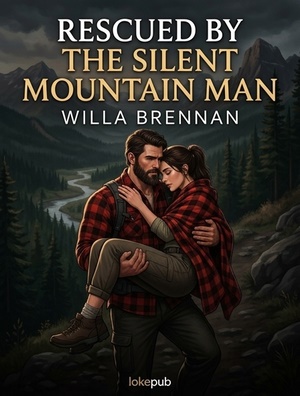
Rescued by the Silent Mountain Man
1. Morgan
MORGAN
I pull the second tray out and start plating. My hands move on autopilot. Tongs, parchment, display case. The same motions I’ve done every morning for the past year and a half—so familiar now that my body does them while my brain drifts.
Wildwood is the kind of town where people stay. Not because they’re stuck, but because the mountains hold onto you. Three thousand people tucked into a valley in Oregon, surrounded by evergreens and trails and the kind of quiet that makes city people nervous.
I moved here from Colorado Springs after my lease ran out. My roommate moved in with her boyfriend, and I realized I didn’t have a single person who would notice if I disappeared for a week. Not anymore. That was a heavy thought at twenty-one.
At twenty-three, I’ve built something different. I know people here and they know me. I’m the girl at the bakery who remembers your order and asks about your dog and says yes when you need help with something.
Always yes.
The bell above the door chimes at 6:45, and every nerve in my body snaps to attention before my brain catches up.
Elias Riggs.
He comes in at the same time every morning.
Same order. Black coffee, blueberry muffin.
He doesn’t say much, doesn’t smile, doesn’t linger the way other people do.
He’s tall, broad in the shoulders, and built like someone who does hard physical work and doesn’t think about it.
Dark hair that’s always a little too long, jaw that looks like it was cut from the same granite as the mountains outside.
He wears his department T-shirt most days, the fabric stretched across his chest in a way I’ve trained myself not to stare at.
I’ve failed at that training. Repeatedly.
“Morning,” I say.
He nods. That’s it. That’s the whole conversation, and it has been for months. He comes in, I pour his coffee, I bag his muffin, our fingers brush when I hand it over, and I pretend my heart doesn’t stutter every single time.
He doesn’t lean on the counter or tell me about his weekend. I don’t even know if he has weekends. He works at the fire station and he lives somewhere up the mountain. That’s the full extent of what I know about Elias Riggs.
I don’t push. Something about him tells me that pushing would be the fastest way to lose him, and I’m not willing to test that theory.
So I say, “same as always?” and he nods and I pour his coffee and bag his muffin.
Then he leaves, the bell chiming behind him, and the bakery feels a little bigger without him in it.
Today, though… Today, he pauses. It’s barely anything—a half-second where his hand is still on the bag and his eyes are on my face and I swear his mouth opens like he’s about to say something.
My breath catches. The whole bakery goes still, or maybe that’s just my imagination filling in what I want to be true.
Then he nods again. And he leaves.
I busy myself rearranging the scone display even though it doesn’t need rearranging. Anything to give my body something to do besides react to a man who barely said a word.
My coworker Alicia bumps my hip with hers on her way to the register, and I nearly knock over the scone display. “You’re blushing.”
“I’m not blushing,” I say. “It’s the ovens.”
She gives me a look that says she doesn’t believe me for a second, but she knows better than to push. She grabs a rag and starts wiping down the espresso machine, and I let the noise of it settle over me.
The morning rush comes and goes. I pour coffee and plate pastries and ask about kids and dogs and jobs, and by 10:30, the bakery has gone quiet. I’m wiping down tables when my phone buzzes.
It’s a text from Linda Marshall. She had shoulder surgery back in the spring, and I made the mistake of offering to help her with groceries one time.
One time turned into every week, and every week turned into whatever else Linda needs done.
Today it’s boxes in the garage. Her daughter is away at school, and she’s been trying to clear the space out for weeks.
She wants to know if I could come up after my shift and help carry them to her truck.
I stare at the text. It’s my only afternoon off this week. I was going to take a bath and read and do absolutely nothing, which is something I never do because there’s always someone who needs something.
I type back, Of course. I’ll be there by two.
Linda’s house is on the far edge of town, where the road gets steep and the trees get thick. Her garage is a disaster, and that’s not a judgment—it’s an objective assessment based on the seventeen boxes I carry from the back wall to her truck over the next hour and a half.
Every box is labeled in her daughter’s handwriting. Winter clothes. Books. More books. Stuff from closet (ask Mom). Half of them are heavier than they look, and Linda keeps apologizing for her shoulder while she points at the next one.
“That stack by the workbench. Those can go too.”
I wipe my forehead with the back of my hand and nod. My arms are sore and my lower back is starting to protest, but Linda’s standing in the doorway with her arm in a sling and guilt all over her face, so I smile and grab the next box.
“I really appreciate this, Morgan. I know you’re busy.”
“It’s no problem,” I say. Because that’s what I say. To everyone. About everything.
And the thing is, it’s not a problem. Not really. The boxes are heavy, but they’re manageable, and Linda’s grateful, and it feels good to help someone.
It always feels good in the moment. The resentment doesn’t hit until later, when I’m home alone with a sore back and a missed afternoon and that quiet voice in my head asking when someone’s going to show up at my door and say, “Sit down. I’ve got this.”
I load the last box. Linda hugs me with her good arm and insists on sending me home with a bag of apples from her tree out back.
“The trail behind the house connects to the ridge path,” she says, handing me the bag. “Beautiful this time of day if you’ve never walked it. Goes right down to the main road.”
I look at my car. Then I look at the tree line behind Linda’s property, where a narrow trail cuts between the pines.
It’s barely 3:30, and the light is golden and warm, and the air smells like pine and dust and the first edge of evening.
I have nothing waiting for me at home except a bath I’m too tired to draw and a book I’ll fall asleep on by page three.
When is the last time I did something just because I wanted to?
“I think I will,” I say.
The first twenty minutes are perfect. The trail is shaded and quiet, and my legs find a rhythm that loosens the ache in my back.
I can hear birds and the distant sound of water somewhere below the ridge, and the trees are thick enough to block the sun in patches.
Where the light comes through, it turns everything green and gold.
I don’t think about the bakery. I don’t think about Linda’s boxes or Mrs. Kimball’s cat or Dave Thacker’s weather reports. I just walk.
The trail forks, and I go right because it looks like it drops toward the road.
That’s my first mistake. The second one is not checking my phone for a map.
I have service, probably, but it doesn’t occur to me until the trail gets narrow and rocky and starts climbing instead of dropping.
The ground is loose under my sneakers. Not hiking boots.
Sneakers. Because I didn’t plan this. I didn’t plan any of this.
The temperature shifts so gradually, I almost don’t notice. The golden light thins out, and the air goes from cool to cold, and the shadows between the trees get longer and darker, and suddenly, the birds have stopped.
I check my phone. It’s 4:45. I’ve been walking for over an hour, and I have no idea where I am.
Okay. Think. I can turn around and go back the way I came, except the fork was a while ago, and I’m not sure I’d recognize it going the other direction. The trail has gotten steep enough that going back up feels harder than going forward.
Forward, then.
I pick up my pace, and that’s when my foot catches a root hidden under the loose rock. My ankle rolls hard to the left and the pain is immediate, hot and sharp. I go down on one knee with a gasp that echoes off the trees.
I stay there for a second, breathing, assessing. My ankle throbs when I try to rotate it. Not broken, I don’t think, but it’s already swelling against the side of my shoe, and when I stand, the weight on it sends a spike of pain up my calf that makes my eyes water.
I can walk on it. Barely.
I look down the trail and then behind me. Nothing but trees in both directions. The temperature is still dropping, and I’m wearing a T-shirt and jeans because I dressed for carrying boxes in a garage, not for hiking a mountain I don’t know at dusk.
This is what saying yes gets you.
The thought lands hard, and I push it away because now is not the time for a revelation about my inability to prioritize myself. Now is the time to keep moving, find the road, get home, and have an emotional breakdown later in the privacy of my apartment where no one needs anything from me.
I take a step. Then another. Each one sends a pulse of pain through my ankle, and I grit my teeth and keep going because what else am I going to do. Sit down on a rock and wait for someone to find me? No one even knows I’m up here.