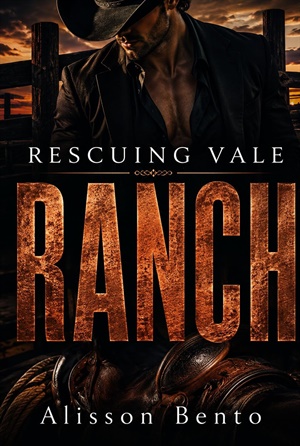
Rescuing Vale Ranch (The Wild Sky Legacy #24)
Chapter 1 Mara — Day 1
◆
The kitchen is cold enough that my breath fogs the window over the sink. I don't turn the heater on. Propane costs money, and I've been counting money since before the sun came up.
The coffee tin sits on the shelf above the stove where my father used to keep it. Blue enamel, chipped along the lip, the word COFFEE half worn off in white letters. It hasn't held coffee in four years. I stand on my toes, take it down, and set it on the table.
The envelope inside is heavy paper. Cream, not white. The bank prints them like invitations to a wedding you don't want to attend.
NOTICE OF DEFAULT, it says. SUL ROSS BANK OF ALPINE, TEXAS.
I know what it says. I've read it every morning for six days. But I unfold it now, in the pale gray light, and I run my finger down the columns like maybe the numbers moved in the night.
They didn't.
One hundred eighty-seven thousand, four hundred dollars, and change. Ninety days from the date of this notice to cure. The notice is dated a week ago. So today is Day One of the eighty-three I have left.
I fold the paper. I put it back in the tin. I put the tin back on the shelf. My hand shakes a little on the way down, and I hold it against my thigh until it stops.
The enameled coffee pot sits on the back burner, blue speckle over white, dented on the side where my father dropped it hauling it out of the truck bed the summer I turned twelve.
I light the burner. I fill the pot from the tap and spoon grounds into the basket the way he showed me when I was nine, and I stand there watching the flame lick blue around the base, because if I sit down I might not stand up again today.
Outside the window, the sky is doing the thing it does over Presidio County — turning from bruise to bone to gold in about eleven minutes. Roman's already at the fence line. He's the big bay, my father's horse. He looks at the house like he knows.
I pour a cup. I drink it black. It's bitter and hot and I need both.
That's when I hear the engine.
It isn't a ranch engine. Not the diesel rattle of Thayer's truck, not the coughing gas motor of the old flatbed we use for hay. This one's smoother. Newer. It hums up the caliche road slow enough not to spook stock, which means whoever it is has been on ranches before. I set the cup down.
I walk to the front porch in my socks. The screen door slaps behind me.
A blue Ford turns in at the front gate. Not new — an F-150, 2015 or 2016, dust up the wheel wells, a dent above the tailgate.
Clean under the dust, though. Cared for.
It rolls to a stop under the cottonwood by the yard fence, and the engine cuts, and for a second the whole world is only Roman's tail switching and my heart deciding what tempo it wants to keep.
The man who steps out is tall.
That's the first thing. Six-two, maybe more.
He shuts the truck door with the flat of his hand instead of slamming it.
Canvas jacket the color of wet sand, faded jeans, boots dusted hard enough to hide how new the leather is.
Dark-blond hair a little too long over the collar.
Sun on the back of his neck and forearms where he must've rolled his sleeves up on the drive in.
The rest of him is fair, like a man who's been indoors most of his life and is only just starting to come out.
He sees me on the porch. He doesn't wave. He walks up the flagstone path the way you walk toward a horse you don't want to spook. Hands loose at his sides. Eyes on mine.
“Morning,” he says.
The voice is low. Quiet. There's the faintest shape to the vowels — not a drawl, something more careful, like he learned English somewhere with more consonants than we use down here.
“Morning,” I say.
He stops at the bottom of the porch steps. He doesn't come up. That's a point. Most men come up.
“Ma'am. I passed a mailbox at the county road said Vale burned into the crossarm.” He tips his head slightly toward the gate. “I was hoping you might be hiring.”
I fold my arms. It's cold, and it's an excuse to fold my arms.
“You were hoping.”
“Yes ma'am.”
“You just happen down every caliche road in Presidio County reading mailboxes.”
“I ask at every place with a good barn,” he says. “Yours has a good barn.”
I make him wait for the next thing. I look at him. This is the part where you decide.
He's too clean-handed for a drifter. That's the first thing I clock. Ranch hands' hands look like tools — cracked, thickened, weathered down to something you could strike a match on. His look worked, but recently. New calluses on old skin. Whatever he did before this week, it wasn't hay.
He's also too well-spoken. Nothing wrong with a man who reads. But drifters coming up the caliche looking for day work don't usually put ma'am at the front of a sentence like a schoolboy who was raised right.
His eyes are blue. That kind of blue that makes you want to look at something else and forget.
I look at something else.
“What's your experience?”
“Cattle. Horses. Fence.” He says it the way you list your groceries. “I can throw hay. I've broken green colts but not lately. I don't ride bulls. I can weld a gate.”
“Where.”
He's quiet a second.
“Alberta,” he says. “Some in Wyoming.”
“Papers?”
“Yes ma'am.”
“How long you looking to work?”
He looks at the horizon a second, and then back at me. “As long as you'll have me.”
“That's a strange answer.”
“It's an honest one.”
I let out a breath through my nose. Roman snorts at the fence like he's got opinions. Every animal on this place has opinions.
“Look,” I say. “I appreciate you coming out. But I'm not hiring right now.”
He nods once, like that's the answer he expected. He doesn't argue. He doesn't shift his weight. He doesn't try again. He just takes one step back, half a step, and says, “Thank you for your time, ma'am.”
That, right there, is when I almost let him leave. I would have. Except Thayer Knox pulls up.
Thayer's my foreman. He's forty-two, ex-rodeo, and he doesn't speak unless the room requires it.
He drives an old red Chevy with a busted grille, and he pulls in behind the blue Ford and gets out and squints at the man on the flagstones the way he squints at everything — like a math problem worth checking twice.
“Miss Mara.”
“Thayer.”
“That your truck?” he says to the stranger.
“Yes sir.”
“You looking for work?”
“I was, sir.”
Thayer looks at me. “Miss Mara?”
I know that look. Thayer doesn't waste breath. If he stopped to ask me, he wanted to say something.
I step down off the porch. My socks find the cold flagstones. I don't put my boots on. I just walk over to where the stranger can't hear us if we keep it low, and I fold my arms again.
“You're going to tell me to hire him,” I say.
“I'm going to tell you what the head count is.”
“I know the head count.”
“You want me to say it anyway?”
“Say it anyway.”
Thayer tips his hat back with one knuckle.
“We've got four hundred and thirty on grass, and we're moving them off the west pasture by end of the month because the well pressure's dropping.
Rafe and Orin can't move that many head with just the two of them in five days.
I can help, but I'm running fence on the east line same week. Leaves us short a body.”
“We could push the move.”
“We could. Then the west grass burns out and we're buying hay we can't afford.”
I look at the ground. There's a small red ant walking across the flagstone. She's having a better morning than me.
“You know him?”
“Never seen him before in my life.”
“You like the look of him?”
Thayer takes a moment. Thayer takes a moment for everything.
“I like the way he closed his truck door.”
That's a whole Thayer sentence, and I hear all of it.
I turn back around. The stranger is standing exactly where he was. Hands loose. Not looking at me and not looking away, either. Looking at the porch post like it's an interesting piece of wood.
I walk back over. I stop three feet in front of him. My socks are getting damp from the dew on the stone and I don't care.
“Two-week trial,” I say. “Room and board in the bunkhouse. Day rate paid at the end of each day while you're on trial; weekly if you're still here after two weeks. If you can't work, you go. If you can't get along with my foreman, you go. If I don't like the way you leave a gate, you go.”
“Yes ma'am.”
“Do you understand what I said.”
“Two weeks. Bunkhouse. Day rate while I prove I can work. Don't leave gates open.”
I have to press my lips together. He said it the way a boy repeats a chore list to his mother, and it should not be endearing. It is, a little. I set the fact aside and move on.
“What's your name?”
“Beau.”
“Beau what.”
“Beau Lorne.” He says it careful, the way people say a name they've been practicing.
His eyes flick down for the smallest fraction of a second — not to my face, not to my hands — to my wrist. To my father's leather watch.
Worn brown, the strap tooled with a tiny running horse at the buckle.
My father wore it thirty years. I wear it now.
He doesn't stare. His eyes come right back up. But he saw it. He read it. He clocked it the way I clocked his hands.
I look away first. I hate that. I look at Thayer, past his shoulder, at nothing.
“Beau Lorne.” I say it back to him so he'll know I heard it. “This is Thayer Knox, my foreman. You take orders from him same as me. If he tells you to do a thing, you do it. If I tell you to do a thing, you do it. If Opal tells you to eat, you eat. Understood?”
“Yes ma'am.”
“Come on.”
I turn on my damp socks and I walk back toward the house, and I hear him fall in behind me two beats later, boots quiet on the flagstone. He walks like a man who's been taught not to walk loud in a house.