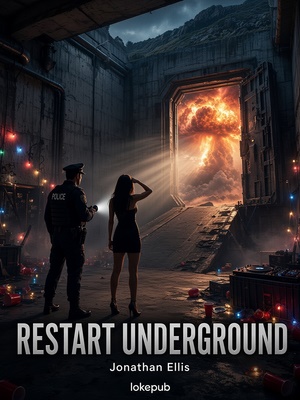
Restart Underground
Prologue
A trembling hand froze above the keyboard.
The young lieutenant, forehead beaded with sweat, turned toward his superior with a question in his eyes.
He was asking for confirmation, for an order.
His head was ringing — a rising panic brought on by a heavy dose of anxiety and despair.
Seeing not the slightest flicker on his superior's face, he gave up and turned back to the screen in front of him.
On the screen a cursor blinked, awaiting one last confirmation beneath the lines of text.
"Ignition system ready"
"Coordinates entered, target designated"
"Target classification: Zagreb, capital city (Croatia – NATO member)"
"Civilian population: 850,000"
"Military infrastructure: Minimal"
"Launch ready"
"Launch"
"(To launch, press the key marked green)"
"(To abort, press the key marked red)"
A drop of sweat slid down the young officer's nose, even though the thermostat on the nearby wall read around twenty degrees.
The only sound in the room was the hum of the air conditioning and the ventilation inside a few dozen computers.
His finger trembled, barely visibly, above the wide, red-painted key. He waited.
Though he was surrounded by several dozen military faces, not one of them dared to move.
They were hardly even breathing. The tension could have been cut with a knife; everyone waited, their eyes fixed on the general who had taken up the raised platform in the middle of the room, beside a stand that held a telephone of outdated make.
With a curt motion he took up the telephone receiver and pressed the call button. Soon, in short sentences, he reported that the crew was ready and requested the launch confirmation codes.
Hope set the young officer's heart racing. Maybe it's all just a drill, like every time before? the thought crossed his mind. He waited, tense. His finger trembled harder and harder.
The adjutant handed the general a sealed cylinder and, with his approval, broke the seal and drew out a short transparent card, which he then handed to his superior. In silence he stepped back and waited tensely, like most of those gathered.
This is it, the lieutenant thought, watching the general's tense face as he concentrated on the card while receiving instructions over the phone. Now he'll tell us it's only a drill.
The general finally confirmed the orders he had received. With a curt motion he set the receiver back on the telephone and slipped the plastic card with the numbers into his pocket. Only then did he deign to look at the tense faces of the people around him.
"The order has been confirmed and issued." He paused to give the men time to grasp it. "Begin the countdown."
Having said that, the general crossed his arms over his chest and waited.
The young lieutenant followed the countdown out of the corner of his eye, his heart quickening steadily as the seconds slipped away.
He noticed his uniform was soaked with sweat, but he did not dare move.
He was no longer thinking. His training had taken over his body.
As if in a dream, he watched his finger press the green key the instant the numbers reached zero.
With a vacant gaze, driven by morbid curiosity, he looked at the screen showing the interior of a great silo where, on a throne of steam and exhaust fumes, a huge silver rocket was nesting.
The silo doors began to grind open, and the rocket shuddered on its mount.
Like some beast, it all but radiated a hunger to take flight and carry out the task assigned to it.
The lieutenant noticed the hammer-and-sickle emblem.
At another moment he would have laughed at the absurdity of using a weapon from a long-dead regime in the twenty-first century. But he was in no mood to laugh.
The stability locks on the rocket released, and the deadly weapon, straining, amid a terrible roar and a cloud of steam, began to climb up the silo set somewhere within the Ural Mountains. In its rounded head it held a murderous payload. Four nuclear warheads, five hundred kilotons each.
A loud gunshot startled the young lieutenant. He turned and saw the falling body of the Russian general who, having issued the launch order, had put a bullet through his own head.
Five thousand kilometers to the south, inside Sljeme, an ancient computer switched on.
Sensors installed long ago, back in the days of Yugoslavia, fulfilled their purpose.
Detecting the ascending trajectories of the intercontinental missiles and following age-old protocols for the event of nuclear war, the computer began waking the systems of the atomic shelter.
The computer did not trouble itself with whether there was anyone to protect, or whether the rooms of the shelter stood empty and uninhabited.
It simply followed its programmed tasks and switched the systems on, one after another.
Soon the vibrations of the music were joined by the vibrations of machines that, like sleeping animals, were waking from their decade-long slumber.