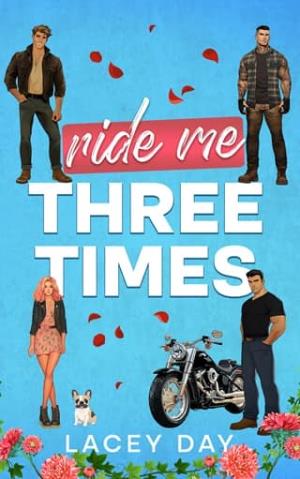
Ride Me Three Times (Coyote Glen #5)
Prologue
AURORA
The first thing I learn about Coyote Glen is that the town smells of my grandmother’s favorite line.
You know the one.
“Oh, Rory girl, it’s just a little town tucked in the pines. Nothing special. But it feels like magic.”
Sure, Evie. And my freckles are “stardust.” And my mother is “emotionally available.” And my father is “just running late.”
I roll down the window anyway. Crisp and piney and clean, it hits the back of my throat and for half a second, I swear I can hear Evie’s laugh. Warm and smug and victorious.
Told you.
“I’m here,” I say out loud, because I’ve been talking to my grandmother as if she can hear me for months and at this point I might as well commit. “I made it.”
The urn on the passenger seat does not respond.
It’s small. Too small. That fact alone is an insult. Like the universe went, Here! Have your entire person in travel size.
I adjust the seatbelt so it’s not rubbing the urn, because yes, I know that’s insane, but also, if I don’t do it, my chest tightens, and I start thinking about hospitals and paperwork and the way grief makes time a glitch.
So, seatbelt.
The road curves, and suddenly the town appears, tucked into the valley, trying not to be noticed. Warm lights in windows. A little main street. Mountains stacked in the distance like someone painted them with a careful hand.
It’s annoyingly pretty.
The “Welcome to Coyote Glen” sign is crooked in a charming way. Maybe it’s been punched by the weather for years and refuses to straighten out on principle. Somebody has tucked fresh wildflowers into the frame.
Why does that feel like a greeting?
My throat does a thing. I clear it loudly, scaring away feelings.
“Okay,” I tell myself. “Mission: scatter ashes. Read letter. Cry a normal amount. Leave town in a week or two. Continue traveling. Do not accidentally join a cult of charming, lumberjack-adjacent residents.”
The town square’s small but busy. People move in clusters. Someone’s laughing, big and easy. I bet they’ve never had a day ruined by an email subject line.
I park, grab my bag, and step out with the urn cradled against my chest. The air kisses my cheeks. The cold makes me feel awake in the way grief hasn’t.
I start walking, mostly because if I stand still, I might dissolve into the pavement and become one of those tragic town legends people whisper about at farmers' markets.
There’s a shop right off the square with a faded sign: Granger’s Goods.
Evie used to talk about it like it was a character in her life.
“Bill Granger always pretended he didn’t like anyone, but he gave the best advice. And the best candy.”
So, of course I go in.
The bell above the door jingles, and I’m immediately hit with the scent of cinnamon, old wood, and a thousand canned goods that have absolutely watched someone cry in this aisle.
It’s cozy as an old sweater with holes in the elbows that you refuse to throw away because it still knows you.
I take three steps inside and then realize something important:
I’m holding an urn in public like it’s a baguette I picked up at the bakery.
Which is… not the vibe.
I hug it closer, as if that makes it less obvious, which is definitely how things work.
A man behind the counter looks up. He’s built like a grumpy tree and wearing flannel all over. His eyebrows are permanently arguing with the world.
His gaze flicks from the urn to my face.
Then his eyes narrow.
“Well, I’ll be damned,” he says. “Harper?”
I freeze mid-step, and my stomach drops as if I missed a stair. “Uh… yes?”
His expression changes subtly. A softness tucked behind all that grump.
“Evie Harper’s…” He pauses, “family?”
I swallow. “Granddaughter.”
A flicker of sadness crosses his face. He turns to stare at the wall behind me, refusing to do emotion in his own store.
Then he clears his throat like a man with a bad relationship with feelings.
“Bill Granger.”
“Aurora,” I manage. “Aurora Harper.”
He grunts like my name is a stamp he’s approving.
“Same eyes,” he mutters. “She used to come in here and act like she didn’t run the whole damn town with her opinions.”
My chest squeezes.
“Oh yeah?”
He smiles. “Your grandmother was a hell of a woman.”
I nod, trying not to show how little I can breathe. This is way harder than I thought it’d be.
“She never talked about herself much,” I just about manage to get out. “Always focused on other people. But… I knew she had her ways about things.”
Bill leans against the counter, crossing his arms, his eyes distant as if remembering something.
“She did. The way she’d come into this store with that little laugh of hers, always acting like she didn’t care what anyone thought, but she knew exactly what she was doing.
She wasn’t just Evie Harper around here.
Everyone listened when she spoke. She wasn’t afraid to tell people what they needed to hear, even if they didn’t want to hear it. ”
I shift the urn in my arms, unsure what to do with this new piece of Evie. I want to gather up all these stories like pebbles from the beach, to finally build a full picture of her.
“There was one time…” he continues. “She came in here late one evening, storming through the door like she owned the place. She was pissed off about something… I can’t remember exactly what, but it was big.
I was busy sorting through some boxes in the back, and I heard her yelling from here to the other side of the store. ”
I raise an eyebrow, intrigued. “Evie, yelling?”
Bill chuckles, the sound rich with nostalgia. “Yeah, hard to believe, huh? But she had a way of riling people up. So anyway, she was arguing with this big shot from the city, some lawyer or something, and she’d come in here to grab a few things, clearly not in the mood for anyone’s crap.”
I can’t help but smile at the thought of my grandmother, so composed in my memory, tearing through a store with fire in her eyes.
Bill continues, his eyes narrowing. “So, this guy’s trying to pull some deal over on her, and she’s having none of it.
She walked right up to him and said, ‘You think you can just waltz in here and buy everything you see? This town might be small, but it’s got teeth. And I’ll be the first to bite.’”
I laugh softly, the sound full of warmth and disbelief. “I never imagined her like that.”
Bill’s eyes soften. “Sure enough, about two weeks later, that same guy came back, hat in hand. And guess who he asked for advice on the deal he was trying to pull off?”
I smile, feeling a little of my grandmother’s spirit back with me in that story. “I bet she had him wrapped around her finger in the end.”
“Dottie’s gonna be thrilled you’re here. Don’t let her talk your ear off, though. She can be a bit much.”
I smile, though it feels weak on my lips. “I’m sure I’ll manage.”
With that, I leave Granger’s Goods feeling a strange sense of connection, as though Bill’s stories have pulled me a little closer to a version of Evie I never got to know.
As I walk out into the crisp air, I’m carrying more than just her ashes now. A piece of her seems to have settled inside me.
I try to shake off the tightness in my chest as I head toward the Lookout Trail. It’s getting late, the sun hanging low, ready to disappear behind the mountains, but I’m not in a hurry. The day has a sense of finality to it, and I’m here to honor that.
The path winds upward, and I breathe in deep, filling my lungs with the sharp scent of pine and the distant promise of rain. The quiet of the trail is comforting. I can hear the soft rustling of leaves, the occasional chirp of a bird. It’s peaceful in a way that feels like it’s been waiting for me.
My steps are slow, my thoughts scattered as I try to keep my mind from spiraling too deep.
I reach the summit just as the sky is starting to paint itself in shades of gold and purple. The sun hovers, uncertain whether it wants to leave just yet. It feels sacred up here.
The mountains stretch out before me, vast and wild. I take a few minutes to just stand there, breathing it all in, feeling the pressure of what I’ve come here to do.
Then I hold the urn out, my hands trembling slightly. It feels heavier now, though it’s the same as when I held it in the car. I grip it carefully, my fingers tracing the edge as I look out over the valley, trying to picture Evie’s face, her voice.
I close my eyes and speak into the wind, almost whispering to the trees and the sky.
“I brought you home, Evie.”
I finally unscrew the lid, and the ashes slip out slowly, drifting in the wind because they want to fly away. I let go, feeling her leave me in pieces, knowing that this is it.
The end.
Evie was there for me, had always been there for me. Even when I didn’t feel I had anyone else.
Mom isn’t emotional, not at all. I don’t always know how she came from Evie. And my dad… well, he hasn’t exactly been much of a feature in my life.
But my grandmother was my constant.
I remember the way she used to sit at the kitchen table, her hands folded in front of her, her sharp eyes taking in every detail of the room.
She’d sip her tea slowly, savoring the warmth of it, and if you were lucky enough to catch her in one of her rare moods, she’d tell you a story.
Not just any story, though. They were full of lessons, of wisdom she’d gained through living a life no one else could understand.
I think of that time she took me aside when I was younger, just before I left for a summer camp I didn’t want to go to. I was terrified, convinced I wouldn’t fit in, that I’d screw it all up. She told me something I’ll never forget:
“People will always try to make you small, Rory. They’ll push you into corners that don’t fit, and they’ll try to tell you that it’s your fault for not conforming. But don’t you dare let them. You’ve got kindness in you, but you’ve also got an edge. Don’t ever forget that.”
She wasn’t wrong. I had learned to navigate the world by watching her. She didn’t just show love and kindness. She demanded it in her quiet, powerful way.
She had a sharp mind and a sharp tongue, but she always used them for something good. I can’t even remember the number of times she helped someone. Often without them even realizing she had, weaving herself into their lives like some kind of quiet hero.
The tears come then, unexpected, because I thought I was ready. I thought I’d be stronger. But the reality of her absence is sharper than I imagined. She’s not here anymore. She won’t ever be again.
I breathe through it, steadying myself. Grief is an unwelcome companion, but it’s the only one that’s ever been honest. I let the last of the ashes fall, the wind picking them up as they scatter over the mountain below.
A small part of me wonders if they’ll float all the way to the town, to the people who loved her.
Maybe she’ll still be there, in the air, in the memories, in the stories Bill shared with me.
When it’s done, I sit there for a while, the sunset painting the sky with its last defiant streaks of light.
I pull out my wallet and find the small collection of “good things” I’ve been gathering over the years.
A pressed flower from a hike in the Rockies.
A coffee sleeve with a note from a stranger who bought me a drink when I needed it most. A ticket stub from a play I went to when I was feeling lost.
I slide the small slip of paper from the urn into the collection. It doesn’t seem to belong, but it does, somehow. I fold it carefully and tuck it in among the other tiny fragments of the life I’m still trying to put together.
The trail is silent, and the sky has begun to darken. It’s colder now, but I feel a little lighter. A little less burdened. It’s the strangest thing, this grief. It comes in waves, but maybe that’s part of learning to live with it.
I stand up, taking one last look over the town, and then I start my walk back down the trail.
The sun’s finally gone, and the cool dusk has settled over everything.
But even as I walk away from the mountain, I can’t help but feel like everything inside me has shifted.
I’m not sure what’s waiting for me here in Coyote Glen.
At last, I can breathe.