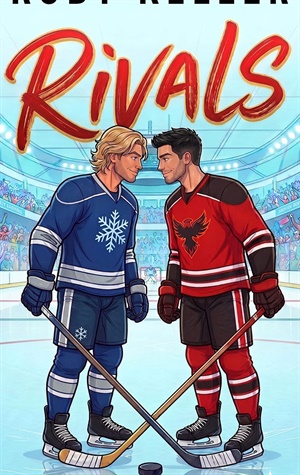
Rivals (MM Hockey Romance)
Chapter 1 Nate - April 2017, Chicago
The guy from the Tribune asked about my grandfather twice in the first four minutes.
"It's a great building with a lot of history," I said. "But we're focused on Saturday."
Media day at the Frozen Four is four hours long and every question is one of nine questions. Are you nervous? What's it like being a Sinclair?
I had answers for all of them, and none of them could be clipped and put on a screen with my face under it, and that is the whole job when you are standing behind a podium with a college logo on the front.
Deb stood off to my left with her phone out, counting. Deb had been my media manager since I was nineteen. She held up two fingers. Two more minutes.
Then somebody laughed three podiums down.
It was ten or twelve grown men in press credentials laughing with somebody, all at once.
I did not look.
"Nate." Another one, front row, notebook already closed. "Duluth's got two guys with more points than anyone on your roster. Any concern?"
"They're a great team. Really well coached. We've got a lot of respect for them."
Down the hall, more laughing. Somebody actually clapped, at media day, in April, in a concrete hallway in Chicago.
"You've been described as the most complete player in college hockey since Brian Leetch. What do you think you still need to work on?"
"Everything," I said, and smiled with exactly enough teeth, and the room made a small pleased noise.
I got two steps into the hallway before my phone buzzed, and Deb was already talking about the four o'clock, and I put a finger up and answered it anyway, because it was my mother.
"Did it come?" she said, no hello.
I had not opened it. It was in the garment bag in my room, in a shipping box, still taped. "I opened it."
"You did not." My mother has a laugh like she's getting away with something. She was in the kitchen in Camden. I could hear the kettle. "Navy. There are lighthouses on it. You can barely see them from more than a foot away. Your father won't notice."
She had sent me ties since I was fifteen. Twice a year, then four times, then every month once I got to Boston College.
The green room was a mistake. A staffer opened a door in a cinder-block hallway and said, "In here, ten minutes, they'll come get you for the joint hit."
There was one couch, two folding chairs, a table with bottled water and a bowl of the small hard pretzels nobody eats, and Riley Kowalski.
Everyone knew him from tape. Duluth's whole forecheck ran through him and he was the only guy in the tournament our video coach had built a separate clip package for, and I had watched that package four times, and none of it prepared me for the way he was sitting.
He was sideways in the chair with one leg over the arm, jacket open, tie already loose at eleven in the morning.
His suit was gray and a size wrong somewhere, sleeves an inch short, so you could see his wrists.
His gear bag was on the floor beside him, and one of the handles had been repaired with stick tape, and he had brought it to media day, in a building he did not need it in.
He looked up at me. And then he kept looking, without hurrying, the way a scout looks at a skater in warmups, up and down, taking inventory.
I have been looked at my entire life. I have never once been looked at like that.
"Hey," he said.
"Hi," I said.
"No, keep going. Say another one."
"Excuse me?"
"That was great." He sat up a little. "That was, like, a full sentence. You said 'hi' like it was going to be on the record."
I put my water bottle on the table. "You must be Kowalski."
"You must have a mirror," he said. "Sit down, you're making the room nervous."
I sat on the couch, which was too low.
"Okay," he said. "Can I tell you what I've got so far?"
"On what?"
"On you." He held up a hand and started counting on his fingers. "One. Haunted lighthouse energy. You've got a whole tie situation happening, I can feel it, I haven't even seen tonight's."
Something in my chest did a very small, very stupid thing.
"Two." Second finger. "You're holding your shoulders like the trophy case is load bearing. Like if you relax, a wall comes down somewhere and somebody's grandmother gets hurt."
"Is there a three?"
"There's a nine, buddy, I've been in here alone for six minutes." He grinned. It was an unreasonable grin, all the way across. "Three. And this is the big one. You answer questions like a guy reading a ransom note that his own family wrote."
I did not say anything for a second, which was the mistake.
"Oh," he said, delighted. "Oh, that landed."
"That's a lot of analysis for a guy who's about to lose on Saturday."
"See, that's better, that's got a little blood in it." He pointed at me. "But you smiled at the end. You always smile at the end. You do it like a period at the end of a sentence. It's very polite and it's the fakest thing I've ever seen in my life."
"I'm sorry my manners upset you."
"They don't upset me. They fascinate me. It's like watching a guy play the whole game behind the cage and then take the cage off in the parking lot and it's still a cage."
I looked at him. He was pleased with himself in a way that should have been unbearable, and his hands were on the arms of the chair, and they were wrecked.
Tape calluses across the palm, a knuckle that had been split and healed wrong, the nail on the middle finger of his left hand black at the base.
He was going to shake hands with a network host in nine minutes with hands that looked like he'd fixed a car.
Everyone I had ever met had handled me with gloves on. Coaches, teammates, reporters, my father's friends, girls at parties who'd been told who I was before they got there. Everyone. Since I was eleven years old, nobody had ever once talked to me like I was somebody who could take a hit.
So I gave him one inch. On purpose. Deniable, small, an inch I could take back.
"For the record," I said, "the ransom note was ghostwritten. My uncle Marsh does the first draft."
There was a beat.
And then his whole face went off. It came apart into this grin, and he made a sound like he'd been hit in the stomach, and he actually put a hand over his eyes.
There was a physical response in my body to a stranger laughing, and it was not in my chest, it was lower.
The door opened. The staffer said, "Two minutes, guys."
Riley stood and shrugged his jacket straight, and the jacket lost. His shoulders were absurd for a college winger. There was no version of that suit that was ever going to win.
"Hey, Sinclair," he said. "You gonna drink that water this time or just hold it like you always do?"
I looked down. The bottle was in my hand. I had not taken a drink.
"That's what I thought," he said, and went out ahead of me.
The TV hit was a disaster, and I was the only person in the building who could measure it.
Riley heckled his own answers. The host asked him about the semifinal and he said, "Yeah, we were bad for a period and a half and then we remembered we were allowed to skate," and the host laughed, and Riley said, "That's not modesty, we were legitimately awful, my mom texted me at the intermission and it was just a question mark," and by the second answer the floor crew was gone.
Completely gone. The camera op was shaking.
I gave my answers. Eleven to fourteen seconds. Great building, great history, focused on Saturday.
And on the third one, right as I opened my mouth, out of the corner of my eye, off camera, Riley Kowalski lifted an invisible glass to his mouth, held it there, and did not drink.
I lost the sentence, for half a second. Maybe less. I have been on national television since I was sixteen years old. I have never lost a sentence.
Afterward, unclipping the mic, Deb touched my elbow. "You okay? You coming down with something? You went weird for a sec."
"It's dry in here," I said.
She looked at me one beat too long and then she let it go, and I spent the entire rest of the day angry.
I was angry at a photo op with a sponsor. I was angry through a coaches' luncheon. And underneath the angry there was this other thing, which was that I wanted to go back into that cinder-block room, and I could not explain why.
The last scrum of the day was small. Half the reporters had gone. There was a kid at the back with a college paper's name on his lanyard, and he waited until everyone else was done.
"If your last name wasn’t Sinclair," he said, "and nobody in this building had ever heard of you. What would you love about hockey?"
Everyone looked up.
"That's a great question. I think the beauty of this sport is it doesn't care what your name is. You get out there and it's the same two hundred feet for everybody. That's what I love about it."
It was perfect. It was smooth and warm and it made three guys nod. It was the emptiest thing I've ever said in my life and I could taste it in the back of my throat.
The eve function was in a ballroom with a cash bar nobody used. Blazers, name tags, a sheet cake. I did a lap and shook hands.
A staffer came through with a clipboard and stopped near the drinks table to check something, and the top page was the banquet seating for tomorrow night, the head table, three names in a row in twelve-point type.
KOWALSKI, R. SINCLAIR, N. And whoever the third guy was; I honestly didn't read it.
I didn't have to move to see it. It was right there. And thirty feet away, on the other side of the clipboard, reading it upside down over the staffer's shoulder without any attempt to hide that he was doing it, was Riley.
He straightened up. He looked across the room at me with a small smile. And his face had the expression of a guy who has just been told he's getting a five-minute power play.
I looked back for a second. Then I looked away, and my ears were hot. I understood that I had just lost that.
I left early, and nobody noticed.
Back in the room I hung tomorrow's suit and finally opened the box, and there it was, the tie. And when you held it up close, under the lamp, about two hundred tiny white lighthouses in rows, each one about the size of a grain of rice.
You've got a whole tie situation happening, I can feel it.
I put it on the hanger and I got in the shower and stood under the water and let the day come off me, and my brain, with no permission from any part of me that makes decisions, went straight back to a folding chair in a cinder-block room, and a hand on a chair arm with tape calluses across the palm, and a wrist coming out of a sleeve an inch too short.
My body took a position on the subject, as my cock twitched. I turned the tap the other way and decided to stay in the cold until my dick calmed down, but it was taking a while. My hand moved down to my cock and I stroked it.
I got out, dried off and lay down in the dark with my heart going.
Long day, I told myself. Eight interviews. No lunch. That's all this is.
I was a very good student. I’ve been trained since I was a child to observe something carefully and then write down the conclusion I was supposed to reach.
I knew a scouting report when I wrote one.