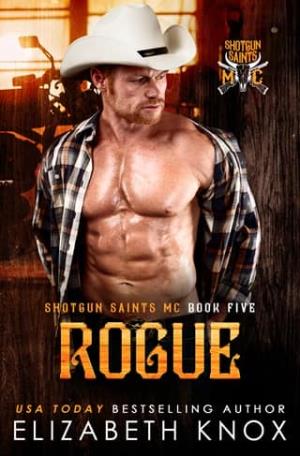
Rogue (Shotgun Saints MC #5)
Prologue
Hadley
Garrett's been dead for nearly two years now, and I'm out of money.
I'm driving a U-Haul that I can’t afford for another week down a Hill Country highway I've never been on before, with my six-year-old asleep in the passenger seat and a job interview at the end of it that I haven’t let myself think about since I got the call.
If I think about it, I'll turn the truck around.
So I don't.
I drink the cold Buc-ee's coffee in the cup holder, keep my hands at ten and two, and I watch the cedar fence line tick past the window.
I tell myself the same thing I’ve been telling myself since I sold my wedding dress to a consignment shop in Tyler for ninety-eight dollars: there is a roof at the end of this road, and my son is going to sleep under it tonight.
Two bedrooms. The man on the phone said.
A cabin behind the bunkhouse.
Fifty thousand a year with meals included and medical through the ranch's books. Plus, a school bus that stops at the gate every morning at eight-fifteen.
He said all of that with the voice of a man who had already decided I had the job before I'd opened my mouth.
I’ve spent every mile since wondering what kind of man hires a stranger over the phone, sight unseen, to live on his property with a six-year-old.
I’ve wondered, and I haven’t let myself stop driving.
Nash makes a small sound in his sleep beside me.
His head is tipped against the window, his stuffed Stitch is wedged under his chin, and his mouth is open the way Garrett's used to be when he slept.
I have to look back at the road because if I look at my son's face for too long I'm going to lose it. What the hell am I doing? I’m being crazy. I’m taking him into a random place I don’t know anything about.
For all I know, the guy who hired me is a total creeper. We could be murdered on this ranch.
A green highway sign says SHARP appears—12 MILES.
My stomach does the thing where it flops around before anything nervewracking.
For a moment, I wonder if this is the right choice, but in reality, it’s my only choice unless I want to be homeless.
I keep driving.
The town is one stoplight, a feed store, a Phillips 66 with a hand-painted price board, and a diner.
That's it.
That's Sharp.
I pass through it in about thirty seconds and take a left where the man on the phone told me to. I follow a road that runs for what feels like an hour past nothing but black cattle, cedar posts, and the kind of fence line that costs money to keep tight.
There’s a livestock vet, a small strip mall, and another diner right by the ranch.
When the gate appears, my hands go cold on the wheel.
Two iron pillars taller than my truck. A cattle skull silhouette over the top, crossed shotguns underneath, the words ‘Sharp Shooter Ranch’ in heavy block letters that look like they were burned into the metal with a torch.
The gate is open.
I sit at the bottom of the gravel drive for a long second with the engine running.
I look at that sign and think about every story I’ve ever heard about motorcycle clubs in Texas, about my boy asleep in the seat beside me, and about the fact that I have one hundred and forty-three dollars in my checking account and no other plan.
I put the truck in gear.
I drive through the gate.
The gravel road winds for a quarter mile under live oaks that hang low enough I have to watch the U-Haul's clearance, the cicadas are loud, and a kennel of big dogs lifts their heads when they hear the engine, and then the road opens up.
There is a main house on the left—stone-and-timber sprawl with a wraparound porch that looks like it grew out of the ground rather than getting built on top of it.
There is a separate building set back from the house with a sign over the door that just says ‘Clubhouse’.
There are a mix of bikes and trucks parked outside it. Some are newer, while others have been around a while, but all of them are well-maintained.
And there’s a man on the porch of the clubhouse, standing in a white cowboy hat, watching me drive in.
He doesn't move.
He is the tallest man I've seen in two years, wearing a navy plaid button-down with the sleeves rolled to the elbow.
His arms are tattooed all the way down in heavy black ink, his face is shadowed by the brim of that hat, and he’s just standing there with one boot up on the porch rail watching my U-Haul roll up his gravel drive like he has been expecting me.
I park where I can.
Nash stirs in the seat beside me but doesn't wake.
I put the truck in park, sit with my hands on the wheel, and look up at the man on the porch through the dust-streaked windshield.
I tell myself the same thing I told myself at the Phillips 66 two hours ago when I almost turned around.
You can’t lose this job, Hadley.
Not today.
Not with only one hundred and forty-three dollars in the bank.
I take one breath, check on Nash, and get out of the truck.
The man on the porch doesn't move when I cross the gravel.
He just watches.
The afternoon heat is pressing down on the back of my neck, the sweat starting at my hairline already, and I’m wearing the nicest blouse I have left and a pair of jeans that fit me better a year ago.
My hair is in a low knot because that's the only thing it will do without a fight, and I walk across that gravel like a woman walking up to a judge.
He takes his boot off the porch rail when I reach the bottom step and tips his hat back enough that I can finally see his eyes.
They’re not the eyes I expected to find under that brim.
Pale blue-green, set deep, sharp the way a hunting knife is sharp—not menacing, not yet, but the kind of eyes that have already finished looking at me before I've started looking at him.
Sun-flushed cheekbones. A full auburn beard, trimmed close. A small scar above his left eyebrow. Mid-thirties, maybe a little older.
He looks like a man you would not want to be on the wrong side of.
He also looks at me like I’m the only thing on the property worth his attention, and I don’t know what to do with either piece of information.
"Hadley Cross." He says it like a statement.
"Yes."
"Rogue. We talked on the phone."
His hand comes down to me from the top of the porch step.
I have to look up at him to take it.
His hand is the size of a dinner plate, and his grip is the kind that could break my fingers without effort and chooses not to.
I feel calluses on his palm and the heat of his skin and the brief, deliberate pressure of his hold before he lets go.
"Nice to meet you," I say.
My voice doesn’t shake, which is surprising. I’m more nervous than a chihuahua in a thunderstorm.
"Come on up," he says, and steps back to let me onto the porch. "Got iced tea inside if you want it."
I climb the steps.
He holds the screen door for me with one hand and I have to duck under his arm to get past, and for half a second I’m close enough to him to smell what he smells like—soap, sun, and a faint hint of leather and something else I can’t name—and then I’m inside the clubhouse and he’s letting the screen door close behind me.
It is so much cooler inside.
A ceiling fan turns slowly above a long cypress table. Twelve chairs around it. A bar at the back wall. A stone fireplace, cold this time of year.
A single shotgun mounted above the bar that I would put money on being functional.
There is nobody else in the room.
I’m alone with him.
He walks past me to the bar without looking back, and I stand at the head of the table with my purse clutched against my stomach, telling myself to loosen up and breathe.
"Sit anywhere," he says.
I sit.
I take the chair closest to the door because Nash is in the U-Haul outside. I sit with my back to the wall, and I don’t let my hands shake.
He brings two mason jars of iced tea over and sets one in front of me, pulls out the chair at the head of the table—not across from me, the head—and sits down.
He takes off the hat, sets it on the table beside his glass.
His hair is the same auburn as his beard, cropped close to his skull.
He drinks his tea and looks at me over the rim of the glass.
I look back.
"Your boy all right in that truck?" he says.
I had not expected that to be his first question.
"He's asleep. I left it running with the AC on."
"How old?"
"Six."
He pulls a phone out of his back pocket, taps something, and puts it back. "Got eyes on the truck now. One of mine'll holler if he wakes up. You're not going to be sitting here worrying about him while we talk."
I don’t know what to say to that.
I take a sip of the iced tea because my hands need something to do.
It’s sweeter than any tea I have ever tasted in my life.
"You came a long way," he says.
"Yes."
"From just a phone call."
"Yes, I did."
He sets the glass down, folds his hands on the table.
His knuckles are inked—a single black dot on the back of each one, on the right hand only.
I don’t let my eyes linger on them.
"That's a long way to drive a six-year-old," he says, "for a man you've never met."
"I needed the job."
"You needed it badly enough to put your kid in a truck for eight hours and drive him into a place you didn't know?"
It’s not a question. It’s the closest thing to a threat that has been spoken to me in two years.
I set my jaw.
I look him in the eye.
"My husband died of lung cancer twenty-two months ago, Rogue, and I’ve been working three jobs to keep my son fed since the day I buried him.
I sold the house. I sold the truck. I sold every piece of furniture we owned.
Four weeks ago, my landlord told me I had thirty days.
Last week, I had my son sleeping in the back of a Ford Ranger in a Walmart parking lot because the motel was full.
So yes—I needed this job badly enough to drive him into a place I don’t know, and if you’re about to tell me I don’t have the job anymore, I would appreciate it if you would do it now so I can be back on the road before he wakes up. "
It’s eerily quiet now.