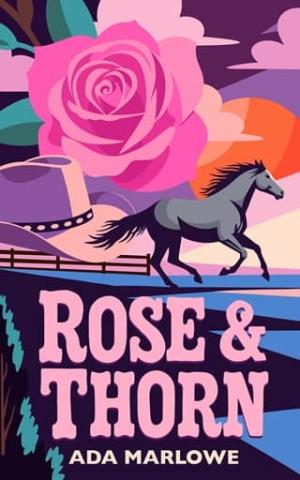
Rose and Thorn (Strawberry Plains #1)
ONE.
Ever
——————————
The long drive home.
I don’t know what I’m doing.
The thought loops through my head like a bad song stuck on repeat as I guide Gladys—my faithful old truck—south along the highway, leaving Illinois behind in a haze of summer heat. She’s not built for this kind of long-haul punishment. And I’m not sure I’m built for it either.
My shirt is already clinging to my back.
The AC gave up somewhere around the Indiana state line, and now every few minutes the engine lets out a low, warning sputter, as if it’s begging me to pull over and give us both a break.
There’s no way we’re making it all the way to Strawberry Plains without something else giving out—either Gladys or me.
But I have to. Because three days ago my phone rang with an unknown number and a thick Tennessee drawl on the other end.
Paul Jenkins, attorney at law. He told me my Aunt Linda had passed.
The words hit like a dull ache. Grief, yes, but distant, the way you feel about bad news when it’s someone you once loved but haven’t really known in years.
I’ve only seen her a few times since I left for college in Chicago nine years ago.
We exchanged the bare minimum: birthday texts, Merry Christmas messages with a few heart emojis, the polite tether that kept us from being complete strangers.
But that was it. So when Mr. Jenkins said she’d left me everything—the Rose and Thorn Ranch, every acre, every horse, every rusted gate—I just stared at the wall of my apartment, stunned.
Panic came next. He laid out the options in a calm, professional voice: sell the whole thing outright, hold an estate sale for her belongings, auction the land and livestock and vehicles to the highest bidder.
Everything could be gone in a matter of weeks, turned into a check for a few million dollars.
Clean. Simple. Final. Yet he never once suggested I might actually want to keep it.
And when I asked for time to think, he gave me until the end of the week.
It took a full day for the practical questions to break through the fog.
What shape was the ranch in? Were the horses still there?
The barn? The house? Who was taking care of it all?
When I had asked Mr. Jenkins, he had been kind but vague—everything was “in good order,” he said, whatever that meant six hundred miles away.
That’s when I realized I couldn’t decide anything from a studio apartment in Chicago. I needed to see it for myself.
So I packed what I could, threw it in the back of Gladys, and started driving.
I texted my friends and coworkers at the little indie bookstore and most of them sent back gentle versions of “are you sure?” They all know Aunt Linda was my last living relative, the final thread connecting me to anything before Chicago, but they also know I’ve built a life here.
So when I told them I might not be coming back for a while, they tried to talk me down.
“You don’t know the first thing about running a ranch,” one friend said gently.
Another just sent a string of question marks and a single “babe, think about this.”
They’re not wrong. I really don’t know anything about running a ranch.
I was eighteen when I left Tennessee. Before that, every summer Mom would drive me out to the ranch, drop me off for a few weeks, and call it a “mini vacation.” I believed her when I was little, but later I understood it was mostly a break for her—a chance to breathe without a kid underfoot.
I get it now, how exhausting that must have been to be a single mom after my dad left when I was five.
But at the time, every time she buckled me into the backseat to bring to the ranch, it felt like she was handing me off because she couldn’t stand having me around anymore.
Like I was the problem she needed a break from.
Those drives planted the first seeds of distance between us, and over the years they grew into something neither of us knew how to prune back.
She stopped calling as often, and I stopped answering as quickly. When I was home, her corrections felt sharper, my mistakes louder. When I was gone, we both breathed easier. It wasn’t hate—just two people who never learned how to stay close without hurting each other.
The ranch, though—it never judged. I learned I could be independent, that my hands could make things better instead of just breaking them.
Leaving Chicago stings. But I can’t decide the fate of the Rose and Thorn Ranch from six hundred miles away.
I need to see if the place still remembers me, if it fits the shape of who I’ve become.
Aunt Linda and Uncle Ray poured their lives into that land.
The least I owe them is the honesty of showing up to see whether I can carry it forward.
And if I can’t, then Chicago will still be waiting.
Gladys lets out a harsh sputter and a violent lurch forward, the whole cab shuddering like she’s coughing up her last breath. My hands clamp down on the wheel so hard the leather creaks under my palms.
“Please, Lord,” I breathe, the prayer spilling out. “Just get me there. Me and this ridiculous truck, in one piece. I’m begging You. Thank You. Amen.”
I let out a slow breath, waiting for the moment of truth, but Gladys chugs on.
“Also. I know it’s been forever since I checked in. But right now… You’re pretty much all I’ve got.” I finish, then reach forward and twist the volume knob until a static-laced guitar riff fills the cab, loud enough to drown out the doubts.
I roll the windows all the way down, letting the thick, humid wind rush in and whip my hair across my face and lean into the music, banging my head like I’m at a concert instead of alone on a highway in the middle of nowhere.
It’s not graceful. It’s not convincing. But for a few seconds, the noise is bigger than the fear, and I let myself pretend that’s enough.
I press the gas a little harder. Gladys groans, but she keeps rolling.
So do I.
— ∞ —
The long road up to the gate of the Rose and Thorn Ranch stretches out exactly the way it lives in my memory—endless, dusty, and perfectly flat, cutting through fields that feel like they go on forever even though the nearest town is only about fifteen minutes away.
It’s the kind of middle-of-nowhere that used to feel magical when I was a kid, but now it just feels remote.
Quiet in a way that presses against my ears after hours of highway noise and radio static.
I ease Gladys to a stop in front of the weathered wooden gates, wincing as the brakes squeal in protest. After stopping to get gas at the half way mark I didn’t stop again once—not for gas, not for food, not even to stretch my legs—because some small, panicked part of me was convinced that if I turned the engine off, it might never start again.
Smoke drifts lazily behind us, and I can’t tell if it’s the red dust kicked up by the tires or Gladys finally giving me the middle finger after eight brutal hours. Either way, we’re here.
I lift my gaze past the gate, and my stomach does a small, surprised flip.
The house next door—farther down the road than I remember—looks nothing like the place I used to sneak off to.
Back then it was just another faded farmhouse, sagging and unremarkable.
Now the porch glows with warm orange lights, the kind that make a place feel lived-in and welcoming even from a distance.
Someone sits in one of the rocking chairs, motionless, seemingly staring straight at me.
I hadn’t pictured neighbors, but maybe it won’t be so lonely.
Maybe someone who’s been here longer than a weekend can tell me what the hell I’m supposed to do with sixty acres and a herd of animals that probably won’t listen to me at all.
I drag in a deep breath and let my eyes slide back to the ranch itself.
The white farmhouse waits at the end of the long drive, single-story and modest, black shutters framing the windows like they always have.
The wraparound porch still holds those two old rocking chairs, paint chipped and weathered by years of sun and rain.
It looks smaller than I remember, but I know that’s just perspective.
Everything feels bigger when you’re a kid dropped onto sixty acres of possibility.
I leave Gladys idling, and climb out to deal with the gate.
My pulse kicks up as I scan for a padlock or a chain Mr. Jenkins might have forgotten to mention.
I told him I was driving down, but he never offered a key, and I never asked.
Maybe he assumed I’d been close to Aunt Linda right up to the end.
And maybe I didn’t ask because the guilt of how little I actually knew her—of how sparse our last few years of contact were.
I find a slide bolt gate latch, flick it up, and kick the gate free with a little more force than necessary.
The gate swings wide and bangs against the post on the other side as I jog back to the truck and half-lean through to nudge the gas.
I roll Gladys through, then throw it into park and step out again to wrestle the gate shut behind me before hopping back in.
The dirt road winds gently toward the house, and every turn brings back another piece of memory. The land is mostly flat with soft rolling hills, wheat grass swaying tall in places the animals haven’t reached, pastures neatly cropped by constant grazing.
To the right stands the big red barn, its paint faded but still proud, the same barn that holds the horses.
Beyond it stretches the open pasture they roam, and on the left is the chicken run and another small paddock.
Farther out, the second white barn looms, the one for the sheep and goat, with acres and acres of grass rolling away behind it for the cows.