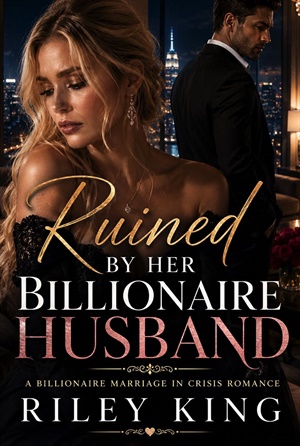
Ruined by Her Billionaire Husband (The Unseen Wives #4)
Chapter 1
The first thing the Whitakers ever taught me was that there are two kinds of silence at a dinner table. There is the silence of people who have run out of things to say. And there is the silence of people deciding, without words, that you are not worth saying them to.
Six years in, I could tell them apart in the dark.
Tonight was the second kind. Eleanor had set her fork down at a precise angle and was looking at the centerpiece as if it had insulted her.
Charles read something on his phone under the table and did not pretend otherwise.
Adrian sat at the head, where Charles used to sit, and ate the lamb I had spent the afternoon teaching the new cook to braise.
"It's good," he said. He meant the lamb. He said it to his plate.
"Thank you," I said.
There was a time he would have said it to me.
He would have caught my eye across the table and made it a private thing, a small flag planted between us in his mother's cold house.
I used to live for that flag. Now he passed me the salt when I had not asked for it, which is its own kind of distance, the kind where a man hands you a thing instead of a word.
I am forty-four years old. I know the difference.
Eleanor broke her silence the way she always did, with a knife dressed as a question.
"Nora, do you still keep up with your little catering people?"
"Some of them," I said.
"How nice that you have something." She smiled at the centerpiece. "A woman should have something."
I had something. I had a husband I had loved on sight in a service hallway eight years ago, when I was carrying a tray of crab cakes and he was hiding from his own engagement party.
He had been engaged to someone else then. Someone his family had chosen for him. He broke it off three weeks later and turned up at my kitchen door with no plan and bad shoes for the rain.
That was the man I married. I keep a photograph of him from that night in the back of my phone where no one looks. In it he is soaked and laughing, before the company tripled, before his father's first stroke, before the house got this quiet.
I do not show that photograph to people. It would feel like proving something. I have learned that the moment you start proving you belong somewhere, you have already lost the argument.
"More wine, Mom?" Adrian asked.
"A thimble." Eleanor held up two fingers a half inch apart, then watched him pour with the attention of a woman counting another woman's mistakes. When he overfilled it by a splash she made a small sound. I poured myself a real glass and did not apologize for the height of it.
After dinner Charles went to bed without a word and Eleanor cornered her son by the fireplace, and I cleared plates I was not supposed to clear because the staff had gone home and I cannot sit in a room while dishes congeal.
From the dining room I heard fragments. I have good ears. You develop them when people lower their voices the second you leave.
"Vivian's back," Eleanor said. "She's taken the Carrow house on the lake."
"Good for her," Adrian said.
"She's divorced now. It was ugly. He hid everything in the Caymans, the absolute worm." A pause. "She asked after you."
"That's nice."
"She's going to co-chair the foundation gala. I've already told the board. She has wonderful instincts for these things. Real ones." Eleanor let that sit. "Not everyone learns them."
I set the stack of plates down very gently so it would not sound like what it was.
I knew the name Vivian Wentworth the way you know a draft in an old house, by the cold of it before you find the window.
She was the one. The one the Whitakers had picked out when Adrian was nineteen, the daughter of the right people, the woman who would have made Eleanor's table make sense.
They had never forgiven him for choosing me.
"I'm sure she'll do a wonderful job," I said, walking through to the hall, because the only thing worse than being talked about is being talked about while you pretend not to hear.
Eleanor's face did the thing it does. It smoothed. "Nora. We didn't see you there."
"Clearly," I said, and smiled, because I am good at the parts you can see.
In the car Adrian drove with one hand and worked his jaw the way he does when his mother has spent the evening filing at him. I let three streetlights go by.
"Vivian Wentworth,” I said.
"Old family friend. You'll meet her. It's nothing."
"I didn't say it was something."
"You had a tone."
“It’s only a tone if you take it as one.”
He almost smiled. For a second the man from the service hallway was there in the dashboard light, and I wanted to put my hand on his leg and say, do you remember when we were the secret, when it was us against that house? What happened to us?
I did not say it. There is a version of a marriage where you say the true thing and a version where you have learned that saying it gets you a sigh and a lecture about being dramatic. We were living in the second version.
I had not decided yet whether we had moved there on purpose or just drifted, the way you end up in the wrong lane on a road you've driven a thousand times.
"She's had a hard year," he said finally. "Be nice to her."
I looked out the window at the dark water of the reservoir going by. Be nice to her. As if I had ever been the one in that family who needed instructing on manners.
"I'm always nice," I said.
It is one of my better lies. It is also mostly true. That is what makes it dangerous.
I have spent six years being nice in that house. Six years of swallowing the gold-digger looks at Christmas. Six years of Charles introducing me to people with a little laugh.
"This is Adrian's Nora," as if I were a make of car he'd bought. Six years of Eleanor sending back the gifts I chose with a note about how thoughtful the effort was.
I was good at being nice. I did not yet understand that being good at it was exactly what they would use.
We pulled into the garage. Adrian killed the engine and sat there a moment with his hands on the wheel, and I waited, because sometimes in that small dark space he came back to me. Sometimes he said something real.
"I've got the Miller closing at seven," he said. "Don't wait up."
So. Not tonight.
I went inside and up the stairs of the house we'd built, which is beautiful and cold and was decorated by a woman his mother recommended.
I stood in the closet and took off the earrings he gave me on our first anniversary, back when he gave me things he had chosen himself.
I put them in the dish. I looked at my own face in the mirror for a while, which is a thing I do not recommend doing tired and a little drunk, and I thought, not for the first time, that I had built my whole life on the memory of a man hiding from a party.
The truth of that night is smaller and better than the legend the family made of it. I was thirty-six and I had a six-person crew and a van with a door that only opened from the inside.
The Whitakers had hired me because their usual caterer had double-booked and someone's assistant had found me cheap and good.
I did not know whose party it was. I knew there were four hundred crab cakes and that the kitchen at that house ran cold and that the host kept sending the butler back to complain that the canapés were arriving at the wrong height of fashionable.
I found Adrian in the service hallway at half past nine with his tie loose and his back against the wall by the ice machine. He looked like a man waiting out a fire drill. I had a tray of the crab cakes the butler kept rejecting.
"You can't be back here," I told him. "Staff only. Whoever you are."
"I'm the groom," he said.
"Then you definitely can't be back here." I held out the tray. "Eat one. Tell me if the host is insane or if these are bad."
He ate one. He ate three. His mouth was full when he said the first true thing anyone in that house had said to me all night. "These are the best thing here, and that includes the bride."
I should have walked away. I was working.
He was engaged. He was, it turned out, worth more money than the town I grew up in.
But he had crab cake on his thumb and a look on his face like a man who'd been seated at the wrong table his whole life, and I stood in that hallway and we talked for twenty minutes while four hundred guests waited for canapés at the correct height.
He broke off the engagement three weeks later. He turned up at my kitchen door in the rain with no plan and the wrong shoes and said he didn't have a speech, he just couldn't stop thinking about the hallway, and could he come in. I let him in. I have always been letting that man in out of the rain.
I brushed my teeth. I got into the enormous bed on my own enormous side of it.
And somewhere across the city my husband was signing papers, and somewhere out on the lake a woman named Vivian Wentworth was unpacking boxes into the Carrow house, hanging her good year over the bad one like fresh paper on a damp wall.
I told myself it was nothing.
I am a very good cook and a fairly good wife and an excellent liar to myself, when I want to be.