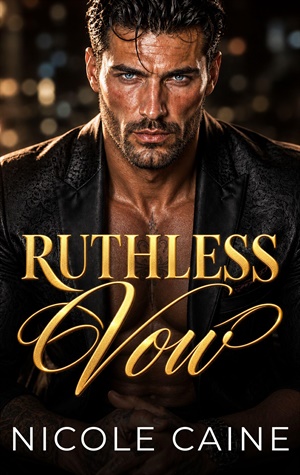
Ruthless Vow
CHAPTER 1
Siena
They rolled him in at two in the morning with no name, no next of kin, and a pressure we could feel but not hear.
"Single gunshot wound, left chest." The medic was breathing hard as he ran the gurney through the trauma bay doors with his partner. "BP’s in the basement.”
“Any information on him?Allergies, medications, something we can use?” I asked as I moved alongside the gurney.
“Somebody found him in the street off the Vinegar Hill waterfront, called it in, and didn't wait around. No wallet, no phone, no ID. Nothing on him," the medic replied.
Dumped. Not brought. I filed the word and reached for gloves.
The man on the gurney was big, mid-thirties, wearing a charcoal suit hand-tailored that was now cut open down the front. Blood had turned the white shirt brown. His skin had gone a shade of gray that told me how close the edge was before I touched him.
"Talk to me," I said.
"Field pressure eighty over palp, dropping. One line in, second blew." My charge nurse, Renata, cut the rest of the shirt away. "Breath sounds down on the left."
"He's filling up." I pressed two fingers below his collarbone and read the story his body was telling.
The trachea had begun to move to the right.
His neck veins raised against his skin. His heart was drowning in his chest, and it only had minutes.
"Tension. I need a chest tube now. Get me two units on the rapid infuser and page the OR. "
"John Doe, Dr. Marlowe?"
"John Doe. Move."
The six people in the operating room found a shared rhythm as they became instruments fully focused on saving life.
The tube tray arrived at my right hand before I asked for it.
Renata had the betadine open and the drape back.
She had worked beside me for four years.
Somewhere in the second year she stopped narrating my own hands back to me.
That is the highest compliment one of us ever pays another.
The night resident took the far side and touched nothing, which was the correct thing to do.
A dying stranger asked for nothing but your work.
No family in the hall. No history to take.
No name to say. There was only the body and the clock, and I knew how to answer both.
I’d spent my whole life learning to be the calmest person in a room full of blood.
My calm was the one thing I trusted about myself.
I opened his chest with steady hands.
The scalpel went in along the rib. The pressure that had been strangling his heart released in a warm rush over my hands. His numbers climbed off the floor. Not far, but far enough to buy time.
Under the lights, I opened him fully and found the rest of it.
The round had gone in through muscle, clipped the lower lobe of the lung, and come to rest against the back of a rib.
It had stopped a finger's width from the vessel that would have emptied him into the street before anyone thought to look.
Whoever fired had almost done the job. ‘Almost’ was a word that only exists after the worst had cleared.
Then the field filled and I couldn’t see.
That was the part people get wrong about this job. They assumed it was steady hands, but anyone could hold a hand still. The real challenge was continuing to answer questions in order while the whole world went red and loud.
"Suction. More. Pack it and give me a count," I called.
The count came back and it wasn’t the number I wanted to hear. His pressure went with it. The line on the monitor stopped being a rhythm and became a suggestion.
"He's going," somebody said.
"He isn't." I didn’t look up. "Two units, wide open. Hold pressure here. Do not move that hand until I tell you."
I found it by feel because there was nothing left to find by sight.
A tear in the intercostal, back along the track the bullet had cut, was bleeding into a space I couldn’t get a light into.
I got a finger on it. Then a clamp. Then I held both and did not breathe for four seconds while the suction caught up with me and the field came back.
The number climbed.
After that, I sewed the lung. I checked it twice.
A lung that holds on the first check and fails on the second made people die in recovery instead of on the table.
I washed out what I could reach. Somewhere in the second hour his heart stopped threatening to quit on me.
It stabilized and found the natural rhythm.
Then I took the bullet out.
It came free against the tip of my forceps, small, dull, and warm from him. I held it up to the light the way I always did. It was a habit older than I could name. The room narrowed down to the metal in my hand.
The entry it took lingered with me. I went back to it in my mind and knew what had been bothering me since the trauma bay.
The skin around the wound had been burned.
A dark tattoo of powder stippled into it, alongside a scorch at the center where the muzzle had nearly kissed him.
That didn’t happen from a shot across a room.
It showed when the gun was pressed to the chest by someone standing close enough to share breath.
Nobody let a stranger walk up and set a barrel over his heart.
This man had been shot by someone he knew, somewhere private.
Then they moved him. They drove him away from wherever it happened and left him in a gutter to finish dying alone.
I turned the bullet over. Intact. Clean. Machined to a shine, jacketed, and precise. Serious ammunition, out of a serious gun.
My hand moved before the rest of me decided anything.
The protocol was simple. A bullet went in a labeled specimen cup. It was logged, signed, and handed to the police, who would be waiting in the corridor by dawn. I’d done it a hundred times.
My fingers closed over the bullet instead. I peeled off the outer glove around it. I pushed the small wrapped weight down into the pocket under my gown.
I’d like to say I had no reason.
The truth is worse than that. The reason got there first and my hand caught up. It came from the same place my steadiness comes from; that was a place I kept shut on shift.
Somebody had put a gun against this man's chest and walked away from him. This was the one piece of evidence that could not be argued with. Bullets do not change their story. People do. Evidence rooms do.
That was as close as I let myself get to my real motivation. I was extremely good at stopping there.
"Dr. Marlowe?" Renata watched me over her mask.
"Closing," I said, my voice as level as it always was.
We finished. I built him back layer by layer. The monitor kept its steady green rhythm the whole time. When the last suture was tied, I stripped my gloves. I let the tiredness in, just at the edges. I allowed it only when the work was done.
He would live. I hadn’t lost him. I was aware of how much that mattered to me. Underneath it sat a reason I didn’t look at directly.
I stepped out through the OR doors into the scrub corridor to pull my mask down and breathe. The skin between my shoulder blades drew tight. Someone had eyes on me.
A man stood at the far end of the hall, past the sinks. No one without a badge was supposed to be there at three in the morning, especially not a tall man in a black coat that had not come off a rack.
No cop stood like that. Cops leaned. They drank the bad coffee, checked their phones, and looked bored to be alive. This man held the hallway like he owned the deed to it and I was the one thing in it he hadn’t accounted for.
He was older than me. Hard through the jaw, silver starting at the temples, still in a way that had nothing restful in it.
Ink showed at his collar and the back of one hand, dark lines climbing out of the cuff.
His eyes were on me and had been, I understood, since before the doors swung open.
Not on the OR. Not on the man whose life was still warm on my hands.
On me.
The skin along my forearms lifted. My mouth went dry in a way that had nothing to do with the twelve hours I’d spent working without water.
Every instinct I owned said to go back through the doors. There was a phone on the wall beside the sinks. There was a security desk two floors down with a man on it. He would’ve come up, eventually, and asked what the trouble was.
I stayed where I was.
Everything in me went quiet. The same quiet that arrived when dispatch said a word you didn’t want to hear. It lived underneath fear. It took the controls on the nights fear turned out to be useless.
I’d spent years reading rooms. Reading the thing a person tries to keep off his face. I looked at him and got nothing back but the cold; that cold told me everything I needed. Here was the private place. Here was the someone who got close.
Without moving closer, his gaze went from my face to my hands to the pocket of my gown slowly, and climbed back up. The corner of his mouth tightened.
He knew.
I didn’t know how, but he knew what was in my pocket, and he wanted me to know that he knew.
Which was not possible. I ran it the way I run a differential.
Nobody had been in that theatre but my own people.
My gown had been on the whole time. He’d come through a set of doors he had no business being on the far side of into a corridor with no window to the OR.
Yet he had arrived at a conclusion it took me an hour and a pair of forceps to reach.
There was no clean explanation. There was only a man at the end of a hall who knew too much.
My pulse should have spiked. It dropped instead, into the flat cold calm I lived in when the stakes went up. I held his eyes across forty feet of empty corridor. I did not look away.
I had saved a man tonight with no name. The person that came looking for him was already here, at the end of my hall, watching me. I understood with a surgeon's certainty that my ordinary life had ended somewhere between the trauma bay and this moment. I hadn’t felt the cut.