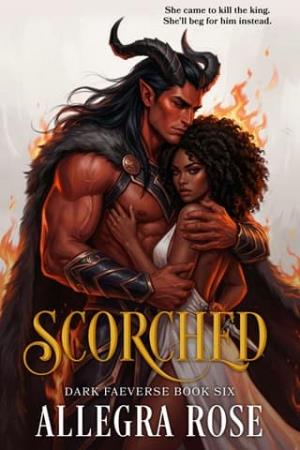
Scorched (Dark Faeverse #6)
Chapter 1
SOPHIA
The anvil is cold at three in the morning.
That's the first thing I notice when I come downstairs—not my grandmother sitting in the dark with the forge unlit, not the dossier open on the worktable, not the smell of the poison she's been distilling since before I went to bed. The anvil.
I put my hand flat on it the way I've done since I was a girl, and just like always, the iron answers my palm as if it knows me. It always does. I’ve never told my grandmother what I feel when I touch the anvil; I’m sure she’d think me foolish if I did.
"Sit down," she says.
I sit. The workshop is cold. No doubt she hasn't lit the forge because she doesn't want the neighbors seeing light through the shutters at this hour. My grandmother thinks of everything.
She raised me to think of everything too.
I count the exits out of habit—the front door I came through, the cellar hatch behind the coal bin, the window she bricked over six years ago when the Ember Court patrols started running tighter routes through the district.
Two viable exits. Three if I go remove the bricks, which I could do if I had no other options.
Often, in my line of work, there are no other options.
She slides the dossier across the worktable towards me.
“Your next target is Ignatius Pyrion," she says.
"King of the Ember Court. Eight hundred and ninety-two years old. Fire Fae. Ancient and powerful.” She pauses, then holds out her hands.
The lamplight catches the scar tissue on her hands—the burns she's carried as long as I've known her, the ones she won't explain.
"He is the reason for these scars. And the reason I have to keep you safe from knowing more about what we are and where we come from.”
I open the dossier. The intelligence contained inside is thin.
A physical description that is almost any Ember Court fire fae male: tall, dark red skin, black hair, horns, fire magic, and of course, the pointed ears of all fae.
There are schedules, but they’re months out of date.
A list of his public appearances at court functions going back three years, each one marked with entry points and guard rotations that someone else has already compiled.
Whoever assembled this had good access and mediocre instincts. The schedules are useless. The entry points are better, though I’ll have to scout them to make sure they’re still there.
"His Harvest Festival is in nine days," my grandmother says.
"You will attend as Lady Sophie Moreau, a minor landowner seeking the court's protection from a border dispute in the eastern territories.
Your cover documents are finished. Your introduction has been arranged through a contact in the Ember Court's trade office.
You will have seven days inside the court before the festival concludes. That is enough time."
It is. I have made twelve kills, never been detected, and the longest any of them took was four days. I’m twenty-six years old and I have never failed a contract.
Not because I’m reckless or violent, eager to kill. Because I’m precise and patient, and I do not take contracts I cannot see through to the end. That is how an assassin keeps a spotless record.
I turn the page. Toxicology options are listed, all proposed to kill a large and powerful fae. Three of them are mine—compounds I developed in this workshop during the years my grandmother was teaching me that poison was a woman's weapon and a blade was a man's.
I didn’t ever tell her that I preferred the blade.
I didn’t tell her that the poisons I mixed were backup plans for the killing edge I preferred.
My favorite way to kill was with a blade I forged with my own hands, folding the steel over and over again, sharpening until it could cut flesh from bone and even bone from bone.
"The compound in the green vial," she says. "Applied to a blade edge, it will bypass Fae healing for a minute, maybe two. That’s your window. One cut, correctly placed, and his magic won’t save him."
I pick up the green vial. Hold it to the lamplight. The poison inside is a deep amber, almost black, and it moves like something thicker than liquid. I mixed this one myself three years ago.
I remember the afternoon I made it: the constant heat of the burner, the way the compound resisted combining until I adjusted the temperature by two degrees and it came together all at once, perfect and lethal. I’m good at making things. Better than my grandmother wants to admit.
"There is one more thing," she says.
I wait.
"He is Fae. Ancient and powerful. His court will have effects on the body that you must be prepared to deal with, or they’ll steal your concentration.
You’ll feel… heat in your body. Disorientation.
A pull you won’t understand." She pauses.
Her jaw tightens. "You’re disciplined, well trained.
I have made sure of that. Do not let the court get inside your head. "
She has trained me well in discipline. Taught me to control my breathing until my heartbeat was a metronome. Taught me to lock my body down so completely that nothing could reach me—not pain, not fear, not anything else, not even love or desire.
I’ve never been inside a Fae court. I’ve killed Fae males, but always in human territory, always at a distance, always before they were close enough to touch. My grandmother was very clear about that. Kill them from a distance. Never let one close. Never cross into their courts.
This time she’s sending me in.
"I’m disciplined," I say.
My grandmother nods. Her face in the lamplight is the face I’ve known my entire life—severe, certain, stripped of anything that might be mistaken for tenderness. She loved me the way she knew how—taught me to kill people efficiently and leave no evidence and feel nothing about it afterwards.
When I had fevers she held me. When I broke my wrist at thirteen she set the bone herself. Not once in twenty-six years has she told me I had done well unless I had done something that could end a life.
Weapons don't feel, and I am her greatest weapon. That means I feel nothing.
I’ve spent my life trying to become what she needs me to be.
"I'll need a blade," I say. "Something that appears to be decorative. A lady's knife, the kind a minor landowner might carry for protection on the road. It needs to be strong, sharp steel, so the edge can be slicked with the poison without rusting.”
"I have one."
"I'll make my own."
She looks at me. An expression crosses her face that I can’t read, though I’ve never been able to read her, not in twenty-six years of reading faces for a living.
My grandmother is the only person who has ever been opaque to me.
I don’t know if that’s because she trained me or because she trained herself first.
"Fine," she says.
I stand. I go to the forge. I light it myself—a match and tinder, the human way. The forge takes a few minutes to come up to working heat. I wait. Patience is the thing I’m best at. Patience and killing and the feeling of metal warming under my hands.
When the forge is hot I pull a bar of high-carbon steel from the rack and I start to work.
This is the part my grandmother does not understand.
This is the part no one has ever understood, because I’ve never allowed anyone close enough to see it.
When I am at the forge, with iron singing under the hammer and the heat pressing into my face and my hands moving in a rhythm that I didn’t learn but have always known—I am not a weapon.
I am something else. Something that makes things instead of ending them.
The blade takes shape under my hands. I fold the steel three times, working the carbon through, feeling the shape of the metal shift and align with each fold.
A poisoner's blade—thin, precise, the edge ground to a bevel that will hold the compound in its pores without dulling.
I shape the handle for my own grip, because a blade that doesn't fit the hand that holds it is a blade that will slip at the worst moment, and I can’t have that.
I’m halfway through the final shaping when my hand touches the anvil again and I feel it.
A pull. Low and warm, somewhere behind my sternum, like a note I can almost hear. The iron under my hand is singing to me, or I’m singing to it, I can’t tell the difference.
I have felt it before—every time I forge, every time I work metal, this pull in my chest that has no name and no explanation, something that doesn’t make sense. Weapons don't feel. But the metal feels me. I'm sure of it.
I pull my hand back. I finish the blade without touching the anvil again.
By the time I'm done the sky is starting to lighten through the shutters. The blade is perfect. Seven inches, double-edged, with a handle wrapped in dark leather and a weight that sits in my palm like it grew there. It’s better than the one my grandmother commissioned from the finest weapons dealer in the city.
It’s better than anything in this workshop.
My grandmother won’t say so. She never does.
I dip the edge in the green vial and let the compound wick into the steel.
Then I go upstairs to pack.
My room is small and cold and contains precisely what an assassin needs: a bed, a trunk, a washstand, a mirror I rarely use. I use it now.
The face looking back at me is the one I was born with: brown skin, dark eyes, the kind of bone structure that reads as pretty without being memorable.
My grandmother chose my features the way she chose everything else about my training—for utility.
A forgettable face is an asset in my profession.
I’ve walked into twelve rooms and walked out of twelve rooms and not a single person has been able to describe me afterward.
I pack light. Three changes of clothing appropriate for a minor landowner at court.
Two additional sets of poisons, both disguised as perfume.
The blade in a hidden sheath at my thigh, where the weight of it feels like an answer to a question I haven't asked. Enough poison for two weeks, although the mission should take seven days. I’m precise, I’m fast, but I always prepare multiple options. Just in case.
At the bottom of the trunk I hesitate. Then I pack the small leather roll that holds my forging tools: the hand hammer, the tongs that fit my grip, the file I use for finish work. A lady traveling to court wouldn’t carry forging tools.
It’s a risk to pack these tools. But the thought of nine days without metal under my hands makes something behind my ribs tighten in a way I can’t explain.
Assassins don't feel.
I close the trunk.
Downstairs, my grandmother is waiting by the door. The forge is out. The workshop looks like it always does—a working forge that belongs to a woman who repairs household ironwork for the neighborhood. Nothing in it suggests that anyone here has ever killed a person. That’s the point.
"Sophia."
I stop and turn to her, meeting her penetrating gaze.
"He is nine centuries old," she says. Her voice is the same as always—flat, controlled, certain.
But her hands are clenched at her sides and the scar tissue on them catches the light.
For a moment I see something in her face that I think might be fear.
Not for herself. For me. "He has survived everything that has ever tried to kill him.
Every assassin. Every war. Every century. He has survived all of it."
"I know."
"You are the best I’ve ever trained. You are the best weapon I’ve ever made." She pauses. "Don’t let him see you. Don’t let him touch you. Don’t let him close enough to hurt you.”
I think about the pull in the forge. The metal singing under my hands.
The fact that my grandmother has spent my entire life teaching me not to feel.
I push it down. I push it so far down that it disappears, the way she taught me, the way I’ve survived twenty-six years as a thing that kills without feeling.
"I never let them see me," I say. “Or hurt me. This will be the same as always.”
I pick up my trunk. I walk out the door. The street is grey with early dawn and the air is cold. I’m the most dangerous person for miles and no one will ever know.
Nine days. One ancient king. One cut.
I have never failed.
I don’t intend to start.