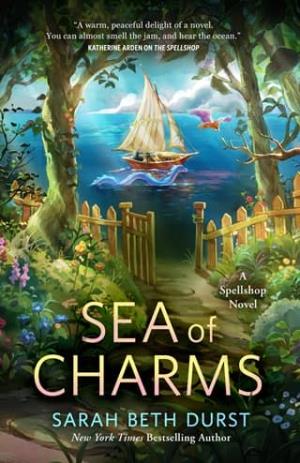
Sea of Charms (Spellshop #3)
Chapter One
Marin was alone on her sailboat, and the sea was singing.
She listened to the waves beat their rhythm on Silver’s hull, while the wind sang its melody as it filled the silver sails.
Adjusting the trim, she tried to let the waves and the wind wash away the knot of hurt and humiliation and fury that had been inside her for weeks now.
She inhaled deeply and then let out a wild scream with every bit of air in her lungs.
No one told her to be quiet.
No one told her to return to shore.
Overhead, a seabird soared eastward, so high up that it was a white dot against the bright blue, and she wondered if it flew alone by choice or chance. Or a mix of both. Like me.
She’d come so close to losing all of this.
Marin breathed in and tasted the salty air, her favorite taste, and tried to focus on that taste on her tongue instead of feeling as if she were choking on regret.
She was here on Silver now, and he couldn’t do anything about it.
He’d failed. She hated thinking about how narrow an escape it had been.
An overheard conversation. A few numbers that didn’t match up in the family account book.
If I hadn’t caught him … But she had, and it was over.
Instead of an engagement, she had this beautiful new boat, a debt that would take her years to repay, and the entire wide, wild sea before her.
So long as she didn’t return home, there would be zero risk she’d be ensnared again and zero reason for him to target her parents.
Iovar had wanted her—or not her but some subdued, shrunken version who wore her face but was content to be a landbound wife whose only desire was to support her husband’s dreams. He never loved me.
If he had, he never would have tried to take the sea from her.
Marin had wanted to be a sailor for as long as she could remember.
She’d worked with her parents on their boats ever since she was little—they were supply runners who made deliveries, both regularly scheduled and one-off requests, between the many islands of the Crescent Islands Empire.
She’d always planned to take over her parents’ business when they retired.
But Iovar … He hadn’t wanted his future wife to have a life on the sea.
He’d begun with little requests. Reasonable requests.
It made him worry, he’d said, when she sailed in rough seas.
It made him worry, he’d said, when she sailed at night.
It made him sad and lonely when he didn’t see her when he came home from work.
Or at dawn. Or lunch. But could she be a little quieter?
Did she have to laugh so loud? And maybe she shouldn’t tell such outrageous stories—everyone knew there was no such thing as a tiger-shark sea witch.
Or a kelp forest with kelp animals. He just didn’t want her to embarrass herself.
He loved her so much … And so, she’d made herself smaller.
For him. Because she thought she loved him too, and it was only a little compromise here and there, a temporary sacrifice, just until he was less anxious …
But then, through sheer chance, she uncovered what he was doing behind her back: he didn’t want a wife who took to the sea, and so he’d tried to secretly ruin her family’s business.
He’d very nearly succeeded.
But he didn’t. And that was what mattered.
She had her own boat now, outfitted for supply running, thanks to her parents.
She’d visited job boards in Dew and a few other islands and had plans to secure regular customers.
For now, she was primarily trading delivery work for supplies: bread, fruit, soap, other necessities.
But soon, if she could figure out how to cheaply secure a regular food source, she hoped to begin hoarding enough to chip away at her parents’ debt.
They’d poured everything that Iovar hadn’t swindled them out of, plus far more they didn’t have, into gifting her Silver, and Marin was determined to ensure they didn’t lose any more.
Tightening the mainsheet, Marin prepared to tack.
She had two more deliveries to make on this supply run.
She should take the safer route and circle around the islands of Iro and Nane.
It would add half a day’s journey to take the outer loop, but neither delivery was a rush—she’d get paid in full whenever she arrived—so she didn’t need to take risks.
Going between the islands … it was unnecessary, reckless, and beautiful.
Iovar would have told her to take the outer loop.
He never would have let her leave the harbor in the first place.
I didn’t take to the seas to skip out on beautiful.
Knowing it was a terrible decision, knowing that she couldn’t trust herself to make good decisions, Marin did it anyway.
She held tight to the mainsheet with one hand while with the other, she steered Silver into the wind.
She both felt and saw the sails luff, fluttering as the bow of the boat turned through the wind, and she gripped the line tighter as the boom shifted to the port side and the sail began to backfill.
At exactly the right moment, she released the mainsheet.
It zipped away from her fingers, and the sail billowed out.
With practiced ease, she grabbed the winch handle and cranked it, pulling the sail in until Silver shot forward.
It was the best feeling, when you and your boat moved as one. Grinning fiercely, she continued to zigzag, tacking into the wind, aiming for the gap between the islands known as the Painted Pass.
Countless tales and songs had been written about the cliffs of Iro and Nane: they’d been painted by two lovers, one who lived on one island and one on another.
Their parents had forbidden them to marry, and so they painted their love in the colors of sunrise and sunset.
Discovering this, their families had tried to wash the paint away, but the very rocks had been stained by the two artists’ love and, regardless of how hard their relatives scrubbed and chipped at the stone, the colors didn’t fade, until at last, both families relented and allowed the two to marry.
To this day, no wind or rain or sea could dim the colors.
Granted, there was also the more prosaic explanation—it was just minerals in the rocks acting as a natural dye. But Marin liked the love story better. If she was never going to have her own great love—and she was done with ever wanting that—then she’d treasure the fictional ones even more.
Using the wind, she guided her sailboat toward the gap between the islands. It was a narrow passageway with sharp, jagged rocks on both sides. Worse, the cliffs created a wind tunnel that made a boat hard to control. She grinned even broader as she aimed for it.
In seconds, she was within. The painted cliffs towered over her.
They were even more magnificent than the stories and songs had said.
On either side of her, the rocks blazed red, orange, and gold—such rich colors that the reflected light made the sea swim with them, a liquid sunset.
Lemon yellow danced along the top of the cliff, so high up it was barely visible, with the blue of the sky above it. She marveled at it all.
And then she heard the cry.
It sounded like the wail of a dying child, but it was far too loud and high-pitched for any human throat to make. It echoed through the gap, ricocheting off the cliff walls. Marin shivered. What is that?
The cry cascaded, like a trumpet playing falling notes. She continued to tack, zigzagging through the narrow passageway, keeping as much of her focus on her sails as possible while she watched for the source of the sound.
As she came around a red rock, she saw him:
A sea serpent.
His scales were mother-of-pearl, and his featherlike fins were dotted with blood.
His body—at least twice the length of her sailboat—was twisted around the jagged, sunset-colored rocks at the base of the painted cliffs of Iro.
He wailed his pain in a crying song that filled the canyon, echoing endlessly.
“Oh, crap,” Marin breathed.
He must have swum into the pass when the tide was higher and then gotten himself beached on the rocks when it retreated.
Perhaps he’d fallen asleep and then woken in a panic, wedging himself deeper between the rocks as he’d flailed.
His feathery, muscular tail smashed against the water as he tried—and failed—to free himself.
That tail could split her boat in two if it slammed down on her hull.
His jaws could snap her mast if she sailed too close.
There was enough space in the passageway that she could, if she was careful, make it past him by sailing just out of reach—if she timed it exactly right.
He met her eyes as she sailed closer.
Such blue eyes, as deep a blue as the ocean when the moon shone on it.
She knew what he saw: a wooden boat with silver sails that he could crush if he could reach it, piloted by a fragile human with silvery skin that matched her sails and white-and-black-striped hair tied back with a silver ribbon. She must look to him like salvation. Or lunch.
“Ahh, Marin,” Marin said, “this is a truly terrible idea.”
Because she could see: he was pinned between the rocks. If someone—someone like, say, me—were to lift just one segment of his middle up over the rocks, he should be able to leverage himself out and back into the water.
There was only a split second to decide: sail around the sea serpent … or toward him.
It wasn’t a decision.
He was trapped; she could free him.
Probably. Maybe. If she was lucky. And quick. Very, very quick.
Marin aimed for him. She locked the lines in place and ran across her boat onto the bow. She didn’t stop when she reached the tip—she leaped off and landed, hard, on the rocks. She hissed as she scraped her knee.