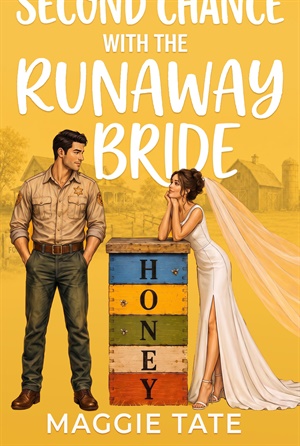
Second Chance with the Runaway Bride (The Sweet Happily Ever After #4)
1. Chapter 1
Chapter one
Savannah
The photographer wants one more shot before the dress goes on.
I stand at the window in my robe, hotel coffee gone cold on the sill, and try to remember what he told me to do with my hands.
“Relax,” he says. “Try to look like you're in love.”
I wish that felt as natural as he makes it sound.
I rest them on the windowsill.
The bride’s room doesn’t stop at a room. It takes up almost half of an entire hotel floor.
It looks out over the courtyard where the ceremony chairs are already lined up in rows, white ribbon tied to every third one.
Preston and his mother chose one of the fanciest hotels in New York City.
Somewhere past the courtyard is the ballroom where two hundred people will eat dinner tonight and call it the happiest day of my life.
I try to look like a woman who believes that.
The bride’s room is already loud.
Two stylists arguing quietly about which pins go where.
A steamer hissing near the closet.
On the wall by the door, someone taped up the schedule this morning like a shift assignment. Hair. Makeup. Bride Getting Ready Photos. Dress. Veil. More photos. Family photos. Ceremony. Every minute accounted for.
Liv sits on the arm of the couch, scrolling her phone like she's bored. She is not bored.
She's been my second-in-command at Blake Co.
since year two, back when it was just the two of us and a shared desk and neither of us had figured out yet that we'd be doing this for the next fifteen years.
She reads a room faster than anyone I know, then decides whether to say something about it — which is more restraint than most people give her credit for.
“Something's off with you,” she says.
“You're worrying me.”
“You're too calm. Pleasant. Like you're modeling 'bride' instead of being one.” She sets the phone down. “I've seen you more relaxed pitching buyers who hated our whole line.”
I don't have a good answer for that, so I let the stylist turn my chin instead.
Liv doesn't push.
She never has to.
She just says the true thing once and lets me trip over it later.
Preston pokes his head in around two-thirty, already wearing his tuxedo, a groomsman trailing behind him with two ties draped over one arm.
“We can't decide on the tie,” he says. “Silver or the blue one.”
“Silver.”
“That's what I said.” He kisses my forehead, careful not to touch the makeup, already turning to go. “You look beautiful. I'll see you down there.”
He's gone before the door swings shut.
Twenty seconds, maybe less.
I stand there waiting for the rest of it.
I can't wait to marry you.
See you in a few hours, darling.
Anything that sounds like a man who's counting down the minutes until I'm his wife.
But there isn't anything else.
The hairstylist tips my chin back toward the mirror.
It isn't the first time. I think of the night I called him from the studio at half past eleven.
I was still buzzing because a sketch I'd been fighting for three weeks had finally come together — the fall coat, the one that ended up on the cover.
I talked for a full minute before I noticed he'd gone quiet on the other end.
“That's great,” he said, when I finally stopped. “Did you move the fitting Thursday, though? I've got the Hendricks call at ten.”
I told him I'd moved it. I don't remember if I actually had.
Three months ago, a writer sat across from me at the Blake Co. office, running through the usual questions about the company.
Then, near the end, she asked, “What are you most excited about after the wedding?”
The honeymoon, I told her. Preston planned a safari in South Africa, then we're spending a week in the Seychelles. I'm taking two whole weeks off. No work, no phone, no schedules. Just being with Preston.
I added the last part because it sounded good in an interview.
Because that's how I was supposed to feel.
The problem was, I didn't.
The two weeks off was the part I meant. Mostly.
Even that was optimistic. Time away from Blake Co. never really means time off. There would be emails. Calls. Something Liv needed me to approve. I'd probably make it forty-eight hours before I checked in.
But I wanted to try.
The writer smiled. A safari. How romantic.
Luxury safari, I said. Preston doesn't really do dirt.
She laughed and moved on.
Mrs. Harrington arrives at three with a folder under one arm, already talking before the door swings shut behind her.
“I finalized the seating chart for dinner,” she says, setting the folder on the vanity like a gift. “I want you to see this before they put place cards on the tables.”
I open it because it's easier than not.
Preston's side takes tables one through twenty-one—partners from the firm, someone from the mayor's office, a food critic Mrs. Harrington has mentioned twice this week like his opinion of the shrimp is a matter of public record.
All of it close to the head table, close to the band, close to wherever the photographer plans to stand for the toasts.
My guests start at table twenty-two.
There are only twenty-four tables.
Liv's there. A dozen or so of Blake Co. staff. A few friends.
“Table twenty-two is lovely,” Mrs. Harrington says, not looking up from her phone. “Good sightline to the dance floor.”
I close the folder.
There's a version of me that says something. My work family, the people I am closest to, would like to celebrate with me from some other place than the back of the ballroom. The people who helped me build Blake Co. shouldn't be an afterthought at my own wedding.
But that version of me hasn't spoken up much in the last six months, and she isn't starting now with the stylist's hands still in my hair.
“It's fine,” I say.
The answer comes so easily I barely have to think about it.
That's what bothers me.
I've gotten very good at answering questions about my own life without stopping long enough to wonder if the answer is still true.
Liv is watching me in the mirror, and the sadness on her face is hard to miss.
She knows. Maybe she's known longer than I have.
The reconstruction of the vows is what actually gets under my skin.
I wrote mine three weeks ago, late, alone in the office after everyone else had gone home.
I remember the exact line I wrote about the Band-Aids Preston keeps in his wallet because I never have the patience to break in a new pair of shoes—a small, specific, unglamorous thing I meant as something sweet.
Mrs. Harrington hands me a typewritten half sheet of paper at three-thirty.
Different from what I wrote.
Not my handwriting — printed, clean serif font, my name at the top like a byline.
“I had Danielle tidy them up,” she says. “You've had so much on your plate. I didn't think you'd mind.”
I read them standing there in my robe.
The Band-Aids line is gone. In its place is a sentence about building an empire and a family in the same breath.
It's good.
Beautiful, actually.
Every sentence is polished and gracious and completely appropriate for the woman everyone in this room seems to think I am.
I read it again, looking for something that sounds like me.
I don't find it.
“Can I still change it before the ceremony?”
“Of course you can.”
She's already checking her watch.
“Though hair's running behind, and we need you in the dress by four.”
“It's fine.”
The dress goes on at four exactly.
One piece at a time. The slip, the boning, the long line of buttons up the back that takes two people and a metal hook to close.
I stand with my arms out and let it happen, the way I've let a lot of things happen the last few months, telling myself each individual thing is too small on its own to be worth a fight.
When the last button closes, someone turns me toward the mirror.
I look—expensive.
Correct.
If a client brought me this dress to critique, I'd struggle to find a single flaw in the line of it.
What I'm looking for isn't the dress. It's the thing underneath it—the specific brightness I've watched cross other brides' faces in other mirrors, the look of someone who can't quite believe her own luck. I know exactly what it's supposed to do to a face.
Mine doesn't do it. I have good posture and careful concealer and eyes that are working hard to seem like they slept last night.
I stand there a beat too long, waiting for it to show up late.
It doesn't.
“One more thing,” Mrs. Harrington says, and reaches for my neck before I understand what she's doing.
My hand comes up too late. She already has the clasp of my mother's necklace pinched between two fingers, working it open with the same brisk motion she'd use on a crooked collar.
“This is lovely, but it's fighting the neckline.” She's already holding the replacement — gold, ornate, unfamiliar, lifted out of a velvet box like she planned this an hour ago. “It was Preston's grandmother's. Much better with this dress.”
The clasp gives.
I feel the exact weight of it leave my skin — the small drag of the chain sliding free — and my throat goes tight and hot so fast it startles me.
My eyes burn. I blink hard, twice, and manage to keep it there, right at the edge, not spilling over, because if I start crying right now nobody in this room will let me stop for hair and makeup.
I don't reach for it. I don't say that was my mother's, she wore it in her own wedding photos, it's the only thing of hers I put on for good days.
I watch it disappear into Mrs. Harrington's palm.
I swallow the hurt climbing up my throat. Eight months of practice has made that almost easy.
She fastens the new one without asking if it's all right. It isn't ugly. It isn't even heavy. It just isn't mine.
Liv doesn't say a word while it's happening. The second Mrs. Harrington steps out to take a call, though, she's off the couch and standing in front of me, hands on her hips.
“Savannah.”
“I'm fine.”
“You are the furthest thing from fine I have ever seen you.”
Her expression hardens. She lowers her voice. “You want me to get it back? I'll get it back.”
“Don't.”
I press my palms flat against my thighs, steady, the way I do before a runway show when my hands want to shake and can't be allowed to.
“It's fine. It's a necklace.”
Liv looks at me like she doesn't believe a single word.
Which is fair, because I don't either.
My fingers lift to the strange chain at my throat.
I could ask for Mom's back.
Instead, I lower my hand.
And that's when something about this stops feeling small.
The seating chart.
The vows.
My mother's necklace.
None of them are reasons not to get married. I know that.
But standing here in a dress everyone loves, wearing jewelry someone else chose, about to say vows someone else rewrote, I have one terrifying thought.
How long have I been letting other people decide what my life is supposed to look like?
The room keeps moving around us — someone steaming the hem, someone confirming with the photographer that portraits start at five, plenty of time before the ceremony.
I stand in the middle of it and hear that magazine question again.
What are you most excited about after the wedding? The same empty space I felt during that interview is here again.
Preston hasn't done anything wrong.
That's what makes this so hard.
There's no betrayal to point to. No terrible thing he's done that gives me permission to walk away.
I just don't want to marry him.
He's a good man. He deserves better than a woman standing in a hotel room two hours before their wedding trying to convince herself she wants to be there.
I should have figured this out months ago.
Yesterday.
Anytime before two hundred people took their seats downstairs.
I can't do this to him.
And then I realize I've had it backward.
Walking away will hurt him.
Marrying him because I'm too afraid to walk away would be worse.
He deserves a woman who can't wait to walk toward him.
And I deserve to know what that feels like.
For the first time all day, something inside me is absolutely certain.
“I need five minutes,” I say.
Nobody argues, because brides always need five minutes.
I don't take five. I take the back stairwell instead of the elevator, because nobody thought to post anyone there, and I'm three blocks from the hotel before a single person thinks to look anywhere but the bathroom.
I can only imagine what I look like—wedding dress bunched in one hand, high heels in the other, veil flying behind me as I sprint down a busy Manhattan sidewalk.
A few people turn.
Someone shouts.
Then I see the cameras.
A few photographers outside a building across the street realize what's happening fast enough to start shooting.
Most don't.
By the time anyone realizes they're watching the bride from the wedding they're supposed to be covering sprint down the street, I'm already around the corner and heading into the parking garage.
My car is the rental meant for the airport run tomorrow morning. I get in still wearing all of it — dress, veil, someone else's necklace — and the train catches in the door when I pull it shut. I yank it free without checking what tore.
I don't have a plan. I have a full tank of gas, a phone I turn face-down on the passenger seat, and a highway that's going to take me somewhere whether I've decided where or not.
For the first twenty minutes I don't think. I just drive, both hands on the wheel, veil still pinned, watching the city thin out into overpasses and gas stations and signs for towns I've never been to.
My phone buzzes twice against the seat, then a third time, then stops.
I ignore it.
Somewhere past the edge of the city, on a stretch of highway with nothing but sky on either side, I stop crying long enough to notice I've already merged onto the road heading south. Not toward my apartment. Not toward the airport.
I'm not going to be anywhere near New York tonight.
I reach over and pull the veil loose, finally, dropping it in the passenger footwell where it sits crumpled and strange, like something that belongs to someone else's day.
Then I drive, and I let myself think about the one place that never once made me feel like I had to perform being happy.