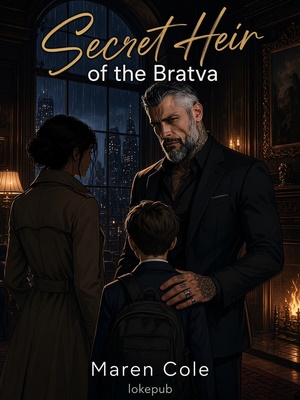
Secret Heir of the Bratva
1. Aria
ARIA
The key turns in the lock with a metallic click that echoes down the empty Philadelphia street.
Midnight, and I’m finally closing up the gallery after another fourteen-hour shift that netted me maybe three sales.
My feet ache, my lower back screams from standing on the concrete floor, and all I want is to hurry home and collapse into bed next to Daniel and sleep until my alarm drags me back to consciousness at six.
I drop the keys twice before I get them into my purse.
My hands are shaking. I’ve been skittish all day, ever since I woke up with that feeling—the one I haven’t had in months. The prickling awareness at the base of my skull that says run.
But I can’t run.
Not anymore.
Daniel starts second grade this fall, and he finally has friends—some stability.
I can’t rip him away from that because of paranoia.
Except it’s not paranoia.
I see him the moment I straighten up and turn toward home.
He’s standing on the sidewalk twenty feet away, hands in the pockets of an expensive charcoal coat.
Streetlight catches the silver threading through his dark hair at the temples.
My breath catches.
That’s new. So are the lines around his eyes.
But everything else is the same.
The powerful build that always made me feel delicate and protected until I learned what those hands could do.
The gray eyes that used to look at me with such warmth and passion.
The gray eyes that are looking at me right now like I’m prey he’s finally run to ground.
Maksim Sokolov.
My vision tunnels.
The purse slips from my numb fingers and hits the sidewalk with a dull thud.
I can’t breathe.
Can’t think.
Eight years.
Eight years of running, of hiding, of building a life from nothing under a name that isn’t mine.
Eight years of telling myself he’d never find me, that I’d been careful enough, smart enough.
I was wrong.
My body moves before my brain catches up. I turn and run—not toward the apartment where Daniel is sleeping, but away from it. Away from him.
If I can lead Maksim away, if I can just get him to follow me instead of—
“Aria.”
The sound of my real name stops me cold.
My legs lock, and I’m standing frozen on the sidewalk three doors down from the gallery, breath coming in short, panicked gasps.
His footsteps are measured and unhurried. He knows I have nowhere to go.
“Don’t run.” His voice is closer now, right behind me. “You know I’ll catch you. Then I’ll have to go upstairs to find out why you’re so desperate to lead me away from that apartment.”
Ice floods my veins. I turn slowly, and he’s there. Close enough that I can see the stubble shadowing his jaw, the scar I used to trace with my fingers, the small lines around his eyes that weren’t there before.
“I don’t know what you’re talking about.” My voice doesn’t sound like mine. It’s too high and thin. “My name is Sarah Mitchell. You must have me confused with—”
“Stop.” He takes a step forward. I take one back, and my spine hits the brick wall of the dry cleaner.
“I’ve been watching you for five months, Aria.
I know where you work and where you live.
I know you take the 7 bus to the grocery store on Tuesdays because it’s cheaper than the one in your neighborhood.
I also know you haven’t bought yourself new clothes in over a year.
” His eyes travel down my body, taking in the threadbare jeans and donated sweater. “I know everything.”
“Then you know I’m not who you think I am.” I try to slide along the wall, but he moves with me, keeping me trapped. Panic is coursing through me. “Please, just leave me alone.”
“I can’t do that.” His handsome face is impassive. “Not anymore. Not now that I’ve found you.”
Air is getting harder and harder to get into my lungs. “I don’t know you.” The lie tastes like ash.
He scoffs before he pulls out his phone, swiping through something before he holds it up.
The screen shows a photo of me from eight years ago.
Longer hair. A real smile.
Standing in front of the gallery in Brighton Beach where we met, where I used to work before—
Before everything fell apart.
“This is you,” he says quietly. “Ariana Delano. Born in Syracuse. Parents deceased. Graduated from NYU with a degree in art history. Worked at Levitsky Gallery for three years.” He swipes to another photo of me and him together, his arm around my shoulders, both of us laughing at something.
I remember that day. It was two weeks before I ran. “This is us.”
I close my eyes. “That was a long time ago,” I whisper.
“Eight years, three months, and sixteen days,” he says roughly. “Not long enough for me to forget.”
When I open my eyes, he’s staring at me with an intensity that makes my skin prickle.
“What do you want?” I ask.
“Answers.” He pockets the phone. “You disappeared without a word. No note. No explanation. Your apartment was empty—everything gone except the furniture. Your phone disconnected. Your bank accounts closed. It was like you never existed.” He pauses, jaw tightening.
“I thought someone had taken you. Hurt you. I searched everywhere. Questioned everyone. Turned over every rock in this city trying to find you.”
The anguish in his voice is real, and it cuts deeper than any threat could.
Because part of me—the part that loved him, that spent three perfect months in his arms—wants to reach out and comfort him.
But I can’t. I can’t let myself forget what he is.
“I had to leave.” I force the words out. “That’s all you need to know.”
“No.” He shakes his head. “That’s not enough. You don’t just disappear for eight years without a reason. What happened that night? What made you run?”
I press my lips together and say nothing.
“Aria.” He moves closer, and I flatten myself against the brick. There’s barely a few inches between us at this point. He’s so close I can feel his body heat. “Talk to me.”
“No.” My voice is barely a whisper.
He stares at me for a long moment, and I can see him thinking. Then his expression changes, hardening into something that makes my blood run cold.
“Fine,” he says. “Don’t tell me. But you’re going to open that gallery door, and we’re going to have this conversation inside and away from the street.”
“No.” I shake my head frantically. “No, I’m not going anywhere with you.”
“That wasn’t a request.” He gestures toward the gallery. “Open the door, Aria. Now.”
My sense of self-preservation is screaming at me to just listen to him and open the door, but I’m not listening to it for once. I tilt my chin up and square my shoulders, trying to appear more brave than I actually am. “And if I don’t?”
He raises an eyebrow before he pulls out his phone again, typing something. “Then I’ll open it myself. And I’ll go upstairs to your apartment to see what—or who—you’re trying so hard to keep me away from.”
My heart stops. “There’s nothing,” I lie, heart thumping erratically.
“Liar.” He shows me the phone screen. It’s a blueprint of my building, with the gallery on the first floor and two residential apartments above it.
The third floor is highlighted. “I know you live on the top floor. I know there’s someone else living with you.
So either you open that door and we talk like adults, or I go up those stairs and find out for myself. ”
“You can’t.” The words come out strangled. “You have no right—”
“I have every right.” His voice drops and becomes almost gentle, which is even scarier. “Because I think I know what you’re hiding.” A sly smile crosses his face. “Or rather, who.”
I want to throw up, horrified. No. No, he can’t know. I’ve been so careful.
“I’m calling the police.” I fumble for my purse, remembering I dropped it back by the gallery door. “You can’t just threaten me like this.”
“Go ahead.” He doesn’t look concerned. “Call them. Tell them Maksim Sokolov is harassing you. See what happens.”
That’s when I remember.
The Sokolov Bratva.
The connections.
The money in every pocket that matters.
If I call the cops, they’ll take one look at him—at his expensive coat, his air of authority—then at me.
The woman living under a fake name with no legal documentation, working cash jobs, and hiding from something.
They’ll side with him.
“Please.” I hate how my voice breaks. “Please just leave us alone.”
“Us.” He latches onto the word immediately. “So there is someone upstairs.”
I close my eyes. Stupid. So stupid.
“Last chance,” Maksim says. “Open the door, or I go up those stairs.”
I think about running or screaming for help. Hell, I even think about fighting him.
But he’s bigger and stronger, and he has resources I can’t even imagine. If I make a scene, and I draw attention, Daniel will wake up. He’ll hear the commotion. He’ll be scared.
I can’t let that happen.
“Fine.” The word tastes like defeat. “But we stay downstairs. Away from—” I catch myself. “We talk downstairs.”
“Agreed.” He steps back, giving me space to move.
I walk back to the gallery on shaking legs.
My purse is still on the sidewalk where I dropped it.
I pick it up, fingers clumsy as I fish out the keys.
It takes three tries to get the right key, and when I finally manage to slot it into the lock, my hands are trembling so badly I almost drop them again.
The door swings open. The bell chimes and it’s too cheerful and normal for this moment.
I step inside, and Maksim follows.
He closes the door behind him with a quiet click that sounds like a prison cell locking.
The gallery feels smaller with him in it.
He’s always had that effect—filling up space, making the air feel thinner.
I back up behind the counter, needing something between us. Some barrier, however useless.
I grip the edge of the counter so hard my knuckles turn white. “What do you want?” My voice trembles even though I’m trying so hard for it not to.
“I already told you. Answers.” He moves deeper into the gallery, looking around. He takes in the cheap fixtures, the donated furniture, and the secondhand display cases. His expression doesn’t change, but I can feel his judgment. “Why did you run?”
I shake my head. “I can’t tell you that.”
“Can’t, or won’t?”