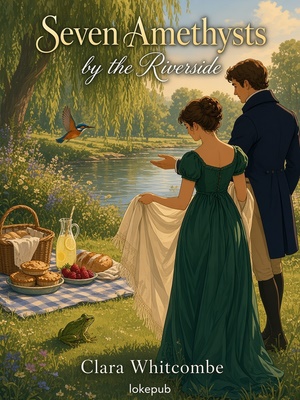
Seven Amethysts by the Riverside
Chapter One
Pack the Peppermints
"The riverside, above Maidstone," Verity read aloud. "A picnic. A lady's amethyst brooch, vanished from her shawl. The lady is distraught, the shawl is innocent, and the brooch, Q. writes, is conspicuous by its absence, which is the worst kind of conspicuous."
Lord Alexander Crowe lowered his newspaper and regarded his wife over the top of it. "Q. sent for us? The magistrate?"
"Magistrate Quinn," said Verity, folding the letter with the care of a woman handling evidence. "He writes that the picnic party searched the riverbank for two hours and found nothing but a frog, which they have declined to arrest."
"Wise," said Alexander. "Frogs have excellent alibis. They are always in the pond."
"Two hours, and a missing brooch, and a shawl with nothing to say for itself. Pack the peppermints, Alexander. We are going outdoors."
"The last time you said that," said Alexander, "I was eaten by midges."
"The last time I said that, you solved nothing and complained beautifully. Bring the magnifying glass."
"I am bringing the magnifying glass," said Alexander with dignity. "I carry it always now. Ever since the palm-pot business."
"Ever since I told you to," said Verity.
* * *
Sir Peregrine Fallow's meadow sloped down to the Medway in a long green sigh, and upon it the picnic had spread itself like a rumor: blankets, hampers, a pyramid of pies, and a quantity of summer sunshine that seemed, to Verity, almost suspiciously perfect.
A kingfisher went past like a dropped jewel, and Verity lost the next three minutes entirely.
"Verity," said Alexander. "The humans."
"The kingfisher was turquoise," said Verity dreamily. "Did you see —"
"I saw. Observe the bipeds now."
The bipeds: Sir Peregrine, round and beaming, presiding over the ham; Lady Fallow, thin and kind, presiding over everything else; the Reverend Mr. Obadiah Plimpton, already eyeing the syllabub with the intensity of a man choosing a text; Miss Honoria Vane, whose bonnet had seen three reigns and remembered all of them; and Mrs. Letitia Harlow — a widow built like a dovecote and twice as certain — holding court upon a camp stool with a cream shawl about her shoulders.
And pinned to the shawl, winking purple in the sun, the brooch.
"Oh," breathed Verity. "Oh, it is beautiful."
It was: seven amethysts — a great oval stone at the center, ringed by six smaller round ones — set in silver like a spray of violets.
"Seven amethysts, Aunt!" cried a young gentleman, bounding up with the waistcoat of a poet and the debts of a prince. "A poet might live a year on seven amethysts!"
"Cyril," said Mrs. Harlow fondly. "My nephew, Mr. Cyril Pettifer. He admires everything and pays for nothing."
"I pay in verse," said Cyril, bowing to Verity. "Lady Crowe! Your husband's cravat is a poem."
"It is a cravat," said Alexander.
As Cyril bent admiringly over his aunt's shawl, something pink peeped from his coat pocket — a folded paper, the particular pink of a tailor's bill. Verity knew the shade. Alexander's tailor used the same pink, and Alexander's tailor was a patient man, but even patience keeps a ledger.
Verity produced her peppermint tin and offered it around. Cyril took three at once.
"Nerves," murmured Alexander, watching him go. "Or greed. With poets it is so hard to tell."
"Three peppermints," said Verity, "is a statement."
"It is a sweet tooth."
"It is both. And Alexander — the pink paper. Tailor's bill."
"Half of England owes its tailor," said Alexander. "The other half owes its hatter."
"Half of England does not stare at seven amethysts the way your poet stared at those seven amethysts."
"Fair," said Alexander. "But staring is not stealing. I stare at pies."
"You steal peppermints."
"Only yours," said Alexander, "which is marriage."