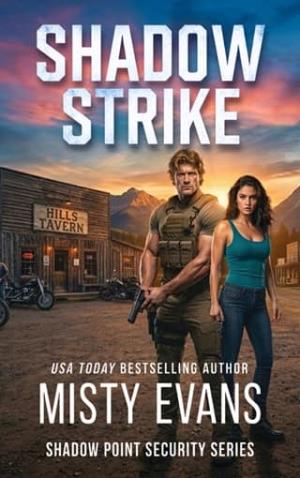
Shadow Strike (Shadow Point Security #3)
Chapter 1
CHAPTER ONE
Hill’s Tavern
Blackridge, Montana
The two men in the back booth hadn’t ordered a second round.
Regan noticed things like that. It was a professional hazard—six years of true crime journalism had rewired her brain into a pattern-recognition machine that couldn’t be switched off, not even on a Wednesday night when all she wanted was to get through last call without any drama.
She noticed the couple by the window who’d stopped talking forty minutes ago and were now performing the particularly painful mime of two people pretending to look at their phones.
She noticed the guy at the bar who’d switched from beer to water without being asked, which meant he was either driving or had made a decision she respected.
She noticed that the jukebox had been stuck on the same classic rock rotation since seven p.m. and that nobody had bothered to change it.
She noticed the two men in booth seven who’d been nursing the same drinks for ninety minutes hadn’t once looked at each other. Men who came to a bar together and didn’t talk were either cops or trouble.
Regan was fairly certain these two weren’t cops.
Third Thursday in a row, she noted mentally, filing it the way she filed everything — date, time, observable details, behavioral pattern.
Two males, late thirties to mid-forties, in motorcycle leather cuts with no visible patches on the front.
Boots. The specific kind of stillness that came from practice rather than personality.
She picked up a rack of glasses from behind the bar and carried it toward the back, taking the long route through the room because she was absolutely not doing a threat assessment on her own customers. She was just collecting glasses. This was a completely normal thing for a bar owner to do.
The closer one tracked her movement without turning his head.
Yep. Definitely trouble.
“Last call in twenty,” she announced to the room at large, which earned her a groan from the couple at the window—ironic, since they’d been actively miserable for the better part of an hour—and a nod from the sensible water-drinker at the bar.
The two men in booth seven said nothing.
By twelve-fifteen, the place was empty except for her, the faint smell of spilled beer that never fully left the floorboards, no matter how many times she mopped, and the silence of a closed room that used to be loud. At least the MC bikers hadn’t caused any trouble.
They also hadn’t left a tip.
She’d always liked this part of the night, back when it was her father’s bar, and she was a teenager doing homework in the back booth, listening to the sounds of closing.
The specific sequence of it—glasses washed, chairs up, lights dimmed in the right order—had felt like a ritual then. Comforting in its predictability.
Now she owned the ritual, and it felt less like comfort and more like a checklist nobody else was going to complete.
She finished wiping down the bar, wrung out the rag, and started on the tables. She put a slow song on the jukebox, one her father had loved, her nightly tip of the hat to him. Outside, a car passed on the empty highway, headlights sweeping briefly through the front windows.
She found the envelope under the back door. She almost stepped on it. Would have, if the corner hadn’t been sticking up. She stopped and flinched as if it were a spider scrambling across the floor.
White envelope. No writing on the outside. It was the second one this month.
The first had arrived three weeks ago on a Monday, tucked under the door with the same lack of ceremony. The number inside had been insultingly specific— four hundred dollars a month , the message read, for the continued goodwill of certain interested parties . For your protection .
Regan had read it twice, taken photographs of it, placed it in a labeled folder, and then poured herself two fingers of her father’s good bourbon and stood at the bar for a while thinking about what her father would have done.
He would have called the police. She could almost hear him telling her to do so now.
She hadn’t called them because she’d spent six months researching the Canon Outlaws, and she knew the names of two Blackridge deputies who attended their rallies, called them friends, and went fishing and hunting with a few of them.
And that was before you got to the judges.
She pulled on latex gloves, crouched and picked up the envelope, carried it to the bar, and slit it open with the letter opener she’d started keeping within reach three weeks ago.
It sat next to her father’s loaded shotgun.
A girl needed to be practical, especially one running a biker bar in Montana.
The monthly rate had gone up by fifty percent. There was a handwritten line at the bottom of the note that hadn’t been in the first one.
We know you’re alone most nights .
Regan read it again. Set it down. She picked up her phone and photographed both sides of the note, then the envelope, then the door where it had been slid under, because documentation was what she knew how to do. Doing it kept her shaking hands a little steadier.
She added the photos to the folder labeled simply OL for Outlaws. Four hundred dollars a month was almost funny. Eight hundred was just insulting. Did they have a rate card? A sliding scale based on square footage and stubborn women?
The dark humor lasted about thirty seconds before the actual weight of the situation settled back in.
She locked the back door. Checked it twice. Went and checked the front.
Once she finished closing, she set her laptop on the bar and opened it. Her research folder on the Canon Outlaw motorcycle gang took up too many gigabytes and too many months of her life.
It was midnight, and she had a seven a.m. delivery—but looking at it had become a habit when she was unsettled. Like checking that the stove was off. Reassuring herself that she understood what she was dealing with.
The organizational chart was on top. She’d rebuilt it four times as new information came in, and it was starting to look less like a motorcycle gang and more like a small corporation with a violence problem.
Ryder Briggs was at the top, with the infrastructure his great-uncle Ben had established in the 1960s.
The Briggs family had been maintaining it ever since.
Ben’s son Wade had inherited the gang, and Wade’s son, Clive, had been next in line.
When Wade had stepped aside ten years ago, Ryder, rather than Clive, had stepped into his shoes.
Thanks to Ryder’s father, Sheriff Ray Briggs and Wade’s brother, the Outlaws had compromised local law enforcement, had sympathetic city and county officials in their back pocket, and ran a network of legitimate front businesses that provided cover and cash movement.
She scrolled past Ryder, past the operational layer, to the file she’d opened and closed more times than she’d admit.
Clive Briggs.
CB, they called him. Born into the famous biker gang, he had once been considered the golden boy. The one destined to lead the Outlaws when Wade no longer could. Except Clive was the anomaly—the Briggs who got out.
A retired Army Ranger, he’d been honorably discharged. Her digging into him revealed he’d been a specialist in surveillance and intelligence gathering and was currently employed by Shadow Point Security.
The business, which operated out of a nondescript compound forty minutes north of Blackridge, had a reputation for being very good at very difficult problems. They didn’t share the names or backgrounds of their employees, but she knew Clive had been back in town since his father’s stroke, and he hadn’t stepped into Wade’s position.
She’d been considering contacting him for three months. As a source. For her podcast, Cold Circuit.
Sure, Regan. That’s definitely why you keep opening this file .
There was one photograph from his Ranger days—not an official headshot but a candid someone had posted to a closed Facebook group that she’d accessed through a source.
Clive was standing with three other men outside what looked like a transport vehicle, all of them in dusty fatigues, all of them squinting slightly in bright sun.
He was several inches taller and the only one smiling.
As if in the midst of chaos, he was calm, alert, and ready for whatever life handed him.
He had his father’s build. Wade Briggs was a big man. His son had come out bigger. But Clive had his mother Mary’s tousled brown hair and her emerald-green eyes. Her easy smile.
Regan closed the file. Closed the laptop. Turned off the bar light—the last one, the one her father had always left burning—and stood in the dark for a moment.
The note was in its bag. The door was locked. The two men from booth seven were long gone, but the crawling sensation they’d triggered lingered.
We know you’re alone most nights .
She could go upstairs and wake her mother, dozing in the office. Tell her about the note. Lucy would want to know.
If she did that, Lucy would be awake until four a.m. running catastrophic scenarios over her morning coffee, and someone had to be functional tomorrow.
So. Not tonight.
Regan went upstairs to wake her mom and take them both home.
At one a.m., she was at her desk in her bedroom, which was nothing more than a door on filing cabinets her father had helped her build at seventeen.
She’d always meant to replace it with something that didn’t make her look like a grad student, but here she sat with a mug of tea she’d forgotten to drink, her headphones around her neck, and the cursor blinking in the episode notes document she’d been pretending to work on for an hour.
Episode forty-seven of the Cold Circuit podcast was supposed to be about a cold case out of Whitefish that her listeners had been requesting for months. She’d done the research. She had the outline. She had two interview subjects lined up.
She hadn’t written a single word of it in three weeks.
Partly because the case required a kind of focused attention that had lately been slipping away from her.
Partly because every time she sat down at this desk, her mind went sideways to the Canon Outlaws material sitting in a folder two clicks away, and the question she’d been circling for months: when ?
Not whether. She was past whether.
She had the documentation. She had the sourcing. She had the organizational chart, the financial records, the incident reports, and the name of a former Outlaw foot soldier who’d agreed to go on record under a pseudonym. The story was ready.
The question was whether “ready” was the same as “safe.”
Not for herself. For Mom.
There it was—the thing underneath the thing.
Regan could handle risk to herself with what she privately considered a reasonable level of equanimity, which her therapist had once called dissociation and which Regan had decided to take as a compliment.
She’d published stories that got her death threats before.
She’d had a source’s location leaked by a DA who didn’t appreciate her coverage of his office.
She had, on one memorable occasion, received a bouquet of dead flowers from a man she’d helped put in prison, which had been genuinely creative and which she’d photographed and added to a file labeled simply: Fan Mail .
And of course, there was the fact that Cold Circuit’s big breakout series had been about Sheriff Ray Briggs.
She’d exposed him, and his dealings with the Outlaws, with brutal journalistic expertise.
The man now sat in prison. That one had landed her more than a few death threats and harassment from members in the sheriff’s department who worshiped Ray with a dedication she found disturbing.
But her mother worked nearly every day at the bar, just like Regan. It was a family business; there were no holidays or PTO.
And Lucy insisted on walking to her car alone at eleven p.m. on the nights she left before Regan because she’d been doing it for thirty years and didn’t see why she should stop now.
Her mother had no idea that her daughter had spent the last six months building a brand new investigation that would, when published, make Ryder and the Canon Outlaws even more unhappy with the Regan than they already were.
The note lay flat on the desk beside the keyboard under the lamp. She’d done her best to ignore it. Thinking about Lucy, the mother she’d gotten her fearlessness as much as her stubbornness from, made her stare at it.
We know you’re alone most nights.
She opened the laptop. Opened the research folder. Opened the file on Clive Briggs.
His photograph looked back at her, the smile on his face, as if he were fearless, too. He must be to have walked away from the Outlaws when he was eighteen and made a life for himself in the Army.
Shadow Point Security—she had the number and address. She’d had them for three months, right there in the file, a professional justification sitting ready-made for the moment she needed it.
He’s Ray Briggs’ nephew , she reminded herself. There was no way, regardless of the fact that Clive had gotten out of the gang, that he would be interested in talking to her. Hell, he might even be back with the motorcycle gang for all she knew.
She closed the laptop. Opened it again.
She picked up her phone. Put it down. Picked it up again.
It was one in the morning, and she was not going to make decisions in the middle of the night based on an unsigned note from people who thought eight hundred dollars a month was a reasonable rate for — what, exactly?
The continued absence of something bad? Protection from a threat they were also the source of?
Organized crime as a subscription service. Zero stars, would not recommend .
She set the phone face down on the desk and pulled the episode notes back up on the screen. She would deal with the extortion in the morning.
She typed three sentences about the Whitefish case and deleted two of them.
Outside, on the street below her window, a car idled for a moment and then moved on.
Regan noticed but didn’t stew about it. She was fine.
She was alone most nights, and she was completely fine with that.
She was going to finish this outline and get four hours of sleep.
In the morning, she would figure out what to do about the note, the men in booth seven, and the gigabytes of material sitting in a folder on her laptop like an unexploded device waiting for someone to decide it was time.
She typed another sentence.
Deleted it.
Call him , said the part of her brain that had been carrying this longest. You already know you’re going to .
“Tomorrow,” she told it.
The cursor blinked.