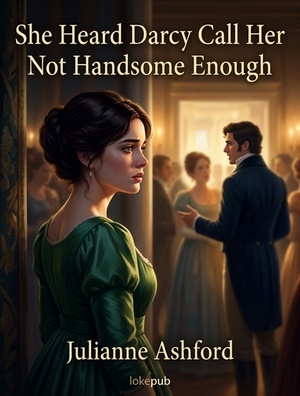
She Heard Darcy Call Her Not Handsome Enough
Chapter One
The assembly room at Meryton was too warm, too loud, and too full of Lucases.
Elizabeth Bennet did not mind any of it.
She had danced twice, laughed more than that, and lost Jane somewhere near the punch table to Mr. Bingley, who looked at her sister the way men in novels were supposed to look and rarely did.
She was fanning herself near the wall, half listening to Charlotte Lucas complain about the heat, when the tall gentleman's voice reached her. Not directed at her. Directed at his friend, some six feet away, in the particular carrying tone of a man who assumes the room exists to be ignored by him.
"Come, Darcy," Bingley was saying, "I must have you dance."
"I certainly shall not. You know how I detest it, unless I am particularly acquainted with my partner."
Elizabeth turned her fan a half inch and kept listening. She could not help it. Charlotte had stopped talking too.
"There is not another woman in the room whom it would not be a punishment to me to stand up with."
"I would not be so fastidious as you are," Bingley said, and then, lower, "there's one of her sisters sitting down just behind you, who is very pretty."
She felt it before she understood it. The pause. The half turn of a head. A pair of eyes finding her, holding a moment longer than was polite, and moving on as if she were a chair someone had misplaced.
"She is tolerable, but not handsome enough to tempt me. I am in no humour at present to give consequence to young ladies who are slighted by other men."
The fan stilled in her hand.
She did not know, afterward, how long she stood there. A few seconds. Long enough for the sentence to finish traveling the six feet between them and land somewhere under her ribs, and stay.
"Lizzy?" Charlotte's hand touched her elbow.
"I am quite well." Her voice came out steady. She was almost proud of it. "Warm, only."
Charlotte glanced toward Bingley's party, where the tall gentleman had already walked off, hands clasped behind his back, surveying the room like a man counting the ways it had disappointed him. "That is Mr. Darcy. Ten thousand a year, they say."
"I heard what he said," Elizabeth said, before she could stop herself.
Charlotte's face did something complicated. Sympathy, and beneath it, the particular relish of a friend who has just been handed a very good story. "Did you? Oh, Eliza. What an insufferable man."
"Insufferable," Elizabeth agreed. She made herself smile. It felt like lifting something heavy. "I shall have to tell it well, at least. A woman ought to get some entertainment out of being called plain."
Charlotte laughed, delighted, already composing how she would repeat it to her mother. Elizabeth laughed too, a beat behind, and discovered that laughing did not undo the thing sitting under her ribs. It only gave it somewhere to hide.
She danced twice more that evening. She was, by every outward measure, in excellent spirits.
She noted, without looking for it, that Mr. Darcy did not dance again after his two obligatory turns with the Netherfield ladies.
She noted where he stood. She noted, with some private, humiliating precision, the exact words he had used, and found that she could recite them back to herself perfectly, in his voice, hours later, lying awake with Jane's soft breathing beside her.
She is tolerable, but not handsome enough to tempt me.
Not cruel, exactly. That was the trouble with it. Cruelty she could have dismissed. This had been worse. Indifferent. Said the way a man dismisses a dish he has not troubled to taste.
I am in no humour at present to give consequence to young ladies who are slighted by other men.
She turned onto her side and stared at the seam of moonlight along the curtain and told herself, quite firmly, that she did not care in the least what a proud stranger from Derbyshire thought of her face.
She almost believed it by morning.
Longbourn's breakfast table, the next day, was a battlefield of gossip, and Elizabeth had already decided which version of the story she would surrender.
"Well, Lizzy," said Mr. Bennet, over his coffee, "I hear you made a conquest last night. Or failed to. I forget which is the more amusing."
"I made no conquest, Papa. I believe I made an enemy of a man's aesthetic sensibilities, and lost nothing by it."
Mrs. Bennet set down her cup with a clatter. "What do you mean? What man?"
"Mr. Darcy," said Kitty, who had heard it from Maria Lucas already, who had heard it from her mother, "said Lizzy was not handsome enough to dance with."
"He did NOT say that," Mrs. Bennet said, in the tone of a woman deciding, in real time, whether to be delighted or outraged, and settling, as she often did, on both. "The insolent, disagreeable man. Ten thousand a year and no manners at all. I hope you gave him a look, Lizzy."
"I gave him nothing at all, Mamma, which I believe wounded him more."
The table laughed. Elizabeth heard her own voice pitched exactly right, light, quick, self-possessed, and felt something in her chest fold itself smaller and put itself away where no one would think to look.
She told the story the way it wanted to be told, the version with a punchline, the version where she came out clever and unbothered and the proud Mr. Darcy came out a fool.
She left out the part where she had stood frozen for the length of an entire sentence.
She left out the part where she had recited it to herself three times before sleep found her.
Jane, across the table, only smiled and did not laugh as loudly as the others. Jane had a way of watching Elizabeth that suggested she saw slightly more than Elizabeth offered. But Jane said nothing, and Elizabeth was grateful for it in a way she did not examine too closely.
"Well," said Mrs. Bennet, already moving on, already circling back toward Mrs. Long's who had told her that Mr. Bingley's income was quite as good as reported, "I shall tell Mrs. Long the whole of it. She will not believe such rudeness from a man in Mr. Darcy's position."
"Mamma," Elizabeth said, "there is no need."
"No need! Of course there is need. Everyone ought to know what sort of man he is."
Elizabeth opened her mouth to object again and then closed it.
There was no arguing with her mother when a piece of gossip had that particular gleam in her eye, the gleam of a woman who has been handed a grievance with social utility attached.
Elizabeth returned to her toast and told herself it did not signify.
Mrs. Long would hear it, laugh, forget it by Tuesday. Meryton had shorter memories than that.
She was wrong, though she would not learn how wrong for some weeks yet.