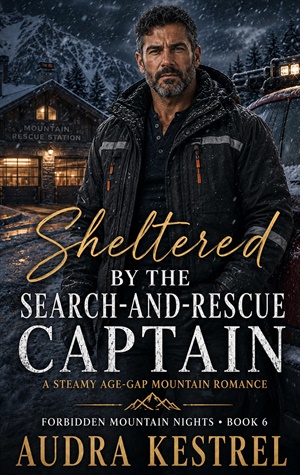
Sheltered by the Search-and-Rescue Captain (Forbidden Mountain Nights #6)
The Wrong Road
The heater blew against Natalie Shaw’s hands without warming them.
She tightened her fingers around the steering wheel and watched snow vanish beneath the headlights. It came sideways now, fine and hard, swallowing the road beyond the narrow reach of the beams.
The navigation screen showed a blue line passing through empty gray. No road names. No buildings. No indication that Blackwood existed anywhere ahead of her.
She had missed a turn.
She knew that. She had known it for at least five minutes, but turning around would require finding somewhere wide enough to do it. The road had narrowed between a steep bank on her right and a drop into dark timber on her left.
Her phone lay facedown in the cup holder. She had stopped checking it because every glance at the NO SERVICE icon made the pressure in her chest worse.
She flexed her fingers.
Cold. That was all.
Too much caffeine. Too little sleep. A bad road in worsening weather.
Her breathing shortened anyway.
Natalie forced air through her nose and held it before releasing it slowly. The technique had worked when she taught frightened patients to use it. Inhale for four. Hold. Exhale for six.
Her lungs refused the count.
The heater hissed.
For one disorienting second it became the oxygen line in Treatment Four.
She was back beneath the white hospital lights, one hand braced against a stainless-steel cart while her heart slammed so hard she could feel it in her throat.
Someone had said her name.
Another nurse had taken the medication syringe from her hand.
Natalie had told them she was fine.
Then the room had tilted.
She pressed her shoulders against the driver’s seat.
Not now.
Her emergency leave had begun thirty-six hours ago. She had booked three nights at Blackwood Lodge because she remembered the place as quiet, and because it was close enough to Denver that the trip had not felt like running away.
She was supposed to be sitting beside a fire by now.
Instead, she was driving deeper into the mountains while snow erased the road behind her.
A pair of headlights appeared around the bend.
They were too close and too wide, a pickup moving cautiously but occupying more than half the narrow road.
Natalie eased toward the right shoulder.
The tires caught loose snow.
The steering wheel tugged.
She corrected left, saw the pickup’s headlights flare in her windshield, and jerked right again.
The car rotated beneath her.
The rear end slid toward the drop. Natalie hit the brake and heard herself make one sharp sound before the passenger side struck packed snow.
The car stopped at an angle.
Silence followed.
The engine was still running. The headlights illuminated a wall of white inches from the passenger window.
Natalie held the steering wheel and waited for pain.
Head, neck, chest, abdomen, pelvis, extremities.
She worked through the sequence automatically.
A burning line crossed her collarbone where the seat belt had locked. Something warm touched her temple. She lifted her hand and found a thin smear of blood on her fingertips.
No loss of consciousness.
No neck pain.
No obvious fracture.
She could move both legs.
The car seemed stable.
Her pulse was too fast to count accurately.
She released the seat belt. It snapped away from her chest, and the sudden freedom made the interior feel smaller.
Air would not enter deeply enough.
Natalie opened her mouth and dragged in a breath.
It caught halfway.
She tried again.
Her fingertips began to tingle.
Hyperventilation.
She knew exactly what was happening.
That knowledge did nothing to stop it.
She reached for her phone and nearly dropped it. One bar appeared, vanished, then returned.
She opened the emergency screen. Her thumb missed the button twice.
“Come on.”
The phone asked whether she wanted to share her location with emergency services.
She pressed yes.
The wheel beneath her other hand felt slick. Her palm had begun to sweat despite the cold.
She sent the alert and watched the progress icon spin.
The screen froze.
“No.”
She lifted the phone toward the windshield as though six inches might matter. The signal returned long enough for the alert to show SENT.
Relief should have eased the panic.
Her body treated it as another threat.
Her heart accelerated. The edges of her vision darkened.
Natalie lowered her forehead to the steering wheel.
Airway clear. No obstruction.
Breathing rapid but effective.
Circulation intact.
She was not dying.
She had delivered those facts to patients in a calm voice hundreds of times.
She could not make herself believe them.
Her breath came faster. She tried counting, but numbers scattered before she could hold them.
The temperature inside the car had begun to drop. The engine still ran, but the front grille was pressed into the bank, and she did not know whether snow blocked the exhaust.
Carbon monoxide risk.
She should shut it off.
Moving her hand from the wheel felt impossible.
Headlights swept through the rear window.
At first she thought the pickup had returned.
Then amber lights flashed against the snow.
A large vehicle stopped behind her at an angle. A door opened.
A man stepped into the storm.
He wore a dark rescue jacket with reflective bands across the chest and arms. Snow blew around him as he moved toward the driver’s side, one gloved hand resting on the car roof while he examined its position.
Natalie tried to lower the window. The control did not respond.
He leaned toward the glass.
His face was partly shadowed beneath a dark knit cap. A short beard covered a hard jaw. His expression was focused rather than reassuring.
He pointed toward the passenger side, then held up one finger.
Wait.
Natalie nodded too quickly.
He disappeared around the front of the car.
For the first time since the slide, she understood that she was no longer alone.
Her body did not know how to stop being afraid.