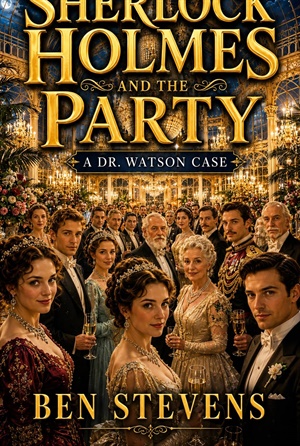
Sherlock Holmes & the Party
Ben Stevens
I had been compelled more than once, during the years of my association with Sherlock Holmes, to reflect upon the curious manner in which the most extraordinary adventures so often sprang from the most commonplace beginnings.
A client arriving ten minutes later than expected, an apparently trivial newspaper advertisement, or a chance encounter upon the pavement had, upon more than one occasion,
opened the door to events so singular that they have remained fixed within my memory long after matters of greater public importance have faded into obscurity.
Yet there came a time when I believed that such experiences belonged wholly to the past.
Holmes had since withdrawn to his little farm upon the Sussex Downs, where, as my readers already know, he devoted himself with remarkable enthusiasm to the keeping of bees and those scientific pursuits which had always afforded him quiet satisfaction.
We corresponded from time to time, and I occasionally journeyed down to spend a few days in his company, while he also sometimes returned to London. Whenever we met, I found him invariably cheerful, with his keen faculties no whit diminished by retirement.
As for myself, I had resumed the ordinary duties of my profession.
My practice prospered sufficiently to occupy the greater part of each day, and there were many who would have considered my circumstances enviable.
Patients came and went, children were born beneath my care, old men and women departed this earthly life with my hand in theirs, and the quiet rhythm of a London physician settled upon me once again.
It ought to have been enough.
Indeed, for a period I attempted to persuade myself that it was.
Only by slow and almost imperceptible degrees did I become aware of a certain vacancy creeping into my existence.
It was not that I desired danger, nor had I any romantic longing to exchange the consulting-room for revolvers and midnight pursuits across the rooftops of London.
I had experienced sufficient violence to last several lifetimes.
Yet I could not deny that something essential had gone out of my days.
There is, I think, a peculiar exhilaration in observing a truly remarkable intellect at work.
For many years I had enjoyed the singular privilege of watching Holmes draw order from confusion, certainty from contradiction, until mysteries which had baffled every other observer dissolved beneath the clear light of his reasoning.
One grows accustomed to such companionship without realising how profoundly it has coloured one's view of the world.
Bereft of it, London itself seemed somehow altered.
The streets remained as crowded, the traffic no less deafening, yet the invisible thread of expectancy which had once accompanied every unexpected visitor or hurried telegram had quietly vanished.
I slept less well than formerly.
Whether advancing years were responsible, or whether my restless mind simply refused to surrender itself to repose, I cannot pretend to say.
More than once I retired at a respectable hour only to find myself, after lying wakeful for what seemed an eternity, abandoning the unequal struggle altogether.
On such occasions I would dress once more, take up my stick, and wander abroad through the city until bodily weariness accomplished what inclination would not.
London after midnight possesses a character entirely distinct from that which it presents by day.
The ceaseless roar subsides into an occasional rumble of distant traffic.
The great thoroughfares, so lately thronged with omnibuses and cabs, stretch away beneath the lamps in long, gleaming perspectives, broken only here and there by a belated hansom or the measured tread of a constable upon his beat.
Shop windows become dark mirrors, reflecting only the yellow gaslight and the solitary passer-by who pauses before them.
It was during one of these nocturnal rambles that my attention was first attracted to a building which, remarkable though it may seem, I could not afterwards remember ever having consciously noticed before.
It stood upon a respectable commercial street, occupied during business hours, as I afterwards learnt, by firms of solicitors, brokers, and various financial houses.
Its lower storeys were severe and businesslike enough, being faced in pale stone and pierced by rows of uniformly proportioned windows.
Nothing in their appearance invited a second glance.
The uppermost storey, however, presented a very different aspect.
Rising above the roofline was a magnificent conservatory of iron and glass, extending almost the full breadth of the building.
Even from the pavement below I could distinguish graceful arches supporting broad panes of gleaming glass, beneath which exotic palms lifted their fronds towards the illuminated roof.
Great chandeliers hung suspended within, their countless lights shining through the crystal like clusters of captive stars.
As I paused to observe this unexpected spectacle, music drifted faintly down from above.
It was scarcely more than a suggestion at such a distance, yet unmistakably the strains of a small orchestra.
Presently figures passed before the brilliantly illuminated windows.
At so great a height I could distinguish little beyond graceful silhouettes moving amongst the foliage, yet the imagination readily supplied the details.
One pictured ladies in shimmering evening gowns, their jewels flashing whenever they crossed beneath the chandeliers, accompanied by gentlemen in immaculate black coats, champagne glasses glimmering in their hands as they conversed with every appearance of ease and refinement.
It seemed the most cheerful gathering imaginable.
I remember smiling faintly to myself as I resumed my walk, reflecting that there could be few more agreeable settings in which to pass an evening than that lofty garden suspended above the sleeping city.
The matter might have ended there had chance not carried me the same way again upon the following night.
The conservatory was once more ablaze with light.
Again the music floated softly into the darkness. Again elegantly dressed ladies and gentlemen wandered amongst the palms as though the festivities had scarcely paused since I had last observed them.
I found myself stopping for several minutes before continuing on my way.
There was, I told myself, nothing especially remarkable in a private society holding regular entertainments.
London abounded in clubs of every imaginable description, and many wealthy organisations maintained premises whose splendour far exceeded anything visible from the street.
Nevertheless, I could not altogether suppress a curious feeling that there was something oddly detached about the scene above me.
It was not anything I could have reduced to words.
Rather, it was the impression of looking upon a world entirely complete within itself, existing high above the ordinary life of the streets below, untouched by the hour, the weather, or the countless concerns which occupied the rest of mankind.
Thereafter my evening walks acquired an almost unconscious destination.
Night after night I found myself approaching the same building.
Sometimes I lingered only a minute or two.
Sometimes considerably longer. Always the conservatory shone with the same warm brilliance.
Always the music continued. Always those graceful figures wandered leisurely beneath the palms, as though engaged in some endless reception whose guests neither arrived nor departed.
By the end of a week I had ceased pretending that my presence in that particular street was accidental.
The mystery, if mystery there truly was, had laid hold of my imagination.
I began to wonder who these people were, what society they belonged to, and what curious circumstance enabled the same distinguished gathering to assemble, night after night, in that lofty chamber of glass above the roofs of London.
At last, I found myself unable to resist the temptation to discover the answer.