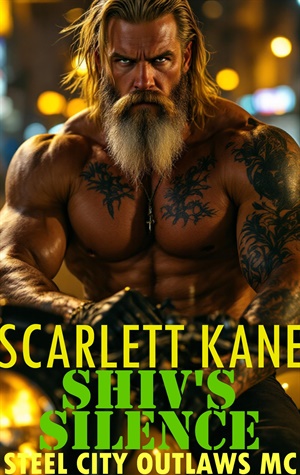
Shiv's Silence (Steel City Outlaws MC #6)
Chapter 1
The rooftop smelled like tar and old pigeon shit.
Shiv pressed himself flat against the parapet wall three stories above Lawrenceville, his breathing so shallow it wouldn't have fogged glass.
Below, Butler Street hummed with the last of the evening traffic—headlights sliding across wet asphalt, a bar door banging open and spilling laughter into the dark.
None of it mattered. What mattered was the man sitting in a lawn chair on the roof of the building across the alley, smoking a cigarette and watching the Outlaws compound through a pair of binoculars that had no business being that expensive.
He'd been up here three nights running. Parkway had spotted the glint off the lenses during a sunset ride, mentioned it at Church like it was a weather report. Pitt hadn't said much. He'd looked at Shiv, and Shiv had given the single nod that meant the problem had a shelf life.
Three nights of watching the watcher. Learning his patterns.
The man—mid-thirties, neck tattoo from some crew out of McKeesport—arrived at dusk, set up his chair, smoked his way through a pack of Newports, and left around two in the morning.
He came up through the fire escape on the building's east side, the one with the broken railing on the second landing.
He never checked behind him. Never swept the adjacent rooftops.
Never once considered that the thing he was looking for might already be looking back.
Sloppy. The kind of sloppy that got men killed in Helmand Province, and the kind that would get this one killed in Pittsburgh.
Shiv waited.
The man finished his cigarette and flicked the butt over the edge.
Lit another one. Raised the binoculars and panned slowly across the compound's front gate, the parking lot, the row of bikes gleaming under the security lights.
He was writing something down—times, plate numbers, patterns.
Intel for whoever was paying him, and it didn't much matter who that was. What mattered was that it stopped.
Shiv moved.
He crossed from one roof to the other using the steel maintenance bridge that connected the two buildings' HVAC systems—a narrow catwalk meant for repair techs, bolted into the brick and just wide enough for a man who didn't waste space.
His boots made no sound on the grating. A lifetime of moving through places he wasn't supposed to be had taught him where to put his weight, how to distribute it across the ball of his foot and roll forward without the jarring heel-strike that announced amateurs.
The distance was thirty feet. He covered it in eight seconds.
The man didn't turn around.
Shiv settled into a crouch four feet behind the lawn chair, close enough to hear the man's breathing, the faint whistle of a deviated septum.
Close enough to smell the menthol smoke and the cheap body spray underneath it.
The KA-BAR was already in his hand—he didn't remember drawing it, never did, the way a pianist's fingers find the keys without the conscious mind getting involved.
He could have done it from behind. Faster, cleaner, the man's last thought interrupted before it fully formed.
But Shiv didn't work that way. Not because of honor—honor was a word officers used to make the ugly work sound noble—but because he needed to be close.
Needed to see the moment the eyes changed.
It was the only way to be sure, and being sure was the only currency that mattered.
"Your binoculars," Shiv said quietly.
The man jerked so hard the lawn chair squealed against the roof. He spun, reaching for something at his waistband, and froze when he found Shiv already inside his reach, the blade resting against the soft triangle of skin beneath his jaw where the pulse ran shallow and fast.
"The fuck—where did you—"
"Put them down."
The binoculars hit the tar paper with a dull thud. The man's hands came up, palms out, the universal gesture of a body trying to survive what the brain already knew it wouldn't.
"Listen, man, I'm just—I got paid to watch, that's all, I'm not—"
"I know." Shiv's voice barely reached above the ambient noise of the city. "Who's paying?"
"Some crew out of Braddock, I don't even know their—"
The blade pressed. Not cutting. Just present.
"Razor. Razor Jennings. He's running a thing out of the old steel yard on—"
"I know where Razor operates."
The man's breathing went ragged. "So we're good, right? I told you what you—"
Shiv looked him in the eye. Held it. Let the man see exactly what was sitting four inches from his throat, patient and calm and completely without the nervous energy that might have suggested mercy was still on the table.
"You watched my brothers for three nights," Shiv said. "Wrote down their names. Their bikes. Their schedule."
"I'll burn the notes. I'll burn everything, I swear to—"
"I know you will."
The man opened his mouth to say something else, and Shiv ended the conversation.
He wiped the blade on the man's jacket, folded the lawn chair, and collected the binoculars, the notebook, the burner phone.
Tucked the phone into his cut for Parkway to pull later.
The body he arranged against the parapet wall in a sitting position, chin on chest, looking for all the world like a drunk who'd climbed up to sleep it off.
It would be found eventually. That was fine.
The message wasn't for the cops—it was for Razor Jennings and anyone else who thought watching the Outlaws was a job with a retirement plan.
Shiv climbed down the fire escape on the building's east side, the one with the broken railing on the second landing, and walked his bike out of the alley where he'd stashed it behind a dumpster.
The night air hit his face and he breathed it in—river fog and exhaust and the faint industrial tang that never quite left Pittsburgh's air, no matter how many mills they turned into loft apartments.
His phone buzzed. Gibbet.
"Done?"
"Done."
"Clean?"
Shiv didn't bother answering that. Gibbet grunted—the closest the Sergeant at Arms came to a compliment.
"Church tomorrow. Pitt wants a full table."
"I'll be there."
The line went dead. Shiv rode south through Lawrenceville, taking Penn Avenue to Butler to the back streets that wound through the flats, the V-twin rumbling low between his thighs.
The city passed in fragments—neon bar signs reflecting off wet cobblestones, row houses with their porch lights burning, the Hot Metal Bridge lit up against the clouds.
He didn't ride fast. Never did. Speed was noise and noise was attention and attention was the opposite of everything he'd spent his life perfecting.
He parked at the compound and walked through the clubhouse without drawing a single look, which suited him fine.
Hollow was holding court at the bar, telling a story about a run gone sideways in Wheeling that got louder every time he told it.
Ash was dismantling something electronic at a corner table, his remaining fingers working with the delicate precision of a man who'd spent years handling things designed to kill him.
Pitt sat in his usual chair near the back, reading something on his phone, the kind of stillness that only another patient man could recognize as alertness.
Shiv caught Pitt's eye across the room. Single nod. Pitt returned it—acknowledgment, approval, dismissal, all in one motion.
The rooftop problem no longer existed. By morning, it would be as if it never had.
He grabbed a beer from behind the bar—helping himself, the way brothers did—and found a spot along the wall where the light didn't quite reach.
The clubhouse noise washed over him without penetrating, the way it always did.
He could sit in a room full of his brothers and still be essentially alone, not because they excluded him but because solitude was the water he swam in.
Had been since long before the Marines, long before the deployments that taught him to lie motionless for days and then move with lethal speed.
The stillness was older than any of that.
It lived in him the way pitch lives in a tuning fork—dormant until struck, and then consuming.
Gibbet dropped into the chair across from him, a whiskey in one scarred fist and his face set in its usual expression of granite indifference.
"Parkway's got a thing," Gibbet said, without preamble. "Bikes need work. A few of 'em are running rough and our usual guy's backed up for three weeks."
Shiv sipped his beer. Waited.
"Shop in the Mon Valley. Woman runs it—Parkway says she does clean work, fair prices, knows her way around a V-twin. He's been taking his personal ride to her for a year."
"You want me to run bikes down there?"
"I want someone to check the place out first. See if she's solid, if the shop's clean, if we can trust her with our hardware." Gibbet's eyes were flat and assessing. "Parkway vouches, but Parkway vouches with his head. I want someone who vouches with his gut."
Shiv turned his beer bottle slowly on the table, considering.
The Mon Valley was Morello territory in the loosest sense—not claimed the way the Outlaws claimed the South Side, but understood.
Crime families operated differently than MCs.
They didn't fly colors or hold territory with iron and chrome.
They held it with money and fear and three generations of knowing exactly which palms to grease.
A garage in the Valley. A woman mechanic Parkway trusted. The kind of quiet errand that most brothers would consider beneath notice.
"I'll go," Shiv said.
Gibbet studied him for a beat, then knocked back his whiskey and stood. "Tomorrow. Take your bike in, let her look at it, bring me back something I can use."
He walked away without waiting for confirmation. Didn't need to. When Shiv said he'd do a thing, the thing got done.
Shiv sat with his beer and listened to the clubhouse breathe around him—Hollow's laughter, the crack of pool balls, someone's phone playing a Steelers highlight reel too loud.
Normal sounds. Brotherhood sounds. The noise of men who'd chosen each other over everything the straight world offered and never once looked back.
He finished his beer, rinsed the bottle in the bar sink, and climbed the stairs to his room without anyone noticing he'd left.
The room was spare. A bed, a footlocker, a wall-mounted rack that held three blades in descending size.
No photographs, no decorations, no evidence that a specific person lived here rather than a ghost who occasionally needed a flat surface to sleep on.
He'd been in this room for four years and it looked exactly the way it had the day he moved in.
He sat on the edge of the bed and cleaned the KA-BAR with the same unhurried focus he brought to everything—oil on the steel, cloth along the edge, the ritual of it settling his mind the way other men used prayer or whiskey or the sound of a woman's voice.
The blade caught the light from the single overhead bulb, and Shiv watched it shine, turning it slowly, seeing nothing but the clean geometry of a tool designed for one purpose and perfected over decades of use.
Tomorrow he'd ride to the Mon Valley and look at a garage. Talk to a woman about bikes. Do the kind of simple, ordinary errand that shouldn't have interested him at all.
But something pulled at him—not a thought, exactly, more like the faint tug of a current beneath still water. The Mon Valley. A shop where nobody knew his face.
He sheathed the blade, killed the light, and lay back in the dark, listening to the compound settle around him. Sleep came the way it always did—not gradually, but all at once, like a door closing.