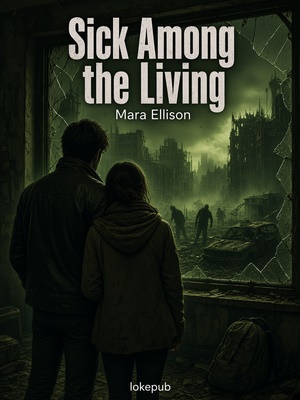
Sick Among the Living
1. The Sound Of Silence
One
The Sound Of Silence
The world was ending, but inside Addy’s apartment, it was strangely quiet.
The electric hum of the refrigerator had stopped days ago, leaving behind a hollow stillness that pressed against her ears.
Outside, sirens had wailed endlessly for hours, but now even they had gone—replaced by the occasional, distant sound of something breaking, or the wind howling through the empty streets of her small Midwestern town of Gains.
Addy crouched by the front door, hands shaking as she taped another layer of plastic over the cracks.
Her fingers were sore from the duct tape—she had used almost two rolls to secure every window, vent, and crevice she located.
The instructions she’d read online—back when the internet still worked—had said to isolate, to stop the air from coming in, to stay put.
So that’s what she did. She tugged the last strip tight and pressed it down.
Her reflection shimmered faintly in the thin plastic.
Her brown hair matted, her skin pale under the harsh glow of the flashlight propped on the counter.
She barely recognized herself. She stared at herself a second longer and looked away.
An unsettling sensation arose from meeting her own gaze—akin to encountering an unknown person who had resigned themselves to their destiny.
She recalled—only seven days prior, her existence had been so uncomplicated.
Around this time, she would’ve been getting home from work, kicking off her shoes by the door, starting dinner while music played low in the background.
She’d pour a glass of wine, feed the stray cat that always showed up on her second-story balcony, meowing for handouts.
She christened him Murphy, though he wasn’t truly hers.
He’d come and go as he pleased, a scruffy little reminder that she wasn’t entirely alone.
Now, she hadn’t seen Murphy in days. She tried not to contemplate what that might mean.
The odor of bleach still hung heavy in the air.
She rubbed her sore hands against her jeans, the skin raw from too much scrubbing, too much fear.
Outside, the wind pressed against the taped windows as if it sought entry.
Somewhere far off, something metallic clanged—possibly a trash can, or something worse.
She closed her eyes and tried to imagine the sound of Murphy’s soft paws against the glass, the way he used to tilt his head like he was judging her for eating cereal for dinner. It seemed like another life.
“Buzz, Buzz,”…. …. …. “Buzz Buzz,” … … … “Buzz Buzz,” … … ….
Her phone buzzed on the counter, startling her. The screen showed another emergency alert: MANDATORY QUARANTINE. SHELTER IN PLACE. FAILURE TO COMPLY IS A FEDERAL OFFENSE.
Addy stared at it until the screen dimmed and went dark again. She didn’t bother unlocking it—nothing left to see. Every notification identical: warnings, curfews, emergency broadcasts repeating the same cold phrases in bold red letters.
No one was calling anymore. No one was texting.
She remembered when her phone used to light up with messages from coworkers—memes, dinner plans, the usual chatter.
Now all that remained was an endless stream of government alerts and silence.
Somewhere in her call log, her last outgoing call to her mom remained visible. It had gone straight to voicemail.
Addy’s stomach twisted. She pressed her palms flat on the counter, grounding herself. “You’re okay,” she whispered to the empty room. “You’re okay.”
The words helped little.
Outside, the wind carried the faint wail of another siren—followed by a distant crash. The sound bounced between the buildings and faded into nothing. The world seemed to be progressively falling apart, and all she seemed capable of was hearing it happen.
She glanced at the list she’d scrawled on the envelope again: food, water, batteries. She’d crossed off “mask,” but was not entirely sure why. Nothing appeared to hold significance any longer—the rules, the cautions, the meticulous strategies she had devised when she still felt things were managed.
She looked back at the taped - up windows. For a second, she thought she saw movement behind her—a shadow shifting—but when she turned, only the flashlight appeared, flickering weakly on the counter.
Addy exhaled, long and shaky. The quiet seemed alive.
Addy swallowed hard. The authorities didn’t sound like they had things under control—more like they had lost their grip. Every hour brought fewer updates. Every hour, the world outside seemed a little farther away.
She moved to the kitchen window, peeking through a slit in the taped curtain. The street below was a mess of abandoned cars, trash bags, and the occasional flicker of movement. Someone had spray-painted HELP US on the side of the pharmacy across the street. The paint looked fresh.
She pulled back quickly, heart hammering. She didn’t want to see anymore.
Instead, she focused on the list she’d written on the back of an envelope—her survival plan.
Canned food: 14 days (if rationed).
Water: half a bathtub’s worth, bottled if possible.
Medication: running low.
Batteries: not enough.
Every creak of the floorboards, every groan of the old radiator made her pulse jump. She tried to convince herself it was the building settling, but the thought didn’t stick.
She turned the flashlight off to save the battery and let her eyes adjust to the dim glow bleeding in from the last fragments of daylight outside.
Something moved down there.
Addy froze, pressing closer to the window.
It was hard to see through the layers of plastic, but there was definitely something—or someone—standing near the pharmacy.
A shape, still and dark against the fading light.
She squinted, trying to focus; the figure lurched forward.
Not walking, not running—but stumbling, unsteady, as if their body didn’t quite remember how to move.
Her breath caught. She stepped back, bumping into the counter.
Seconds later, the last glow of light slipped away as the sun dipped below the horizon.
She stood in total darkness, her own heartbeat pounding in her ears. For a moment, she contemplated turning the flashlight back on—but the idea of being seen seemed worse than being blind.
The wind howled outside again, rattling the taped - up windows. Somewhere below, a door slammed. Followed by a sound that didn’t belong to the wind at all—a low, wet cough, echoing through the empty street.
Addy covered her mouth, as if they could infect her from out there, forcing herself not to make a sound.
She stayed like that for a long time, counting her breaths, until the silence returned.
Only then did she move—slowly, quietly—toward the couch, curling up beneath a blanket. Her body ached with exhaustion, but sleep didn’t come.
Every time she closed her eyes, she saw the shape in the street, swaying under the dying light.
* * *
When Addy woke, she wasn’t sure at first if she had actually slept.
The light creeping through the taped plastic was dull and gray, the kind of morning that couldn’t decide if it was still night. Her neck ached from sleeping on the couch, and her mouth was dry, her tongue thick with fear.
For a few seconds, she sat there, listening. The world outside was quiet again—no sirens, no shouting, no coughs. Only the low whistle of wind through the cracks she hadn’t sealed.
She pushed the blanket off and sat up. The air was cold now, colder than it had been the night before. The power was still out.
Her stomach growled. The sound startled her—it seemed too loud.
She moved to the kitchen and opened the cabinet, carefully counting what she had left: five cans of soup, two of beans, one of peaches.
A single bag of rice. She ran her finger down the rim of one can and stopped herself.
She couldn’t afford to ration from hunger—only necessity.
She poured a little water from one of the gallon jugs into a mug and drank slowly, forcing herself to make it last.
At the window, the world outside looked worse than it had the night before. The cars were still there, but now one of them had its door hanging open, swaying slightly in the wind. A trash can had rolled into the middle of the street, its contents scattered. Nothing moved.
No people. No sound.
Addy pressed her hand to the plastic, the faint pulse of cold air beneath her palm.
She thought about the figure she’d seen last night, stumbling near the pharmacy. Maybe they were gone. Perhaps they hadn’t even been real. The mind did strange things when it was scared and tired.
But then again… maybe they were still out there.
She turned away from the window, trying not to let it bother her.
Instead, she focused on small, human things—washing her face with the last of the cheap cucumber-scented wipes she’d bought months ago, back when her coworker Megan had insisted that “self-care” was the cure for burnout.
Addy had laughed at the time, tossing the wipes in a drawer and forgetting about them.
Now, they seemed like gold—soft, clean, a reminder of a world that had cared about moisturizers and bedtime routines.
The faint, artificial scent filled the air, jarringly sweet against the sour tinge of bleach and dust.
She tried the radio again. Static. Then, faintly, a voice—male, distant, broken by static:
“…if you are getting this… shelter… supplies… stay inside…”
Followed by nothing.
Addy leaned closer, adjusting the dial, but the signal was gone. The emptiness that followed was worse than the silence before.
For a long moment, she sat there, staring at the small radio, willing it to come back to life. Static still hissed faintly through the speaker, soft and ghostly, like the last breath of something dying. But it, too, faded.
The silence felt personal.