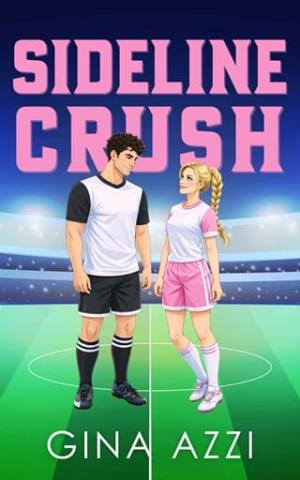
Sideline Crush (League Valencia #2)
Chapter 1
Carla
“You will not cry.” I glower at my reflection.
Bracing my palms on each side of the sink, I pull in a breath. My hair is twisted away from my face and looped into a low knot at the base of my neck. My makeup is, surprisingly, intact and the midnight blue of my gown skims over my frame like a second skin.
I wanted to wear black, but my sister, Valentina, thought it would be too depressing. So? I countered. It feels like I’m in mourning.
Standing alone in the women’s bathroom at the swanky downtown Chicago venue for this year’s Girls-in-Sports Charity Gala, a gala I’ve helped orchestrate, feels like premature grieving.
In a few minutes, I’ll leave the bathroom, glide across a stage in a large room where several hundred of Chicago’s most influential people will stare at me, and I’ll say goodbye.
Goodbye to my career, to my team, to the city I’ve called home for four years. Farewell to my lifelong dream of playing professional soccer. At least, in America.
I skim my hands over my hips and suck in another shaky breath.
Two years ago, I attended this gala with my entire family. Last year, with my sister. Both occasions were fun and carefree, with the new year stretching before me, filled with promise and opportunity.
This year, I’m alone, being forced to leave the country, and on the verge of tears.
“You got this. Don’t cry,” I remind myself.
At least, not yet. Not here. Not now.
Hold it together until after the speech, after the goodbyes, after tonight.
I release the breath I’m holding and pull in another. Slowing my racing heart, I force my shoulders to drop.
I can do this. It’s one speech. My last speech.
And no one in my family is here to see it.
But my closest friends, my teammates, ahem, former teammates, are. There are even some fans in the crowd.
I think that’s what hurts the most. Everyone—the team owner, the club director, Coach Hunter and the front office staff, the community, the entire fucking city of Chicago have been so empathetic. Understanding. Apologetic and caring and loving.
And that’s made the ordeal worse. Nearly unbearable.
I’m not leaving because I didn’t perform well. I’m not leaving because I don’t have the heart or stomach for the competition. Or because I didn’t make an impression on the fanbase.
I’m leaving because of logistics! Because the Tornadoes lost an international spot when they decided to invest in younger, more affordable talent.
My entire life I’ve lived by the motto: Do the work.
And I did it. I did it so damn well.
I always believed that if you want it, it’s yours. You just have to take it.
I trained hard, showed up, and showed out. And in the end, my contract wasn’t renewed.
My stomach tightens as sourness creeps up the back of my throat.
I’ve been in America, playing soccer with these women, in these circles, since my freshman year of college. It’s been eight years in the States and now…I’m moving home to Valencia, Spain. But it feels wrong because America feels like home.
I blink rapidly, willing my body to reabsorb my tears before they have the chance to fall.
Just get through the damn speech and say goodbye.
Tomorrow, I board a flight to Valencia and then, once I’m locked in Mamá and Papá’s apartment, I’ll break down.
A knock at the bathroom door forces me to look up as one of my best friends and teammates, Raia, enters. “You ready?” she asks softly. The empathy in her bright blue eyes shines and it hurts.
“Mm-hmm,” I manage, clearing my throat.
“Ah, fuck, Carla.” Raia throws an arm around me. “This sucks.”
I snort, hugging her back. Tightly. “I know.”
“You’re going to be okay, Car. This will all work out, somehow.”
“Yeah,” I say, even though I don’t see how.
Soccer is the foundation of my identity.
I’m a García—daughter to Rubén, the greatest futbolista of his generation, and little sister to one of Spain’s standout players, League Valencia’s captain, Alejandro.
If I’m not a soccer player, I don’t know who I am.
“Come on. You’re almost up.” Raia takes my hand and leads me out of the women’s bathroom.
Right before I clear the door I glance over my shoulder. My reflection in the mirror shines back and I hate how I look.
Downtrodden. Shaken. Fragile.
The door swings shut and I breathe a sigh of relief.
Just get through the speech.
Applause rings out as I ascend the stage. A lump forms in my throat as I settle behind the microphone. Looking out into the crowd, the clusters of tables, each seated with ten impeccably dressed guests, I find my teammates. Raia flashes me a thumbs-up, and I breathe a little easier.
“Good evening,” I say, relieved my voice doesn’t tremble. “My name is Carla García and for the past four seasons, I’ve had the immense pleasure of playing soccer, a sport that I love with every fiber of my being, for the Chicago Tornadoes.”
I manage a smile.
Be strong. You can do this.
I grip the sides of the podium tighter as I lean closer to the microphone. I wrote and rehearsed my speech a week ago. I know it by heart and left my notecards in my purse at my table. But now, I go off script.
“Many of you may know my family name in the soccer world. My father, Rubén García. My brother, Alejandro García. Or even my brother-in-law, Avery Callaway, if football is your sport. But tonight isn’t about them.
Tonight is about the women—the incredible and resilient women in sports who shaped me, who gave me a place to call home, who changed my life.
Tonight, we’re here to celebrate those women and I would be remiss if I didn’t share the stories of how they made my dream career possible.
” I note the tissues several of my teammates pull out.
Giving them a quick grin, I share heartfelt, personal, true stories of how being an athlete, being a soccer player, changed my life for the better.
“When I first arrived in America, a division 1 collegiate player at a competitive program in North Carolina, I felt like a fish out of water. My English was rusty, it was my first time living away from home, and I didn’t know anyone.
But my team captain, Kate, stepped up for me.
When she saw me staying late at the field, she started staying behind too.
Through her guidance and support, I honed my skills, but I also made my first real friend on campus.
When I signed with Chicago, Kate had a deep-dish pizza delivered to my apartment in Chapel Hill to congratulate me.
” I pause as the crowd releases a chuckle.
“When I think of my teammates, I think of my sisters. The group of women who took bus and plane rides that crisscrossed the country. We would fill the time playing random games—Uno, Wordle, ones we would invent on the fly. They became my chosen family who brought me into their real families. I’ll always be thankful to Raia and the Callaway family for hosting me at Thanksgiving dinner. ” I smile at my friend.
“Being a female athlete transcends the sport. It’s about tenacity, commitment, and grit.
But it’s also about belonging, personal growth, and leadership.
Women in sports changed the trajectory of my life.
They carried me here, to Chicago, where I made a home among a team I adore, and a community I value more than words can say.
“I’m not sure what my next chapter looks like.
Tonight, I stand before you, writing the last paragraph of my time here…
and it’s scarier than I thought,” I admit, pausing as my voice wavers.
Come on, Carla, you’re nearly there. “But…” I release a shaky laugh.
“I do know this: the girl who moved to Chicago four years ago is not the woman standing before you tonight. And that is because of you. This community, this team, these women”—I extend my hand toward the table of my teammates—“have given me the opportunity of a lifetime. I’m so grateful to be here tonight to witness the continuation of that support.
From the bottom of my heart, thank you, Tornadoes, for being my home. ”
I release an exhale as I conclude my speech. My final farewell.
The clapping is instant and enthusiastic, ringing in my eardrums. Beginning with the table of my teammates, people stand. Tears spring to my eyes as emotions, raw and unfiltered, crash over me. I blink rapidly as the crowd blurs. And then, I’m pulled into Coach Hunter’s arms for a hug.
“We’re gonna miss you, Seven,” he mutters, calling me by my number.
I nod, blinking against his shoulder. “Me too, Coach.”
“You’ll be making headlines in Europe before you know it,” he adds with more confidence than I feel as he escorts me off the stage.
But I don’t reply. Because, right now, playing in Spain feels like a long shot. Belonging to any team but this one feels like an impossibility.
Coach gives my arm one final squeeze before releasing me. I offer a watery smile. “Excuse me,” I murmur, tilting my head toward the ladies’ room.
I’ll just lock myself in a bathroom stall and sob my eyes out.
Coach offers an understanding nod. I force myself to take measured steps toward the women’s room, but as I push open the door, I hear the laughter of women inside.
“I love that lipstick on you!”
“Here, try it.”
“God, Carla’s speech was so good.”
“Really heartfelt.”
“My daughter started playing soccer after her camp last summer.”
“Yeah, she’s amazing. She’ll be missed.”
I let the door fall closed. I don’t have the emotional bandwidth to engage with those wonderful women and not fall apart. Hurrying down the hallway, I turn a corner and find a small room, an office of some kind.
Slipping inside, I perch on the edge of a chair and tip my head all the way back.
You’re okay. You did the speech. Standing ovation. Isn’t that a great goodbye?
Don’t you dare cry. You’re in control here. Lock this shit down.
I blink frantically, trying to keep my tears at bay. But it’s no use. Several fall, sliding from my eyes, across my temples, and into my hair. Knowing it’s a losing battle, I drop my face into my hands and breathe. But my breath work sucks and, before I know it, I’m full-on sobbing.
Ugly crying, Raia calls it.
My shoulders shake and my throat feels scraped raw as I cry into my hands. Open palms that have nothing to hold on to anymore. There’s nothing left for me here.
The door to the office swings open and my head snaps up.
“I’m so sorry,” I hiccup, pressing to my feet.
“Carla.” His voice is a low rumble. Smooth and seductive and far too understanding.
I squint, bewildered by his presence.
Luca DiBlanco eats up the space in the doorframe and most of the oxygen in the small room. He’s wearing a sharp suit, Italian made and tailored, just like him.
He’s Alejandro’s best friend. His teammate. The serious, steady, reliable futbolista on League Valencia’s team.
Over the years, he’s doled out advice and guidance to me the same way he does to his little sister, Bianca.
He’s always been my off-limits crush. My brother’s best mate who has never seen me as anything more than a kid sister.
And seeing him here now, when he should be in Valencia, surprises the hell out of me. My shock is quickly replaced by mortification. I don’t want anyone, least of all him, to see me like this.
“What are you doing here?”