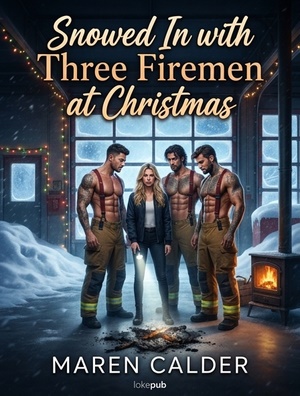
Snowed In with Three Firemen at Christmas
Chapter One Noelle
When I arrive on the scene, the first thing that draws my attention is the holiday wreath.
It’s hanging crookedly above the remains of the apparatus bay doors, one half burned entirely black and the other half still intact enough to show off a red velvet ribbon and tiny gold bells. Fresh snow has collected on the scorched greenery, contributing a cruel softness to the damage.
“Merry fucking Christmas,” I mutter under my breath.
That is exactly the problem with the holiday. It exists to pretend that everything is beautiful and fine, intentionally concealing all the ugly truths.
I know I could give Scrooge a run for his money with an opinion like that, but I haven’t been proven wrong yet.
Standing behind the yellow caution tape, I stare at what remains of Station 4.
The historic firehouse, one of the oldest in Chinatown, occupies nearly half a block.
At least, it used to. Now, the eastern side has collapsed inward, leaving nothing but twisted steel beams and piles of blackened debris exposed to gray winter sky.
Staff from the city’s fire investigation unit move through the wreckage, photographing the scene and marking evidence.
Several firefighters from neighboring stations are still onsite helping with salvage operations, carrying boxes of recovered equipment to a van where it will be sorted, logged, and redistributed back out to other stations according to necessity.
The thought of it, of how little remains of a vital city resource, puts me in an even worse mood. So much lost, so much that can never be recovered. It makes me sick to my stomach. My therapist used to call that displacement, but I stopped seeing her about three years ago.
I adjust my scarf against the wind and duck beneath the caution tape. Nobody stops me. The bright orange CITY ARSON INVESTIGATIONS lettering across the back of my jacket answers most questions before anyone can think to ask them.
The snow does little to muffle the sound of my boots on the pavement, cluttered with gravel and debris, as I make my way toward the building.
The smell gets stronger the closer I get. Lingering smoke, of course, mixed with the scent of damp wood, singed plastic, and burned electrical wiring.
Plus, underneath all of that, a subtle hint of pine.
Someone had clearly gone all out decorating the station before it burned down.
Once-fresh garlands still cling to portions of the brick exterior.
Partially melted Christmas lights dangle from shattered windows.
A large plastic Santa lies in pieces near the sidewalk, his smiling face grotesquely separated from the rest of his body.
A toy donation box sits near what used to be the entrance to the station. The cardboard and its contents were first burned and then soaked through, leaving very few salvageable items inside.
I force myself to keep walking.
Objects tell stories, but only in the sense that they are evidence. Nothing more. There’s no need to attach emotion to things. The moment you start doing that, you stop being objective, and objectivity is the main thing that makes me good at my job.
With a frown, I step over a section of collapsed timber as a frigid wind whips down a nearby alley and stirs up a fresh swell of ashy air.
Crouching down near what used to be an interior wall of the electrical closet, I see where all the crossed wires and tangled cables kept this station connected to the rest of the city’s emergency resources.
The preliminary report for the fire arrived in my inbox shortly after midnight thanks to the diligent night staff. I read through it twice on my way to the scene. Something about it bothered me instantly and, now that I’m standing here in the aftermath of it all, I know exactly what it is.
The fire moved too efficiently, too deliberately.
My gaze traces the subtle patterns that form the fire’s pathway throughout the structure.
Most fires are messy and chaotic. They wander, change direction, and follow opportunities based on what they consume most efficiently.
This one, however, took a more focused and intentional route.
Honestly, the fact that it happened in the first place was bizarre. Who ever heard of a fire station burning down? It was a twisted sort of tragedy, like a hospital becoming the scene for mass violence. Or a police station getting raided by the FBI. It wasn’t supposed to make sense.
And it wasn’t even the first time this had happened in recent months.
A shadow falls across the snow-speckled wreckage, blocking out the already weak light filtering through the dense clouds.
“You’ve been staring at the ground for ten minutes.”
I glance up at Deputy Chief Morrison. He moves like a cat, but not so quietly that I didn’t already sense him approaching through the rubble.
The middle-aged man looks exactly like how most city administrators look this time of year: tired, overworked, and one small inconvenience away from developing a drinking problem.
“Seven minutes,” I correct, rising to my feet.
His mouth twitches. “Morning, Meadows.”
“Not a good one, huh?” I brush an unruly strand of hair out of my eyes. “I’m trying to reserve judgment until I’ve had a sip of coffee, I suppose.”
Morrison snorts. I might be young for an elite investigator, but we’ve been working together for long enough that he knows I’m the last person to have an optimistic outlook on any morning.
“You haven’t even had coffee yet?” he asks.
“I wanted to get over here as quickly as possible.”
He nods, his lighthearted demeanor fading slightly as we stand there amid the disaster.
The wind whistles through what remains of the structure.
It wasn’t just a fire that ripped through this place, but also the explosion of gasoline reserves and outdated wall plaster that acted as a catalyst and kindling respectively.
Somewhere behind us, there’s an ominous metallic creak as one of the other staff gently maneuvers something out of their way. The entire scene is full of non-sentient grunts and groans, making the building seem wounded.
But there I go assigning emotions to inanimate things.
Buildings aren’t alive. They can’t be injured. They are just structures.
It’s just that, after so many years investigating fires, it’s difficult not to develop these habits. Especially when I already have so many of my own emotions attached to fire.
Morrison shifts on his feet. “This makes three.”
“Yep.”
Three firehouses have burned down in the last two months.
All of them have been historic structures, more vulnerable in their lack of pristine modern infrastructure.
It began in early November, around the time when these places start decorating for community holiday events, the fires leaving a mixture of Thanksgiving- and Christmas-themed detritus in their wake.
Each time, civilian casualties were only narrowly avoided.
And, most notably, every single one of the fires has left me with more questions than answers.
I turn to Morrison. “Well, you didn’t meet me out here just to meditate in silence, did you?”
“Nope.”
“You need me to lead this investigation, as well? Because I’ve been making so much progress on the previous two?”
He offers me a sympathetic glance for the self-deprecating sarcasm.
“I’ve actually got a different sort of assignment for you.”
“Is that so?”
“You’ll love it, I promise.”
Which means I definitely won’t.
“Right,” is all I say.
“I’ll cut to the chase. We’re embedding you inside Firehouse 23.”
For a second, I think I’ve misheard him. The wind blows again, tossing flurries and ash in opposite directions to form a macabre swirl around us.
I stare at my superior, letting the words sink in.
Then, perhaps a little rudely, I say, “No.”
Morrison chuckles. “That’s the spirit.”
“I’m serious.”
“Well, so am I, Meadows.”
“I help the city investigate alleged arsons,” I state, as if he needs reminding.
“Correct.”
“Nothing about that role requires me to live side-by-side with firefighters.”
“Not usually, no.” Morrison shrugs. “It’s temporary. You’ll be out of there by the new year at the latest.”
That’s still weeks away.
“Why is it necessary?” I ask. “And why me?”
The look on his face tells me he’s willing to play twenty questions, but his mind is already made up.
“You’re the best,” he replies simply. “And 23 is most likely the next target, if we’re assuming that this is a pattern.”
I purse my lips. I already had a feeling about that. One burnt firehouse is a tragedy. Two burnt firehouses is an unpleasant coincidence. Three burnt firehouses is most definitely a rhythm, and that means it’s my job to figure out the melody.
And it’s not just the way they were destroyed that makes them similar.
It’s the fact that they were all considered historic structures, old brick monoliths hailing from an earlier era of Manhattan’s rapid growth.
As a result, it means they also all went through similar preservation processes, renovations designed to conserve the dignity of their age but keep them functioning for the twenty-first century.
They were all also located in popular neighborhoods, serving a stylish demographic and standing proud among the brown-brick elite.
Firehouse 23, built in 1914 and positioned on East 96th Street where the Upper East Side meets Lower Harlem, was already on the top of my list of suspected victims.
If this is truly arson. If it’s all being done by the same person. If that person is following a strict pattern.
Again, we haven’t had much luck confirming anything all that useful.
“Why don’t you just send a patrol unit?” I ask Morrison.
“I have.”
“Bolster the surveillance system.”
“Did that, too.”
“Make sure the crew is prepared for anything.”
“They always are, Meadows. It’s their job.”
I look away, doing my best to hide the flinch that I already know I can’t prevent at those words.