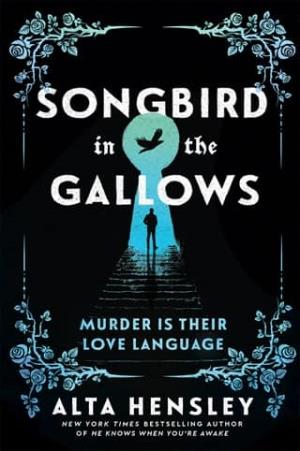
Songbird in the Gallows (Grimlock #1)
Chapter One Saylor
Chapter One
Saylor
Once upon a time, I believed in right and wrong.
Before I learned the truth. Learned it in the spray of my father’s blood, felt it hot across my face while I choked on the
urge to scream. The sound of him dying is still inside me, a metronome to every choice I make.
There’s a bone-deep truth. A blood-written truth . . .
It’s not what you do, but why you do it.
The driving force that lives beneath your skin, pulsing with every heartbeat, whispering justifications in the dark hours
when sleep won’t come. When you understand someone’s why—when you relate to it, fall in love with it, cradle it against your
chest like a secret—that’s what can turn the villain in any story into the hero.
But maybe this is the real question: Who is the villain?
Can you be the villain in your own story? Can you watch yourself make choices that would horrify the person you used to be,
and still believe you’re doing the right thing?
Can you go from rabbit to wolf and convince yourself it was always your true nature, that the innocence was just a costume
you wore until the world forced you to shed it?
I think about this now, when my hands are steady and my conscience is quiet. When the weight of what I’ve done settles into
my core, and I can look in the mirror without flinching at what stares back. When love means something different than it did
before. It’s deeper, more honest, written in a language that most people are too afraid to learn.
They say you can disappear in New York. Become someone new between one subway stop and the next. I should know—I’ve been Saylor
Mitchell for so long now that sometimes I forget I was ever Sara Mitchell.
But here’s the thing about running: You can change your name, dye your hair raven black, build a whole new life, but some things follow you.
The phantom weight of your father’s blood on your hands.
The sound a throat makes when it’s being cut.
The way your real name sits like a stone in your chest, even when no one’s called you that in years.
These nights performing at the White Note are the only time I feel like both versions of myself can coexist. Where scattered
applause and clinking glasses create their own kind of percussion, and cigarette smoke curls through the air like visible
notes. Where Saylor Mitchell sings jazz for tips, but Sara Mitchell’s rage hums underneath every note.
I’d considered changing my last name too—new identity, clean slate. But Mitchell was my father’s name, and as much as I needed
to disappear, I couldn’t bring myself to lose that last piece of him. So Sara became Saylor, but Mitchell stayed. A small
rebellion against my own survival instincts.
The cabaret is dimly lit, smoky, a place where secrets thrive in dark corners. I scan the crowd as I slink across the stage,
my scarlet-red sequined dress catching the light. My fingers find the compass necklace at my throat—Dad’s compass. Antique
brass on a simple chain, the face no bigger than a quarter. It clashes with everything I wear, too practical for sequins and
satin, but I haven’t taken it off since that awful night. North still points north, even when everything else in my life points
nowhere. I give it a quick touch for luck. Same ritual every night since I started singing here.
As the sultry melody from the band fills the room, I adjust the rose in my slicked-back black hair and take hold of the microphone.
It’s time for me to seduce the crowd and lose myself in the music.
I close my eyes and let my body move to the rhythm, swaying my hips and running my hands down my curves. The audience is captivated,
their eyes following every movement of my body.
My voice comes out low and smooth as I sing the first line of “Fever,” a classic jazz song that never fails to get hearts
racing. It’s not my favorite song—too mainstream for my tastes—but Joey, the club owner, insists I start each set with it.
Says it draws in the regulars.
Sometimes I wonder if the regulars would recognize Sara in Saylor.
But Sara was an eighteen-year-old girl from Seattle who watched her father die, who ran to New York with nothing but the clothes on her back and a fake ID she bought at Port Authority.
Saylor is twenty-three, trying to be confident, and attempting to never look over her shoulder.
Sara hid in closets. Saylor owns every stage she steps on.
Not that anyone here knows there’s a difference.
The music shifts into something slower, sultrier. My hips follow the rhythm as I work through the standards. Songs that pay
rent and keep me invisible. Each performance is a balancing act between being memorable enough for tips but forgettable enough
that no one asks too many questions about where I came from.
I open my eyes and scan the crowd again, checking faces out of habit. Making sure no one looks too interested, too familiar,
too dangerous. Every time I check faces, I expect to see one of them—the Crow who leaned close to wipe his blade on my father’s
shirt, his grin etched so deep I still see it when I close my eyes. I see my father’s back as he shoved me into the closet,
hear his whispered command to stay quiet, stay hidden.
Obedience saved me. Cowardice haunts me.
But that’s when I see him.
He’s not a Crow from that night, but there’s something about him . . .
Sitting alone at a corner table, he stares through the audience, pinning me in place. I almost miss my next line—something
that never happens. But this man is throwing me off balance for some unknown reason.
Dark hair falls across his forehead, and there’s something dangerous in the curve of his smile that’s hidden by a thick beard
that makes me want to run my fingers through it. It’s long and dominates his face, but I can still make out the distinct line
of his jaw beneath it. His mustache is subtly curled at the ends, giving the villain vibe I didn’t know I wanted—maybe even
needed—until now. This is a man who clearly is comfortable in his own skin, who exudes confidence and danger in equal measure.
His suit is impeccable, but there’s a wildness in his presence that tells me he’s anything but tame.
The suit is obviously expensive, perfectly tailored. It’s an understated luxury that whispers money instead of shouting it. Most men his age in jazz clubs wear leather jackets, trying to look younger, cooler. But this man doesn’t need to try.
Dad would have said that confidence belonged to men from his generation, not mine. Maybe he’s right . . .
This guy’s got to be in his forties at least. Old enough to know better than to look at me like that. Old enough that I should
know better than to like it.
I can practically taste the mystery rolling off him in waves.
I’ve had my share of admirers, sure. Being a singer in a jazz club, you get used to the attention. But I’ve never been one
to mix business with pleasure. Music has always been enough—that and staying inconspicuous, staying safe, staying one step
ahead of whoever might still be looking for Sara Mitchell.
But this man . . . he’s different. His gaze holds mine as I continue to sing, and I feel exposed, as if he can see past the
stage persona I’ve carefully crafted. As if he can see through Saylor Mitchell straight to the frightened girl who chose her
new name in a Greyhound bathroom stall with shaking hands.
I hold his stare as I continue to sing, my voice growing huskier with each verse. My fingers trail along the microphone stand
suggestively. I’m performing for the whole room, but in this moment, it’s just for him.
As the song reaches its climax, I descend from the stage, weaving between tables like I do every night. The patrons reach
out, trying to touch me, but I dodge their grasping hands with practiced ease. I’m heading straight for my mysterious observer.
I reach his table just as the final notes fade away. Up close, I can see the glint in his dark eyes, the slight curl of his
lips that hints at cruelty. The lines edging his thick lashes that confirm what the suit suggested—he’s got at least twenty
years on me.
I should care. I don’t.
I smile, a simple gesture that feels more genuine than any I’ve given in this club before. Then I turn and make my way back
to the stage, my heart racing as I feel the intensity of his stare following my every move.
I return to the stage and finish my set, but my mind is elsewhere. As I belt out the final notes of my last song, I steal a glance in his direction. He hasn’t moved, hasn’t taken his focus off my face for a second.
The applause washes over me as I take my bow, but it’s all background noise. There’s a hum in my ear. The same hum I felt
that night, minutes before they slit my father’s throat. The one that says danger is coming.
But this time, I don’t run.
After my final song, I head to the bar, deliberately passing close to his table. My throat is dry from singing, but that’s
not the only reason I need a drink.
His gaze burns into me. I’m a match and he ignites the flame.
“Whiskey, neat,” I tell the bartender, my body buzzing from my performance and—
“Make that two,” a deep voice says from behind me. The sound is low and rough, like gravel wrapped in velvet. The voice of
someone who’s lived long enough to know exactly what he wants.
I turn, coming face to face with the stranger. Up close, his eyes are even more mesmerizing—dark and cavernous. There’s a
scar running underneath his right eye that makes me wonder what stories his body could tell. Yes, he’s older than me, but
in the sexy mmmm . . . daddy way.
My father would have chased him off with a shotgun if he knew his little Sara was having the kind of dirty thoughts I’m having
now.
I raise an eyebrow, a smirk playing at the corners of my lips. It’s a facade, I know it, I just hope he doesn’t. “Buying a
lady a drink? How quaint.”
He chuckles, but it doesn’t lighten the darkness and shadows that engulf him. “I assure you, there’s nothing quaint about
my intentions.”