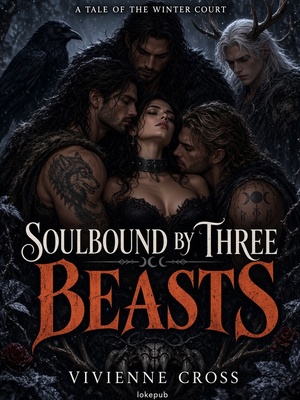
Soulbound by Three Beasts
CHAPTER ONE
?
SEREN
The last time a Council cart took someone out of our yard, his dog waited at the gate for eleven nights. Bel fed him there because he would not leave. Tonight the cart had come for him.
Maunt held the tally roll out at arm’s length and read it at the curtain wall, the way a man reads to something that has never argued back. Forty of us stood in two ranks in the long yard, and Rhodry had counted his leashes twice before the herald was off his horse.
“Vale, Seren. Half-blood. Tracker. Held.”
“Here,” I said, and it went up flat in front of my face and hung there in the cold.
Nineteen years in that yard had taught my mouth to answer before the rest of me agreed to anything.
Vaughn Ironmere stood at the narrow end of it, where the ground runs down to the kennel door.
He had one palm set flat on the top of the tally post. Very large, very still. The stillness emptied the yard. Winter-blue eyes, pale to the edge of colorless, spent on the herald and not on us.
The ground was frozen into ridges hard enough to turn an ankle. Forty collars, each a finger wide. Thirty-nine held the cold. Mine had never learned how.
Nineteen braided leashes hung on Rhodry’s hooks along the kennel wall; the twentieth was in the shed for repair. Of the men who lived and worked in that yard, only the Warden wore nothing on his neck. The leash law sat in his mouth and in no other.
I had seen his wolf come through the Winter Gate ahead of the Hunt, black with a gray ruff.
His eyes came off the herald and went along Rhodry’s hooks, low, to the third one from the kennel door, which is mine.
My pulse came up into my throat and sat there. My breath went short, heat climbed the side of my neck, and I put my chin down before anybody in the rank could read it off my face.
Rhodry drove those hooks himself the winter I came in. I was nine. I have counted the notches on the tally post ever since.
Bel Arrowood stood four men down the rank with his weight on his good leg.
“He’s reading to the wall again,” Bel said, barely moving his mouth. “One year that wall’s going to answer him back and none of us will hear the end of it.”
“Don’t.”
“He’s gone back to the Ks. Kestrel. Kite. Kinnard.” His breath came up in short pieces. “He reads the Ks like they owe him money.”
“You’ll get a hand across the mouth.”
“I’ve had one. It’s a cold night for it. He’d not want to take his glove off.”
Maunt turned a leaf of the roll over, and Bel shut his mouth like a door.
Bel came into the kennels the same winter I did, nine and taller, and he gave me half a heel of bread on the second night and never once mentioned it again. He taught me to splice wet leather.
My kennel-mate nineteen years, and I never heard him say a cruel thing.
“Fourteen collared out of Marrow last season and not one of them’s come back to a hook,” he said. “You’d think somebody would write that down somewhere.”
“Rhodry writes it down.”
“Rhodry writes down hooks.” Bel put his chin back level. “Not the fourteen. He knows it, and he takes the hooks, because a hook stays where a man puts it.”
Rhodry stood at the rail with the tally book open on his forearm and did not look up.
“Master of the kennels,” Maunt said, without turning around. “Your book has twenty leashes on that rail. I’m counting nineteen.”
“Nineteen on the rail and one in the shed with a strap I’m splicing.” Rhodry’s thumb was already at the back of his own collar. “It’s on the leaf. I write every one of them down, every season, and the Warden signs the leaf, and he signed this one.”
“Then the leaf wants amending.”
“The leaf’s right.”
“That satchel’s fat,” Bel said.
“I know.”
“A fat satchel’s never been good for anybody standing in a rank. Last one had two names in it and I couldn’t tell you either of them now.”
Maunt came to the bottom of the second rank and wiped his thumb down the roll, which is what he does before the part that matters.
“Arrowood, Bel. Half-blood. Tracker. Collared out, by writ, to the Council’s cart.”
That was a Writ of Severance, and nobody in the yard moved.
Behind us the gate chain ran out over its drum, a long dry sound.
The two carters came up either side of him. Bel walked. He walked like a man who has decided not to hand them the other thing.
They stood him in the cart bed, closed the chain bolted through the boards onto the front of his collar, and dropped the pin in.
I said it out loud to the yard, flat, the way I would give a distance.
“That road only goes one place. They’re taking him to Vaeloth to cut the bond out of him.”
Nobody contradicted me. Rhodry looked at his hooks. Maunt read a line on the roll that he had already read.
Coal smoke off the smithy came over the wall and lay down flat. Under it I had both carters: salt, wet stone, and the sour of the Gullet road under the ice shelf. They had come up from the south gate without a stop.
“If they call me,” Bel said from the cart bed, “tell Rhodry the brown gelding favors his off fore and it isn’t the shoe.”
“Tell him yourself.”
“I’m telling you. You’re the one he can’t argue with about a smell.” The chain took up and he set his boots against it. “And they’ll want somebody on my hooks. Don’t let him give them to the boy out of Marrow. He can’t tie a knot and he lies about it.”
“I’ll tell him.”
They turned the cart. It came past our rank close enough to put a hand on the wheel, and Bel changed.
A bond in distress has a smell. It is a struck match held under water. I have never met another living thing that can find it. Bel was the only person I had told; he had kept that secret as carefully as he kept my place at the fire.
“Seren,” Bel said.
My hands dropped open at my sides. I took the whole yard’s air in one long pull with my chin up, frost and coal and horse.
“Don’t follow it,” he said. “You’ll do it anyway, and it won’t help either of us, and I’d sooner you—”
Under my sternum, slightly left, three bonds sat where they have sat for three years, and one of them rolled over.
For as long as it took that wheel to pass me, I was glad the name he read out was Bel’s and not mine. Then Bel looked at me, and I put my hand on the wheel. One turn of it took the warmth off my fingers. I had nothing that would make it stop.
Maunt came down the line with the writ folded over two fingers, wiping his hand on his coat, twice, the way a man does after a chain. He had not looked at one face all evening.
He put the two fingers out toward the front of my collar, to read the seam.
“Take your hand back.”
Vaughn had not come off the post. The palm was where the palm had been.
“Yes, Warden,” I said.
That was said to Maunt and not to me. I said it anyway. It came out of me like a coin out of a slot, and Rhodry heard it.
?
The seeker-glass came out of the satchel next. Maunt worked the line with it, right to left, a thumb’s length off each throat, and Rhodry watched him do it from the rail without once putting the tally book down.
He began on his own men. That is not a courtesy. It is a calibration.
Over the second carter, a full-blood fae with a farrier’s shoulders, the glass came up like a held candle and stayed lit until Maunt drew it away.
“There,” he said. “That’s what it does when it’s doing it.”
Down the ranks it gave a dim green, throat after throat. A reading, Maunt called it. Over some of the older trackers the green barely held.
Over me it did nothing whatsoever.
Maunt stopped. He tapped the glass on the heel of his hand and ran it back over me, slower, jaw to collarbone.
Nothing.
“The glass isn’t wrong. It’s slow in the cold, that’s all,” he said, to the instrument and not to me.
He took out a stub of lead and wrote something down and did not look up.
“You wrote something down,” I said. “You’ve not written anything down for anybody else on this rail.”
“I write down what the instrument gives me.”
He put the lead away and found the Warden with his eyes instead.
“The Council doesn’t take a tracker off a Court rail for the pleasure of it. Every half-blood on that rail lives forty years longer with the bond out of him. That’s mercy, written down and paid for.”
“It’s a cart.”
“It’s a cart with a physician at the far end of it.”
Nettle came out the kennel door, twelve years old and nothing on her neck, and crossed the yard backward in front of Vaughn with her hand out, palm up.
“I’ll carry it. You can say yes or I can just take it.”
“You’re going inside. The yard’s done.”
“That’s not a refusal.” She walked backward without looking where she was going, and the ruts did not trip her.
“It’s what’s happening.”
“I’ve carried the tally book twice and I never dropped it, and I’m the only one who oils those hooks, and you know I am.”
Vaughn’s hand stayed flat where it was.
“You’re going inside, and Rhodry’s going to bolt the door, and you’ll be asleep before the Council’s cart is off the ramp.”
“I’ll be at the shutter.”
“You’ll be asleep.”
“I’ll be at the shutter, asleep.” She reached the door and stopped in it. “You’re not even a bit frightening. Rhodry’s worse and he cries at the foaling.”
Down the second rank a man laughed and turned it into a cough. Vaughn did not move his head. Nettle went in and slammed nothing, which is worse.
Rhodry shut the door after her and bolted it from the yard. Nettle’s shadow appeared at the shutter before his hand left the iron.
Maunt folded the roll away and told the carters they’d make the relay line by dark.
“Your near horse has been going short since the Gullet,” I said. “You’ve a stone bruise or you’ve a nail in the frog, and it’s a nail.”
“It’s four hundred yards to the turn and the light’s going,” Rhodry said. “You’d want to—”
“And what would a collared nose know about it?”
“Four hundred yards, upwind, and one of your horses is lame behind. You’ll not make the line tonight.”
Maunt looked at the horses for a while. Rhodry looked at the ground and kept looking at it.
I am the best tracker in the Winter Court. I hold a trace at thirty miles, through stone, through water, through weather, and it has bought me a low hook and a collar.
Rhodry started talking then, which is what he does when he’s frightened.
“It’s the frost, that’s all it is, you can’t hang wet leather on a cold hook, I’ve told them, I’ve told them every year—”
“Rhodry.”
“—because it goes stiff at the splice, and then it’s the splice that opens and not the strap, and a man will blame the strap. I’ve a rule about it. Nothing wet on a hook after the frost sets. Nothing wet on a hook, herald or no.”
His thumb went round and round the back of his own collar the whole time.
?
Vaughn came off the tally post and crossed the long yard, once and completely, the way he does everything.
He did not come through the middle of us. He arrived inside my space before I registered him leaving the post. I come to his collarbone, and I had to put my chin up to keep his face.
He reached past me to the rail and lifted my leash off Rhodry’s hook. He did not ask for it and Rhodry did not offer it. Braided leather, nineteen years on that hook.
The backs of his knuckles went across the front of my collar on the way down. Below the jaw. Never above it. He read the seam without a word, the way a man checks a thing he owned.
Heat came up under my sternum and my palms went cold in the same half breath and my nipples drew tight under my coat, and my mouth was open, and I had decided nothing whatsoever about him.
My body answered a question nobody had asked it. Something in me liked being taken off the hook by his own hand.
There was no wolf anywhere in his face. He hung the leash on his own belt and did not look down at it.
“That leash comes with me.”
“Warden, the instrument has to be run twice on any half-blood who reads clear, and I’d have to—”
Maunt put his hand out toward my throat.
“You can read your writ from where you’re standing. You put a hand on that collar and I’ll take the hand.”
The yard did not make a sound. Forty of us. The brazier by the gate ticked and settled.
Maunt took his hand off his own instrument and put it in his coat. The glass hung at his side.
“That’s my tracker.”
Two fingers went to the leash on his belt without his looking down at them, and stayed.
“You understand what you’ve done in front of a herald,” Maunt said. “A leash on a Warden’s belt makes the Warden answerable for whatever’s on the other end of it. I’ll be writing that down as well. I’d sooner you had let me finish the line and gone in to your supper.”
“Finish the line.”
“I’ve finished it. So I’ll put the rest of it plainly, Warden, since you’ve an audience and I’ve a satchel. The Council doesn’t lose a name once it’s written down. It only decides which evening to read it out.”
He had come north to get one sentence written down, and he had it.
Then Maunt opened the satchel again. He took out a second writ, a heavier wax gone dark red in the cold.
“There’s a second writ in the satchel. It isn’t for tonight.”
“Yes, Warden,” I said.
It came out of me a second time and it was not for him and it was not agreement, and Vaughn turned his head toward me and not his body.
I cannot read. I can count. I counted the seal on the writ they had spent on Bel and the seal on the one folded in Maunt’s hand, the way I count the notches on the post, one and one.
Two seals mean two writs, and two writs mean two names.
He held it up in the gray light, sealed and unread, and I stood in the frozen ruts of the long yard and understood that somewhere inside that satchel there was a name.