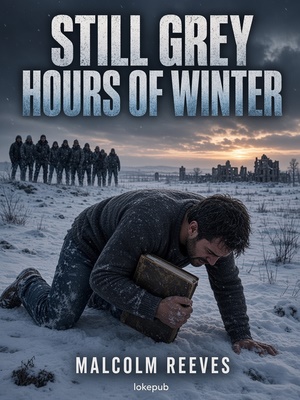
Still Grey Hours of Winter
Chapter 1
The snow that came down out of that flat gray sky in November came down for two days.
Stuart Redman stood in the lane until his shoulders were white and the light went out of the afternoon, and then he went inside, and that was the beginning of the fifth winter.
He did not know anything about it yet. He knew it had started and that was all, and that was all anybody ever knows on the first day of a winter.
By the second morning there was eleven inches on the level and better than three feet where the lane bent.
By the fourth there was a path stamped down the middle of the town six feet wide and hard as a road, because eighty-seven people walking the same line four times a day will make a road out of anything, and the Crossing had eighty-seven people in it now.
That was the number Davey read out at the wood meeting, and Stuart heard it and did not like the sound of it, and he sat on that feeling for a while before he understood what it was.
It was the sound of a town that had been fifty-three in February.
He kept the letter in his coat.
He did not take it out much. Twice, maybe three times, in that first month, and each time in the dark with a candle, and each time he read the same eleven lines and folded it back along the same creases until the creases went soft.
I am asking you to come north in the spring. I have nothing to give you for it. I am asking anyway.
Camille caught him at it once and said nothing, which was worse than if she had said something.
"Go ahead," Stuart said.
"I have not said one word."
"You've got a face on you."
"I have this face always," Camille said. "It is the only one I was issued." She sat down on the other side of the stove and put her boots up on the rail. "You will go in the spring."
"That's the plan."
"Then there is no problem, and you can stop reading it like a man looking for a different ending."
"That's not what I'm doing."
"Stuart. That is exactly what you are doing." She did not look up. "You read it and you count the weeks and you think, if I left in February I would only lose a foot or two, and then you think about the pass, and then you put it away. I have watched you do it three times."
He put the letter away.
"I have not counted the weeks," he said.
"Twenty-one," Camille said. "That is how many there are. I counted them for you so you can stop."
The wood was the trouble, and everybody had known it since about the second week of October, and nobody had said it out loud until the snow made it a thing you could not talk around.
The valley had cut wood for nineteen chimneys.
It had cut that wood in the spring and the summer of a year when there were fifty-some people in it, and the cutting had been done by the same eleven or twelve men who had always done it, in the same draws they had always done it in,
at the same unhurried rate that had kept the Crossing warm through four winters.
And then thirty-one people had come in March and stayed.
They had brought ground knowledge with them and they had put in a crop the like of which the valley had never seen, and there were two towns' worth of food in the cellars because of it, and Davey had built a second root cellar in September with eleven men to build it with.
Nobody had built a second woodlot.
You cannot. That was the thing. Wood is not a crop you put in and take out in the same year.
Wood is a decision a town makes three years before it needs it, and the Crossing had made its decision in the second year, when it was a small frightened place with fourteen chimneys, and the decision had been correct then and was wrong now, and there was no fixing it in a January.
Davey ran the meeting on the ninth of December and did not pretend.
"We are short," he said. "I am not going to soften it. We are cut for nineteen houses at four years of use and we have got twenty-six houses lit and eighty-seven people in them, and if this winter runs the way the last one ran we come up short somewhere around the middle of February."
Nobody made a sound.
"So we are going to cut green," Davey said, "which is miserable and smoky and about half the heat, and we are going to cut it out of the west draw, which is a mile and a half further than anybody has ever had to carry a stick in this valley, and we are going to do it in the snow."
"How many days," somebody said.
"Every day that isn't a blizzard," Davey said. "From now until the melt."
Stuart went out with the first crew and every crew after it.
He was fifty-one years old with a right arm that had never come all the way back and a hip that talked to him in the cold, and he could not swing a maul for more than about forty minutes at a stretch, and he knew it, and so he did not swing a maul.
He drove the sledge. He broke trail. He stood in the snow with a rope over his good shoulder and dragged tops out of the draw eleven hours a day for three weeks, and at night he sat down on the bench inside the door of his own house and could not get his boots off,
and Camille got them off for him and said nothing about it either.
It was good work.
He was surprised by how good it was. There was nothing in it that required him to be anybody.
He was a man on a rope in the snow, and there were twenty other men on ropes in the snow, and eleven of them had come in March and nine of them had been in the valley four years, and after about the second week nobody could remember which was which out there.
That was the part Stuart watched.
Because in the lane, in the town, with the fire going and the meeting called, they still sat on the east side.
Three months of that. Every meeting since May, the new people on the east side of the long room, and Stuart had noticed it in June and filed it and had not liked it, and it had not gotten one inch better.
But in the west draw at four in the afternoon with the light going, there was no east side.
"It is the rope," Camille said, when he tried to explain it.
"It's not the rope."
"It is the rope. You cannot pull a rope in a direction that has a side to it." She was mending a strap by the stove with her boots on the rail the way she always was. "In there they are sitting down. A person who is sitting down has time to remember what he is."
"That's a hard way to put it."
"It is the correct way to put it," Camille said. "In here you are a man who voted a certain way in May. Out there you are the man on the third rope. I would rather be the third rope."
Then it got cold and the cutting stopped for nine days, and that was when Stuart learned what the fifth winter actually was.
He had a name for the fourth one. He had been carrying it for a year, and it had been the truest thing he knew about the world after the lights went out, and it was the sunrise that dies.
That was the gray and then the gold along the eastern rim, and the animal in a man standing up and saying there, it is over, the day is here, the day will be different, and then the light going flat and dead across a country that had not changed overnight and was not going to.
Forty minutes of that, every single morning, the promise leaking out of it while you watched.
He had walked ten thousand miles on those forty minutes.
The fifth winter did not do that.
The fifth winter came down over the Camas country in the last week of December and took the sunrise away entirely.
There was no gold. There was no rim. There was a long slow lightening that started somewhere around eight and finished somewhere around ten, and what it finished into was not day.
It was a flat white sky over flat white ground with no line between them and no shadow anywhere in it, and the light came from every direction at once and therefore from nowhere, and a man standing in the middle of the lane at noon could not tell you which way was east if his life hung on it.
And nothing moved.
That was the thing Stuart could not get used to, and he had been through four winters and thought he had seen every kind of stillness there was.
No wind. No birds. No creak in the timber. Smoke standing straight up out of twenty-six chimneys and going up two hundred feet before it thought about spreading. The dog lying by the stove with her nose on her paws, not asleep, watching the door, and nothing at all for her to watch.
From ten in the morning to three in the afternoon, for nine days.
The still gray hours.
That was what the old man in the north house called them, and Stuart did not know that anybody had a name for it until Callum Hennefresy said it in the lane on a Tuesday like it was a thing everyone said.
"Been a long one," Callum said.
"Long what."
"Gray hours." The old man had a load of green fir on a hand sledge and he was not hurrying with it. "My father called them that. Up in the Palouse. Said the still gray hours were when you lost men."
Stuart stopped in the road.
"Say that."
"You lose men in the gray hours," Callum said.
"Not in the storm. Everybody's sharp in a storm. A storm tells you what it is and a man gets up and fights it and does fine."
He shifted the rope. "It's the nine days after. When there's no weather to push against and nothing's happening and nothing's been happening and nothing is going to happen."
"And then what."
"And then a man quits looking," Callum said. "That's all. Nobody decides it. You just stop, because there has been nothing on that road for nine days and there is nothing on it now, and the eye gets tired of doing a job that has never once paid it."
He picked the rope back up.
"My father lost a brother that way in nineteen and fifty-one," he said. "Not to a thing. To the nine days before the thing."
Stuart thought about that for the rest of December.
He thought about it enough that he went and sat down with Davey on the second of January and asked for the watch schedule to be changed, and Davey looked at him like he had asked for the river to be turned around.
"The watch is fine."