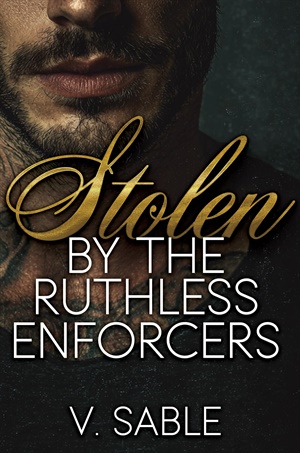
Stolen by the Ruthless Enforcers (Sins of Novarra #3)
1. Veronica
VERONICA
I’ve never seen this many lilies in one place.
Not even at my grandmother’s funeral, where the flower arrangements were stacked like barricades against the open casket and guests dipped their heads to avoid the perfumed haze.
This is an artful siege: hundreds of white blossoms rise from every surface of our estate’s main salon, and their scent is so sweet it grows sickly as the hours crawl by.
There are lilies in polished silver urns, lilies woven into glossy black ribbons that gutter the marble columns, lilies crushed beneath the soles of Novarra’s most dangerous men as they drift in solemn, predatory clusters from tray to tray of wine and obscenely beautiful canapes.
The men are all in suits—each a little too sharp, a little too new for true respectability—and they wear their grief the way they wear their watches: heavy, and meant to be seen.
I stand at the edge of it, black dress and hair pinned like the picture in my father’s campaign advertisements: the good daughter, the proof of bloodline.
My wineglass is filled almost to the brim and perfectly untouched. The condensation collects in a little pool on the tip of my ring finger.
I do not know the dead man. I only know him from the obituary and the low, careful conversations around me.
They say he was a “benefactor,” which means the money that fueled my father’s last decade of political legitimacy has now evaporated into the same thin air that draws the lilies’ scent into my lungs.
I keep my expression fixed to the correct degree of loss, which is not much.
The only evidence of upset is the small, involuntary twitch at the side of my jaw whenever the air-conditioning kicks in and spatters goosebumps over my arms. I listen to the voices of the men who run Novarra, and I catalog them the way I was taught: by who they defer to, who they insult, who is missing from the invitation list and who lingers too long at the bar—or returns there too often.
My father moves through the mourning crowd shaking hands and speaking to everyone.
He should be in mourning, but there is no real sorrow in his demeanor.
He has the same stride he wears on debate stages: head up, hands clasped loosely behind his back, lips pressing into a straight line after every handshake.
A server comes around with a tray of drinks and I hand over my untouched wine in an almost desperate gesture. He takes it without a word and without looking at me.
Abandoning my glass means I can walk, and I drift at the edges of the room just out of reach of the knots of men who cluster around my father. Their words fragment when I approach.
“Orlov—” and then the glass lifts, lips seal, eyes slide off my shoulder.
“Shift in alliance,” is spoken clearly, but to another man, not to me. The room is a low, well-dressed murmuration of threat. No one has addressed me by my given name all evening. I wonder if they even know who I am.
My father only brings me to events when it looks proper to have family around him.
Each time I find the courage to angle closer to my father, there is a look from across the room.
Sometimes it is his: a raised eyebrow, a tensing of the jaw, a tilt of the head so subtle that only I would recognize it as a command.
Other times, it is a stranger’s eyes on my neck, a reminder that I am being measured, not just by hemline and posture, but by the yield of value I represent in a room like this.
I obey the choreography, and remain on the periphery, where the lilies are freshest and the scent does not yet feel like drowning.
A woman in my position learns to inventory her surroundings. There are twenty-three men in the room, not counting the staff. Thirteen are familiar faces from the old donor’s galas; the rest are new, imported from the edges of the city or from across the borders of old feuds.
Four carry the faint, greasy shadow of police on their shoes, and one—an older man with a pinched lip and the slow, appraising gaze of a snake—keeps his left hand in his coat pocket at all times.
There are personal security guards present as well—trying to blend into the shadows or appear casual. They’re failing at both.
Across the expanse of black satin and white flowers, my father’s face finally softens—not for me, but for the man standing beside him. This man is compact, with sharp blue eyes and hair silvered at the temples. He does not wear the nervous energy of the others.
When my father shakes his hand, the gesture is prolonged, almost tender, and the other men recede in a widening arc. I cannot hear what is said, but I see the blue-eyed man tilt his head toward me, just a fraction, and my father’s eyes follow.
The look that passes between them seems like an agreement. I realize, with a twist of something cold in my gut, that the dead man is not the reason for the evening. He is the cover story.
What matters is what fills the vacuum his absence has left.
The blue-eyed man moves off to be greeted by a new circle of suits. My father’s gaze scans the room until it lands directly on me. His smile is the same one I’ve seen many times: a brief, bright flicker, calculated to vanish before it can be mistaken for affection. I smile back, but not too much.
My father moves away through the crowd, shaking hands and gesturing to the bar. I wonder if I can leave. It’s not as though I’ll be missed.
A young man with the hunched posture of an intern sidles up to me with a fresh glass of wine. I wave him off, but he lingers, his eyes on my hands where they’re clasped at my waist.
“What?” I breathe tersely.
He doesn’t hesitate. “Your father is waiting for you in his study, Miss Acerbi,” he says, voice already breathless as if delivering some contraband.
I thank him with a tight smile and turn away.
I don’t need any more information than that.
I already don’t want to know what he wants.
This was an evening for making deals—not for mourning.
As I cross the room, the conversations seem to hush and I can hear my own footsteps on the marble.
There is a strange power in being the thing that makes other people quiet.
I do not meet the eyes of the men I pass, but I feel them follow the line of my shoulders, the fall of my hair, the way I do not stoop or hurry.
There are no more lilies beyond the threshold. Only the hush of old wood, and the taste of metal at the back of my throat. I step inside, and the door swings shut behind me with the faintest click.
My father’s study smells of dust, leather, and the brine of old liquor—a scent that always made me think, as a child, of preserved things: animal hearts in jars, and old things I wasn’t allowed to touch.
There are no lilies here, just the stark, sepulchral glow of a single lamp burning on the desk, and the geometric shadows it throws across the wood-paneled walls.
The shelves behind him are filled with biographies of men who died on their own terms, and with the bristling, ornamental weapons of deals struck in darker decades.
Atop the desk: a sheaf of legal folders, a half-finished glass of scotch, and a silver pen that once belonged to the mayor of Novarra, now serving as paperweight for the obituaries section.
He does not look up when I enter, nor does he indicate that I should sit. I remain standing, hands folded at my waist.
“We have to talk, Veronica,” he says. Not even a greeting—just a statement dropped like a coin into an empty well. His voice is thin with exhaustion but uncracked, the way it always is when he is about to do something necessary but distasteful.
“About what?” My question is quiet and precise.
He lifts the glass, studies the amber residue at the bottom as if searching for a shape in tea leaves. “Viktor Orlov has expressed an interest in becoming a donor to my re-election campaign.”
“A large donor?” I ask.
I already know the answer. I can see the greed at the edge of my father’s gaze as he studies the silver shine of the mayor’s pen.
“Oh, yes. He will request a formal introduction by the end of the week.”
“Introduction?” I ask. “You haven’t met him yet?”
He chuckled. “Not for me,” he says. “Now, you have to understand that the timeline has moved forward faster than I would have preferred. But old Giamatti’s heart wouldn’t hold out for any longer.” He sets the glass down, spins it once and the ice clinks in a steady, nervous rhythm.
He taps his fingers on the desk beside his glass.
“Everything we worked for. All those years of campaign, all those speeches—gone the moment Enzio died.” He does not use the dead man’s title, only his name, as if familiarity might soften the gravity.
“Everything will collapse without Orlov’s backing.
Our donors are already being approached by his people.
They’ll make it look like charity, but it’s a takeover, plain as day. ”
My throat is dry, but I force my tongue to move. “Is he dangerous?” I ask, more for the sake of the ritual than because I do not already know.
“Dangerous?” The question seems to amuse him, and for the first time in months, there is a ghost of a real smile on his lips.
“They call him the Widowmaker. I don’t want to find out what that means…
” His fingers tap in an uneasy cadence. “What matters is that the offer is genuine, and that you are going.” He holds my gaze for the first time since the funeral.
His eyes are glassy and bloodshot, but they do not waver.
My throat is tight. “Me?”
“This is what the family requires,” he says. “It will save our name. And you will secure his promise. And, of course, represent us with the dignity you have always shown.”
The room is so silent I can hear the slow settling of the house’s bones. Even the wind outside, that whistled between columns all evening, has died. For a moment I imagine everyone in the house has disappeared, and I might disappear, too.
“When?” I say, and I am proud that my voice does not crack.
His fingers splay on the desk as if to steady the weight of the decision. “You’ll leave tomorrow evening.”
“I don’t understand. You want me to leave— For a meeting? Can’t he come here?”
He shakes his head. “It’s more than that, Veronica. There is nothing to negotiate. These are the terms of the agreement.”
My fingernails bite into my palms. “I need you to tell me what was agreed,” I say through gritted teeth. “You can’t just… send me away without telling me why.”
“I can, and I will,” he says. His voice is dangerously low and I want to step back as he rises from his chair.
The leather creaks and he looms over the desk.
“Viktor Orlov has promised to eclipse the commitments of all my other donors—that promise will secure my position in Novarra’s political sphere for the next decade.
A heartbeat away from power.” He inhales deeply. With satisfaction.
I stare back at him. “And what do I have to do with it?”
“You are the bargain.” He says the words with ease. As though they don’t matter. “Viktor needs an heir. His sons are all dead… and he has a vast legacy to secure. You are the key to that legacy—and mine.”
I fight to keep from swaying on my feet.
“You— you traded me away for… a political victory?”
“I would do it again for less,” my father roars. “If this is the price demanded, I would pay it a hundred times.”
I have no words for him. No argument would change his mind. No pleading would sway him or bend his heart to pity. I can see it in his eyes.
He brushes a hand over his perfectly coiffed hair and tugs at his jacket sleeves.
The diamonds on his cufflinks sparkle in the lamplight.
“Pack lightly,” he says, calm now. “Nothing sentimental, nothing that draws attention. There’s a car arranged, a driver who will get you through the checkpoints.
Orlov’s men will collect you from there. ”
He does not offer a promise that I will be safe, only that the logistics have been managed.
I look at my own hands, and force them to open. The red half-moons in my palm throb. I wonder if I can remember how to behave around terrifying men without drawing their ire. I think of the lilies, their perfume thick in my nose, and realize I have not truly tasted fresh air in days.
“Do you understand?” he asks.
“Of course,” I say, and the syllables come out smooth and flawless, the way he taught me. I see the relief in his face—sharp and fleeting, as if he is grateful I did not make him say it twice.
He lifts his glass of scotch and takes a long swallow. His eyes are on the window. Not on me. He doesn’t need my approval. Just my obedience.
The meeting is over; I am dismissed, already fading from his mind and his priorities. He picks up the silver pen, and twirls it between his fingers. A satisfied gesture. One I’ve seen him do a hundred times since the pen came into his possession.
I turn, step out of the pool of desk-lamp glow, and open the heavy door as quietly as I can.
The corridor outside is dark, and the overhead bulbs seemed dimmer.
The hum of the funeral reception runs through the house and I wonder how many new deals and alliances will be made in that room amid the lilies.
I close the door gently behind me and stand for a moment with my back pressed to the cold stone wall.
My breath is thin and high in my chest, as if the news has hollowed out a space between my ribs. I count three long inhalations before the trembling starts, but even then, I keep my face still. There will be no witnesses to this.
This is what the family requires.
I press the back of my head to the wall and stare up at the ceiling’s arch until the blackness resolves into shapes: the edges of a chandelier, the faint movement of a fine misted rain in the shaft of a streetlight outside the window.
I stand there until my spine stops aching and the need to cry is replaced by something else.
Tomorrow, I will pack and start to wonder what it will be like to be traded away to a man I have never met—to secure the future of a family who are strangers to me.
For now, I stand in the dark and think of lilies, their scent too strong to be beautiful, and their pure white petals curling brown at the edges the moment no one is watching.