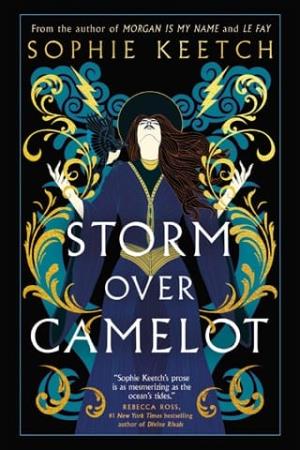
Storm Over (Morgan le Fay #3)
Chapter 1
How easy it was, to ride into darkness.
I had travelled through dusk and midnight, and the forest should not have felt so familiar.
Only two days in my life had I ever passed through these woods—once on horseback with a guide, and the other running.
Escaping. Between the dense trees, the years gone by and the new route I had taken, I should not have been able to find my way.
But to be bound by magic is no small thing. For my sins, I could have found Merlin’s house blindfolded, on the blackest of nights.
As dawn rose, I paused beside a stream so my horse could drink and take a few hours rest. I reclined against a tree but could not sleep, instead watching the brook glimmer over its stony bed, sluggish with the height of summer.
My thoughts ran slow with the water, steeped in guilt for my departure the previous day, when I had saddled Phénix without telling a soul and absconded from my house, my valley; Fair Guard as it once was.
Belle Garde, we had called it this past twelvemonth—a tribute to Accolon, my Gaul, my love; the lost half of my soul. He had always referred to our home in his native language and now it could be nothing else. A change as natural as the tides, and as relentless.
The moment, too, had arrived suddenly, without mercy. A year ago to the day, Accolon had died, killed at the hands of my own brother.
The household had wanted to acknowledge the anniversary, hold a banquet and subsequent vigil to mark his passing with the honour it deserved. I appreciated the gesture, even if I could not participate. For them, it would help. For me, I hoped Alys and Tressa at least would understand why I left.
As the morning light strengthened, I remounted and rode onwards, a horde of memories in pursuit. Halfway to noon, Phénix gave a shiver of his muscles, and I knew we were getting close.
I had never fully trusted in the claims of Merlin’s death, as one never turns one’s back on a wild beast thought tamed.
When I emerged into the clearing and beheld his enchanted island, every doubt that had lain dormant reared up.
Had Ninianne truly locked the sorcerer in a cave until he died?
Or had he managed some final trickery and was now lying in wait, hungering and dangerous?
That cannot be, I told myself. If Merlin were still alive, you would feel it.
The gabled house and stone tower slumbered in green shade, bracketed by the enormous elder and oak trees.
The rocky moat ran with water but low and calm, not the roaring, deadly rapids it had once been.
The marble bridge only Merlin or Ninianne could summon—that supposedly kept intruders out and had kept me in—stood unconcealed above the surface, reclaimed by dried leaves and dirt.
Horses will not cross, Ninianne had explained upon my first arrival, but Phénix walked the bridge without qualm.
There could be no starker sign that things were not as they had been.
Still cautious, I dismounted near the main door.
The house was structurally the same but not untouched by time and nature: grass overgrown at the front and climbing plants crowding the windows; unchecked hops vines hanging down, giving out their sleepy yeast scent; the tower almost entirely carpeted with ivy.
Beside it, the giant oak stood mute and resplendent. Once, Merlin and I had buried a white hart at its roots, dead and mangled, brought back to life whole by my skills, my work, my blood. Such a feat had been everything to me, and here I was, chasing the same miracle.
I took the sacks I had brought from the horse’s saddlebag and went to the entranceway. The door was swollen from rain and stuck fast, so I laid my hands on the planks and sought the water within, drawing the element forth. The wood contracted with a creak and yielded, letting me inside.
I faced the dim hallway, flagstones echoing under my boots.
Spiderwebs hung from the rafters, the air scented with damp and soot, bundled herbs long turned to dust. I paused, letting my senses sharpen to the atmosphere.
Beyond my heartbeat, only emptiness. If this was a trap, then it was an extremely well-wrought one.
Still, I could afford to trust nothing.
I began with checking every room. My former bedchamber was eerily undisrupted, the bedsheets thrown back as I had left them on the morning of my escape.
Here, I had slept uneasily for over a year, and for three of those nights I had lain unaware, birthing a baby who I never saw, never heard, never named.
Mine and Accolon’s son, taken by the sorcerer under Ninianne’s unbreakable charm of concealment, eternally hidden from me.
The child was gone, Accolon was gone, every trace that such a thing had happened, gone. The thought made me want to curl up on the dusty mattress, but I forced my unsteady feet to walk away. I was stronger than this; I had to be.
Ninianne’s study was still the brightest place in the house, the huge half-moon window letting in a curve of morning. Shelves of manuscripts, cut quills and crystals stood dust-furred but orderly, the long marble worktable empty except for one vase, bearing a few stems of vivid purple foxglove.
The sight of life startled me, until I reached out to touch the flowers and found them hard and cold.
They were the same foxgloves that Ninianne and I had turned to stone, her first demonstration of the elemental magic I had come to love, and my earliest, imperfect attempt at recreation. For some reason, she had kept them.
The thought thudded into my gut—that Ninianne had valued our time together as I had, long before she helped my brother orchestrate Accolon’s death and turned us into enemies.
Now, it didn’t matter if we had sat at this table, sharing knowledge and confidences in unusual sisterhood, that we had once transcended our mortal and fairy differences and become closer than either of us could acknowledge aloud. None of it had meant anything.
I put my back to the foxgloves and left the room. I was not here to lament the past; I had come to seek my future.
Finally, I went to the long, dim classroom where the sorcerer first taught me, its windows crowded by bitter nightshade. Empty, unchanged, just as the rest.
A cool sweep of draft lifted the hairs on the back of my neck. Only one place remained unseen: Merlin’s tower.
The door to the stone stairs stood open.
How many times had I made the twisting climb towards wonders and horrors alike?
How often had I lamented ever placing my foot on the first step?
Despite this, I went forth, up one flight, then another, and the third.
It was just another empty room, I told myself. There was nothing to be afraid of.
At the summit, I stopped. The door to the sorcerer’s study was shut.
You have nothing to fear, my mind replied, unless you are not alone.
Dread flashed through my veins, but I pushed the feeling away. I was Morgan le Fay and I no longer knew fear.
With a defiant shove, I threw the door open. The room was empty.
Of course it was—what had I expected? To see Merlin behind his huge tree-trunk desk, regarding me with his pointed smirk?
He was gone; there hadn’t been a whisper to the contrary.
Even Arthur’s rule had moved on in the five years since Merlin’s strings had been cut from the kingdom—the sorcerer would never have relinquished control for so long.
No, Merlin was dead. Ninianne had captured her captor, and the world had continued without him. A year ago, I had walked into Camelot’s Great Hall and seen the extinguished black wicks of his life candles with my own eyes.
Regardless, I did not wish to linger. Fortuitously, everything was where I’d left it: the books and scrolls for my work on resurrection; piles of unbound pages; a few rare and interesting manuscripts on other subjects that my study shelves did not have.
I unfolded the sacks I had brought and filled them with as much precious knowledge as I could carry.
I heaved my cargo down to my horse and secured the weight evenly across his hindquarters, then returned to Merlin’s lair.
Only the final part of my quest remained—the upper tower floor where the sorcerer had watched the stars and hidden his greatest treasures.
A place that I had never been permitted to go.
There, I hoped to find the miracle I had come for: the Shroud of Tithonus.
A resurrection object of untested but formidable power, the secrets of which Merlin had been trying to unlock to reverse Arthur’s prophesied death.
The one thing I needed to bring Accolon back to life.
When I had last seen it, the Shroud lay in Merlin’s saddlebag, before he imprisoned me and rode off to Camelot to become the architect of my downfall.
Logic suggested that he must have come back to discover my escape, returning the treasure to its hiding place before Ninianne tempted him away to his death.
I ascended the stone spiral, ready to do battle with the threshold, surely locked under magic. Instead, the door flew open at my hand. I felt the scratch of Merlin’s mockery; he had never feared me disobeying him, because he believed he held me rapt. The thought filled me with gall.
The mysterious chamber was large and empty, walls panelled in black, highly polished wood. Halfway down, a ladder descended from a closed trapdoor, a route to the tower top and the stars. At the far end, five narrow windows let in barred light, hazy with dust, casting a large lectern in silhouette.
Upon closer inspection, the panelled walls revealed themselves to be doors of large cupboards. I prised one open, revealing a series of smaller cupboards and drawers, studded with silver handles in the shape of dragon heads.
I grasped a handle, expecting magical resistance.
The drawer slid open, but was only full of sun-bleached bird bones.
In a slim cupboard, I found a chunk of smoky quartz, swirling with its own light.
Another panel revealed a board pinned with dead butterflies, splayed and bright.
A bag of goat horns toppled from a shelf and spilled onto the floor with a clatter. The room was full of Merlin’s detritus.
Impatience overtook me from there. Black doors flew open under my hands, drawers wrenched from their sockets, scraps of herbs and twine collecting about my skirts, runestones rattling like teeth as I tossed them aside.
I even found the dragon-hilted dagger Merlin had used to slash Ninianne’s arm in one of our “lessons,” but no ebony box. No Shroud of Tithonus.
I flung the final drawer aside, pausing to suck a splinter from my fingertip.
As I did, my eyes landed on the hulking shape of the empty lectern.
In the angled light, I could see the pedestal was carved with carousing dragons, a horizontal shelf jutting proud at the back. On it sat a dark wooden box.
At last. I charged across and snatched up the vessel, throwing the lid open.
A warm, muted glow met my eyes, emanating from a rectangular object within. Reaching inside, I lifted out not the folded fabric of the Shroud, but a book.
It was smaller than most manuscripts, maybe ten inches tall, but thick and weighty, armoured in solid gold. White pearls and blood-red rubies studded the gilt covers, bringing yet more heft, like a cathedral bible. Substantial was the word that came to mind.
Gently, I propped the volume against the lectern. For all the dust, not a speck dared settle on the gleaming surface. Enchanted, then—a potentially dangerous prospect. But never in my life had I been able to resist opening a book.
The gold cover was warm against my fingers, parchment creamy and smooth, the most perfect I had ever encountered.
On the first page, a star chart had been painted in blue and silver, illuminated at the edges with gold-inked crowns.
At the top, Merlin’s slanting hand had written a date in early March that had been familiar to me since the first day the skies rendered it significant.
I turned the page. It was blank, aside from two flourishing words.
Arthurus Rex.
Then another, alone beneath.
Prophetiae.
I heard myself gasp. Before me was Merlin’s Book of Prophecies for Arthur and his reign, his kingdom, his entire existence. The definitive record of my brother’s past, present and future, according to the sorcerer’s interpretation of the stars.
Tentatively, I lifted a sheaf of pages, revealing reams of writing in the sorcerer’s distinctive script: every prophecy Merlin had made and given to my brother like a poisoned chalice, and used to hold sway over his life.
Within these pages would be the words that led to Arthur’s birth through my mother’s violation by Uther Pendragon, the dark exchange made for a first-born son; the declaration that Merlin had cast upon the sword in the stone, until Arthur drew it free and first felt a crown on his head.
There would be accounts of battles won, of the allies, enemies and deaths that carved the path to Camelot’s creation, the glories and dangers found in the destiny of Britain’s greatest king.
Then, the final prophecy, powerful and devastating—Arthur’s death, and the realm’s resulting fall.
And amidst the rest was a prophecy bearing my own name, for a betrayal I was not guilty of, not a prediction of my fall as much as it was the cause.
The collapse of my whole life—the loss of my true love, of motherhood, the bond with my brother and my place in his world—all written there with an authority utterly indifferent to the devastation it had wreaked.
Morgan le Fay’s ruination, rendered in ink.
I would not look at any of it; there was no enlightenment to be had.
I slammed the heavy cover shut and turned away. Chaos greeted my sight—yawning cupboards, drawers pulled out, the floor littered with polished stones, feathers and shards of pottery. I had torn through Merlin’s secret world like a tempest.
A vague satisfaction thrummed in my blood, but in truth I had nothing to show for it. Yet surely, if Merlin left his precious Book of Prophecies here, then the Shroud of Tithonus could not be far.
I closed my eyes, letting my mind reach forth. The Shroud’s life force had always sung out to me, and my senses, my deepest elemental instincts, had only got stronger over the years. If it was here, then it should answer my call.
A ripple passed through me, subtle but distinctive. Not the comet-tail thrill of a resurrection object, but a disturbance—the pulse of a moving body, whispering robes brushing floorboards, a presence drawing near.
“Morgan,” said a familiar voice. “What are you doing here?”