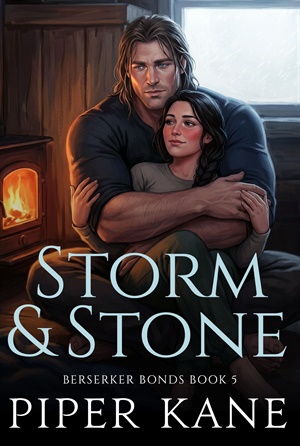
Storm & Stone (Berserker Bonds #5)
1. Maren
MAREN
The thing about being snowed in is that you have to already be ready before it starts.
I checked the wood stack at noon: four days, conservatively.
Three if I run the generator longer than I should.
I stored the water containers behind the stove at two in the afternoon.
Radio check at four: storm track holding, Highwall Post status confirmed, no assistance required.
Dispatch signed off sounding like they already knew I was going to say exactly that.
The covered passage between the station and the gear room started going marginal around hour four.
I put on my full gear, made two trips, came inside, and decided the passage could handle itself.
Hour six: the storm is doing exactly what the forecast said it would do.
I’m eating a protein bar and reading a topographic survey I’ve read four times this month.
It’s the North Fork section. I know the North Fork section.
I’m reading it anyway because the radio has nothing interesting, I don’t feel like sleeping yet, and the wind is making the kind of noise that it makes when there’s nothing to do about it, which means the only reasonable response is to stop listening to it.
I’ve been at this posting for two years. I’m good at this.
The door blows open.
It doesn’t blow open the way doors blow open in wind—hinge complaint, a bang against the wall, the cold coming in sideways.
It opens like something pushed it. Like something with both hands and a sense of purpose reached the station through three feet of snow, twelve hours of blizzard, and decided it was done waiting outside.
He is in the doorway.
My eyes go to the cock ring before they go to his face.
The amber glow cuts through the dark and the driving snow before anything else does, before the shape of him resolves, before I can see the scars or the size of him.
Just that warm light, impossibly warm against the cold white behind him, at the base of his cock, blazing.
Okay. Well. Fuck.
That’s going to be a whole separate conversation with myself later, probably out loud, probably at three in the morning.
He’s naked. He’s enormous. He’s covered in snow the way a cliff face gets covered—it’s settled into the planes and angles of him and it’s not going anywhere fast. He’s fully aroused and completely still and the ring is throwing amber light across my floor.
My heart is doing something stupid and fast against my ribs, a drumbeat with no business showing up right now, and I hate that my body noticed him before my brain got a vote.
He’s looking at me.
He doesn’t say anything.
I put down the survey.
“Get in and close the door,” I say. “You’re letting out the heat.”
He gets in. He closes the door.
The cold that came in with him takes a moment to settle. My breath isn’t quite visible but almost. The station temperature dropped a full degree and now the stove has something to argue against.
No frostbite—his extremities are moving, color’s okay. Hypothermia is the real question; the cold coming off him drops the air two degrees when he steps inside, and he’s been out in that for a while. His eyes are tracking. He closed the door when I told him to. Not okay, necessarily, but coherent.
I go to the emergency shelf.
Behind me: no movement. No sound except dripping water.
I grab the emergency blanket—the heavy one, the foil-backed wool—and cross back to him. He tracks me coming. His eyes are very dark. Nothing readable in them. He’s just watching. Waiting to see what I do.
I hold out the blanket.
He takes it. Wraps it around his shoulders. His hands work the way hands work when the rest of the body is in distress but they haven’t gotten there yet—fine motor control intact, which isn’t always true with hypothermia. That’s something.
“Sit down,” I say, and point to the spot nearest the stove.
He sits down in one motion. The floor creaks under him in a way I’ve never heard this floor creak—a deep board-complaint, wood under a load it wasn’t built for.
I go to the radio and confirm the check-in is logged, then come back and stand across the stove from him. The stove is between us. This seems reasonable.
He fills the floor space in front of the stove in a way that the stove wasn’t built to accommodate.
His knees are up because his legs are too long for the layout.
The blanket across his shoulders is a regular emergency blanket covering approximately half of what it needs to cover.
His arms are out of it entirely. He’s not cold anymore—or not cold in the acute way—I can tell from how he’s stopped holding himself tight, the way the cold goes when warmth starts to reach it.
His hands are resting on his knees. They’re very large hands. I know this because one of them is about the width of my forearm, and my forearms are not small, thank you very much. Great. Cool. Very normal thing to be noticing about the hypothermic stranger currently melting snow on my floor.
The ring is still glowing. Softer now, amber-warm, not the beacon it was in the dark doorway.
Sitting at the base of him, dark metal I don’t recognize, carved with something I can’t quite make out from this distance.
The glow is steady—not flaring, not dimming.
Just warm and present, the way a banked fire is warm.
I stop looking at it.
The ring, what it is, why it’s glowing—tomorrow. Right now the man attached to it has given me one word with the flat certainty of someone who has already asked himself the same question and arrived at the same answer.
I hand him another protein bar.
He looks at it the same way he looked at the first one. Not offense, not suspicion. Just—taking stock. He accepts it, eats it in the same two-bite motion, and holds the wrapper.
“I’ve got three more,” I say.
He says nothing.
“That’s all I’m going to say about it,” I say.
He puts the wrapper down on the floor in a neat folded square. He’s tidy. I don’t know what to do with that, so I don’t do anything with it.
I add wood to the stove. Check the water.
Check the passage seal from inside. The passage is done—the frame sounds wrong, the draft is gone, and there’s nothing to do about it tonight.
I note it and move on. That also means the outhouse now exists only as a concept.
There is a bucket-based solution for this, one I’ve used exactly twice in two years and hoped to god never to explain to a houseguest, let alone this one. I decide that’s a tomorrow problem too.
He’s still where I put him, by the fire.
The blanket has migrated somewhat. His back is against the wall, his legs stretched across about two-thirds of my floor, his shoulders wider than the shelving unit behind him.
He’s very large in my station. He’s large the way the mountain is large—in a way that doesn’t seem negotiable.
I bring him a second blanket, full-size, and he arranges it across his legs without being asked. His hands move with the easy economy of someone who has arranged camp equipment in the dark, in the cold, more times than he’s counted.
He says: “Thank you.”
Not mechanical. Like he sat with it first.
He’s calm the way people get calm when they’ve been in bad situations before and know the difference between this and one of those. Not relaxed—aware. He tracks every shift in the room. When I move, his eyes follow. When he’s satisfied with where I’ve gone, they return to the fire.
I sit back down with the survey.
After a while he shifts the blanket and I get a look at his back.
I go still.
His front is relatively unmarked—the one long scar across his chest I noticed on arrival, a few older healed things on his forearms. His back is different.
Long pale-white lines against dark skin.
Blades. Several of them, different angles.
Some go all the way across. None of them are defensive wounds—nothing on his forearms, nothing on his hands, nothing that says he turned to block.
He took them straight on. No—not straight on. He wasn’t facing forward.
He turned around.
Something in my chest goes tight and low, a fist closing around nothing.
Jesus. I hold that for a moment without knowing exactly what I’m holding.
The scars say something I don’t have words for yet, and I leave them where they are, the way you leave a thing on the table when you’re not ready to put it away.
I go back to the survey.
The covered passage has been groaning for an hour. We’re in the station for the duration—already knew that. The generator goes off at nine; the stove carries the rest.
I get up to add wood. He watches.
“I can—” he starts.
“I’ve got it,” I say.
He closes his mouth. Most people don’t do that—most people push back, or apologize, or ask again. He just watches me add the wood and settles against the wall like the conversation is finished, because it is.
The station is quiet except for the fire and the storm. Questions—his name, where he came from, why he was outside naked in a blizzard, the ring—none of them require tonight. The storm requires tonight.
I look at him once more before I go back to the survey. He’s watching the fire. The ring glows amber against his dark skin, warm and steady, the urgency of it quieter than it was in the doorway. His face in profile is completely unreadable. Just present. Not asking anything. Not filling the air.
I’ve been at Highwall Post for two years and the silences here are mine. I know every kind of silence this station makes. Every silence has a context and I’m good at all of them. This is different. This is a silence with another person in it.
Most people’s silences require management.
There’s the silence of someone who’s uncomfortable and waiting to be rescued.
The silence of someone who’s sulking. The silence of someone who has something to say and is waiting for you to ask.
His silence doesn’t require anything from me.
It’s just—in the room with me. The way the fire is in the room. The way the storm is outside it.
The room doesn’t feel empty.
I don’t examine that. I pick the survey back up instead.
I check the time. It’s later than I thought. The evening has moved past the point where checking the time is useful, into the territory where the night is just the night and the storm is just the storm. The only thing to do is let it be.
The stove needs banking. I do that. The wood stack by the door is at three days—I was at four this morning and he’s been feeding the stove on his own through the day, apparently, which is a level of initiative I note without commenting on.
He’s been making small correct decisions all evening.
When I handed him the second blanket he arranged it immediately.
When I moved the water containers he tracked the new location without being told.
He pays attention the way people pay attention in the backcountry, where you pay attention because not paying attention has consequences.
He watches me do it without offering to help this time—he learned when I don’t want the offer, apparently, which is faster than most people learn it.
I set the morning wood on the rack where it’ll be warm to the touch when I reach for it at six. I put the lamp on its lowest setting.
He’s still watching the fire. His profile, in the low light, is still. Scarred. Dark. Completely unreadable.
I get into the cot.
Just the fire and the storm and the two of us not talking.
He doesn’t try to fill the silence. I think about asking him more questions—his name, where he came from, why he was outside naked in a blizzard, the ring most of all, the scars on his back, all of it—and then I don’t, because the immediate situation is stable and everything else can wait until morning. One thing at a time.
“Good night,” I say.
He says nothing.
“You do know what ‘good night’ means,” I say.
He looks at me. “Yes,” he says.
“And you’re not going to say it.”
He looks back at the fire.
Okay. Fine. Whatever. I’m sharing my station with a mute Viking who reorganizes shelving for fun, apparently, and I’m somehow the weird one for wanting a “good night” back.
I pick up the survey.