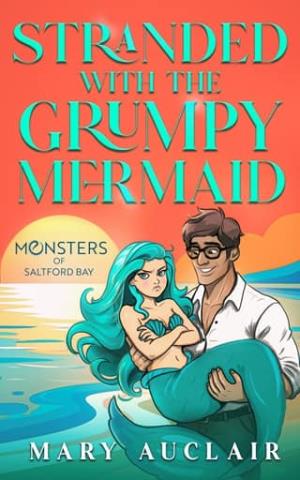
Stranded With the Grumpy Mermaid (Monsters Of Saltford Bay #10)
1. Chapter 1
Neri
There are two kinds of people in this world: people who show up to a nine a.m. boat at nine a.m., and then there are people who show up at six forty-five with a backup laptop battery and a thermos of coffee strong enough to qualify as a controlled substance.
I am the second kind of person. Unapologetically so.
The working dock at Saltford Bay smells like diesel and old bait.
Gulls scream at each other over a lobster crate like the poor creature owes them money.
Somewhere down the row of boats, a winch complains.
And past all of it, past the pilings and the moored hulls and the entire reasonable world, the ocean just sits there.
Big. Gray-blue. Patient.
I keep my eyes on my checklist.
My talk slides are looking good. They’re backed up in three places, one of which is a USB drive zipped into the interior pocket of my windbreaker jacket like I’m smuggling state secrets.
My clothes are neatly sorted for the short trip, with my good blazer folded in a garment bag with a precision that would make the matron at a military academy weep with joy. I’m officially ready for the ceremony.
I have one year left in my postdoctoral employment contract and it’s metaphorically riding my shoulder like a parrot that only says you’d better nail this talk.
And I will. Nail it, I mean. I’ve been preparing for a moment like this my entire life.
The AETHER inauguration is seven days out, on an island far off the Maine coast, and today’s boat carries the science party over for the run-up week: commissioning, rehearsals, and then, Sunday next, the inauguration ceremony, in front of every senior scientist whose grant decisions will determine whether I have a career or a cautionary tale by this time next year.
I have the “future of the field” slot. Twenty minutes to convince a room full of people twice my age that Dr. Nerissa Marsh is a serious researcher with a serious future.
Not the pretty mermaid. Not the diversity hire. The scientist.
Which is why I’m reviewing my slides on a bait-stained bench at six forty-five in the morning instead of thinking about the ocean.
I’m not thinking about the ocean.
The ocean, for the record, is thinking about me.
I can feel it doing it, the way you can feel someone staring at the back of your neck in a seminar.
The tide shifts against the pilings below me, and something under my ribs shifts with it, slow and traitorous, and I put my eyes back on slide fourteen where they belong.
Slide fourteen has a typo.
“Oh, you have got to be kidding me.” I fix it with the fervor of a woman performing surgery on her own reputation.
There. Perfect.
Everything is perfect and under control. I repeat this like a mantra in my head even though it’s kind of crazy. I’m kind of crazy. A control freak, like my ex would call me.
He wasn’t wrong.
My phone buzzes. A name lights up the screen, and the knot in my chest loosens one full notch. I can always count on Dad to be right on schedule.
Sunday morning is when he calls me. Seven a.m. my time, four a.m. his, because my father is a lunatic who has watched the sunrise from his office for thirty years and calls it discipline.
“You’re up early,” I say, instead of hello.
“You’re on a dock,” he says, instead of hello. “I can hear the gulls. How’s my favorite scientist?”
“You can’t call me that. You work with four hundred scientists.”
“And yet.” There’s a slurping sound, tea, the awful smoky kind Mom used to say tasted like a campfire after the rain. “It’s a big day for you. Walk me through it.”
So I do. I tell him about the boat and the island and the telescope, and the twenty minutes that are going to determine the entire trajectory of my professional existence.
He makes the little mm sounds he makes when he’s actually listening, not the other mm sounds, and somewhere in there I catch myself smiling at a broken lobster crate.
This is the humiliating truth about me: I have exactly one person left on this earth I don’t perform for, and he lives three thousand miles away and drinks campfire tea at four in the morning.
“You’ll be brilliant,” he says. “You’re always brilliant. Try to eat something that isn’t coffee.”
“Coffee is a bean. Beans are food.”
“Nerissa.”
“I packed snacks,” I lie with a pinch of guilt.
Well, technically, it’s not a lie. I did pack snacks, in the sense that I piled snacks with every intention of bringing them with me on this trip.
I can picture the granola bars sitting on my kitchen counter with perfect photographic clarity. I just forgot them there.
Well. That’s a problem for boat-Neri.
“Call me after your talk,” Dad says. “I want the whole thing. Standing ovation, weeping deans, all of it.”
“Deans don’t weep. They just huddle in a corner and rub their faces with old linen tissues.”
His laugh is warm and familiar and I hold the phone a little closer to my ear than strictly necessary. “Love you, kiddo. Knock ’em dead.”
“Love you too.”
I hang up, and the armor takes a second to settle back into place, like it always does after his calls.
I take a minute to allow myself to feel how much I miss him, how much I feel lonely to the bones since I left San Francisco.
Then a seagull lands on the piling next to me, screams directly into my soul, and the moment officially passes.
The Saltford Belle sits at her berth twenty yards down, white hull, navy trim, her name painted across the stern in cream letters.
She’s a working boat, wide and unglamorous, and her captain is currently on her back deck, radiating the specific gloom of a man who has been awake for hours and enjoyed none of it.
Captain Fergus Williamson is his name. We spoke for eleven seconds when I arrived this morning.
He is a selkie, covered head to knuckles in short beige fur, built like a barrel that decided to become a man.
He took one look at my hair, then my face, then said “Departure is at nine o’clock” in a tone that suggested he’d rather let seagulls pluck his eyes out than allow me to wait on the boat.
Well, I’m still here and I don’t care one bit. Take that, Captain.
He’s coiling a line now with the enthusiasm of a man attending his own funeral, and I go back to my slides. For a while the dock is just gulls and diesel and the tide doing its slow, patient thing against the pilings.
Then a voice rolls down the dock like warm weather.
“Buenos días! You must be Captain Williamson. I love your boat.”
I look up. I shouldn’t, but the human neck is a design failure, and I look up.
The man walking down the dock is tall, dark-haired, wearing hiking boots and a fleece zip jacket. He’s also carrying, and I want to be very clear that I am not hallucinating, a life-sized cardboard cutout of Carl Sagan under one arm.
Cardboard Carl Sagan gazes serenely out at the harbor, turtleneck and all, as if contemplating the billions and billions of bad decisions that led him here.
The man himself has the kind of easy, loping walk that says nothing bad has ever happened to him in his entire life. Glasses. Backpack. A smile aimed at Captain Fergus like they’re old friends instead of strangers.
Here’s the thing. I know that face.
Everyone in my department knows that face. It’s on the news every time AETHER clears another milestone, usually mid-laugh like he’s privy to the best inside jokes in the universe. It’s a face also usually captioned with words like visionary, genius and mastermind.
Dr. Rafael Vasquez is the Halloway University Chair in Astronomy. My department chair, technically, in the way that the sun is technically my primary energy source: relevant, distant, nothing I deal with directly, but capable of burning my retinas if I dare stare at it too long.
The great man has arrived.
“She’s a fine boat,” Captain Fergus says, in the tone of a man saying the weather is weather. Gloom incarnate. A conversational door, closing.
And then I watch Rafael Vasquez do something I have never once managed in twenty-seven years of being alive. He wedges himself into the closing door, cheerfully, and it just... opens.
“Downeast hull, right? Late nineties?” He runs a hand along the rail like he’s greeting a horse. “My dad and I used to watch these come into Boston Harbor. What does she draw?”
Pause. A long, furry, suspicious pause from our furry, suspicious boat captain.
“Four foot,” says Captain Fergus.
“With that beam? She must sit like a church in a swell.”
Another pause. And then something horrifying happens to the captain’s face. The gloom cracks. The whiskers twitch. The pot-belly heaves once, twice, and Captain Fergus Williamson laughs.
I have heard about this laugh. The woman at the harbor office mentioned it in the way coastal people mention weather events.
It starts somewhere below decks, rolls up through the barrel of him, and detonates across the harbor at a volume that startles two gulls off a piling and one academic off her slide deck.
A hundred yards of working dock briefly stops working.
“A church in a swell!” the captain booms, delighted, thumping the rail. “Hah! I’m stealing that one. Aboard, then, come aboard. Mind Mr. Sagan on the gunwale.”
“He’s been through worse,” Dr. Rafael Vasquez says. “We’ve been to Comic-Con.”
The captain laughs again. The famous grump of Saltford Bay harbor, chuckling like a kettle, helping a cardboard astronomer over the rail with genuine care.
It took him ninety seconds. Ninety seconds, one boat fact, and a smile, and the gloomiest selkie in Maine is his best friend.
I know exactly what this is. I grew up around his kind, the effortless kind, the kind of people who walk into rooms and the room just likes them back, no audition required.
Everything about the man says it: the easy shoulders, the laugh lines, the total absence of doubt that he’ll be welcome.
Men like that get believed. Men like that get their telescopes built.
Nobody has ever looked at Rafael Vasquez and seen anything but exactly what he wanted them to see.
Must be nice.
My stomach does something small and warm and complicated, and I categorize it instantly as dock-related nausea, file it under never, and close the folder.
Because here is what I know, from twenty-seven years of field observation: charm is weather.
It rolls in, it makes everything golden for an afternoon, and then it rolls out to wherever charm goes, and you’re left standing there having rearranged your entire life for it.
My mother could pull sunshine out of a room like that.
And that man has it in industrial quantities, plus a telescope, plus tenure, plus a cardboard Carl Sagan that Fergus is now lashing to the wheelhouse with the tenderness of a man securing his firstborn.
Dr. Vasquez says something I can’t hear. The captain’s laugh rolls across the water again, scattering another rank of gulls.
Great. Wonderful. They can be golden together for the whole crossing, and I will be below, or at the rail, or wherever is farthest from all that sunshine, rehearsing the twenty minutes that actually determine my future.
Today has one job. It is not friendship, it is not weather, and it is definitely not tall astronomers who make grumpy sea captains giggle.
I gather my bags, and march myself down the dock toward the Saltford Belle, past the ocean, which is still there, still patient, still breathing against the pilings like it has all the time in the world.
As I move closer, Dr. Rafael Vasquez notices me and waves frantically, high above his head, flashing me the kind of smile that belongs on billboards.
My stomach does that annoying little stunt where it flips upside down.
The golden retriever of astronomy is charming, fine. Noted.
But I have absolutely no intention of throwing him a ball.